

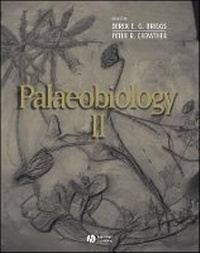
Palaeobiology II
Published on 13. December 2007
Software
Other digital
600 pages
978-0-470-99929-5 (ISBN)
Description
Palaeobiology: A Synthesis was widely acclaimed both for its content and production quality. Ten years on, Derek Briggs and Peter Crowther have once again brought together over 150 leading authorities from around the world to produce Palaeobiology II. Using the same successful formula, the content is arranged as a series of concise articles, taking a thematic approach to the subject, rather than treating the various fossil groups systematically. This entirely new book, with its diversity of new topics and over 100 new contributors, reflects the exciting developments in the field, including accounts of spectacular newly discovered fossils, and embraces data from other disciplines such as astrobiology, geochemistry and genetics. Palaeobiology II will be an invaluable resource, not only for palaeontologists, but also for students and researchers in other branches of the earth and life sciences. * Written by an international team of recognised authorities in the field. * Content is concise but informative. * Demonstrates how palaeobiological studies are at the heart of a range of scientific themes.
Reviews / Votes
"One of the great strengths of the volume is the combination of focused treatments of well-studied areas (Taylor on locomotion in Mesozoic marine reptiles or Trewin on the Rhynie Chert) with discussion on broader principles (the late Jack Sepkoski, to whom the volume is dedicated, on competition in macroevolution or Cerling on the evolution of modern grasslands). ... This approach provides both the general patterns and processes behind the history of life as well as the richness of unique events." Douglas H. Erwin, The Palaeontological Association Newsletter <!--end--> "The bottom line, as I think you'll see, is that this volume is an entirely new one, and it provides an excellent complement to the first. ... I will have to recommend it. If not for individual purchases, then an absolute must for libraries. Faculty will find it very useful in preparing their lectures ... Students will find it useful for getting a comprehensive survey of what's going on in palaeontology all in one place ... In addition, it is an easy-browsing text. ... I very much recommend it." Linda C. Ivany, American Paleontologist "Palaeobiology II is an essential reference work for any geology library and most palaeobiologists will want their own copies, but do not lend them out as they may never return. ... The editors have done an excellent job of marshalling their authors and the huge volume of information into a readily usable structure and format." Douglas Palmer, Geoscientist "What this book covers is no less than the current state of thinking on just about every paleontological topic imaginable...I would recommend it to anyone interested in adding a comprehensive, authoritative, up-to-date volume to their library. I can guarantee that you won't be disappointed." Fossil News, August 2003More details
Language
English
Place of publication
Hoboken
United Kingdom
Publishing group
John Wiley and Sons Ltd
Target group
Professional and scholarly
Dimensions
Height: 280 mm
Width: 211 mm
Thickness: 33 mm
Weight
1328 gr
ISBN-13
978-0-470-99929-5 (9780470999295)
Copyright in bibliographic data and cover images is held by Nielsen Book Services Limited or by the publishers or by their respective licensors: all rights reserved.
Schweitzer Classification
Other editions
Additional editions
Derek E. G. Briggs | Peter R. Crowther
Palaeobiology II
E-Book
05/2008
Wiley-Blackwell
€135.95
Available for download
Content
Part I: Major Events in the History of Life:. 1. Early Life. 2. The Cambrian Radiation. 3. Palaeozoic Events. 4. Mesozoic Events. 5. Cenozoic Events. Part II: The Evolutionary Process and the Fossil Record:. 6. Species Evolution. 7. Evolution of Form. 8. Macroevolution. 9. Patterns of Diversity. Part III: Taphonomy:. 10. Fossilized Materials. 11. Fossilization Processes. 12. Preservation in Different Ecological Settings. 13. Lagerstatten. Part IV: Palaeoecology:. 14. Fossils as Living Organisms. 15. Ancient Communities. 16. Fossils as Environmental Indicators. Part V: Systematics, Phylogeny and Stratigraphy:. 17. Morphology and Taxonomy. 18. Calibrating Diversity. 19. Reconstructing Phylogeny. 20. Fossils in Stratigraphy.