

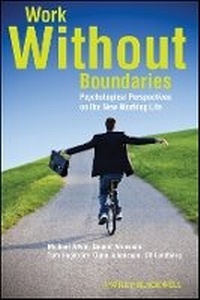
Work Without Boundaries - Psychological Perspectives on the New Working Life
Published on 15. March 2011
Software
Other digital
280 pages
978-1-119-99123-6 (ISBN)
Description
Drawing on more than a decade of inter-disciplinary research, this book provides a comprehensive overview of the available theories, concepts, data and research on new work organizations and the concept of 'work without boundaries'.* Explores a concept of work that is not restricted by traditional organizational rules like regular office hours, a single workplace, fixed procedures and limited responsibility* Provides a comprehensive overview of the available theories, concepts, data and research on new work organizations* Examines the shift of power away from organizations to make individuals accountable for their own employability and work* Draws on over a decade of original research into 'work without boundaries' in which the authors are key authorities* Brings together organization theory and work psychology with scholarship from related fields including sociology, social psychology, cognition and psychobiology
More details
Language
English
Place of publication
New York
United States
Target group
Professional and scholarly
Dimensions
Height: 229 mm
Width: 152 mm
Thickness: 15 mm
Weight
666 gr
ISBN-13
978-1-119-99123-6 (9781119991236)
Copyright in bibliographic data and cover images is held by Nielsen Book Services Limited or by the publishers or by their respective licensors: all rights reserved.
Schweitzer Classification
Other editions
Additional editions
Michael Allvin | Gunnar Aronsson | Tom Hagström
Work Without Boundaries
Psychological Perspectives on the New Working Life
E-Book
03/2011
1st Edition
Wiley
€39.99
Available for download
Michael Allvin | Gunnar Aronsson | Tom Hagström
Work Without Boundaries
Psychological Perspectives on the New Working Life
E-Book
03/2011
Wiley
€39.99
Available for download
Person
Michael Allvin is Associate Professor of Sociology in the Department of Sociology at Uppsala University and a licensed Psychologist. Gunnar Aronsson is Professor of Work and Organizational Psychology in the Department of Psychology at Stockholm University. Tom Hagstrom is Professor Emeritus of Education in the Department of Education, Stockholm University and a licensed Psychologist. Gunn Johansson is Professor Emeritus of Work Psychology in the Department of Psychology, Stockholm University. Ulf Lundberg is Professor of Biological Psychology in the Department of Psychology at Stockholm University, and at the Centre for Health Equity Studies (CHESS), affiliated with Stockholm University and the Karolinska Institute, Sweden.
Content
About the Authors. Foreword by Cary L. Cooper. Preface. Acknowledgments. 1 The New Work. The new inequality. New markets and new structures. The new work life. What is so new about "The New Work"? The new and the old work. The purpose and structure of this book. 2 The New Rules of Work: On Flexible Work and How to Manage It. Flexible work. Flexibility through empowerment. Flexibility through substitution. Separate paths? 3 The New Work Life and the Dimensions of Knowledge. The cognitive knowledge demands. The social knowledge demands. The societal knowledge demands. The existential knowledge demands. Some concluding considerations. 4 The Place of Work in Life. Separate spheres. Competing spheres. Coping with boundaries. Mutually favored spheres. New conditions outside work life: the consumption society. The moral supermarket. The market aesthetic. The new family. Organizing living. Conflict and balance in life. An individual matter. 5 Work Life, Stress, and the New Ill Health. Stress as a social problem and research area. Stress models for the work life. The new work life as a source of stress. The new ill health. The new ill health, work environment, and the possibility space of work. 6 Some Concluding Comments and Reflections. The deregulation of working life. The individualization of working life. The heterogenization of working life. The new inequality. New strains and symptoms. Flexibility and power in times of economic recession. Future - trust or new forms and fields for external regulation? References. Index.