

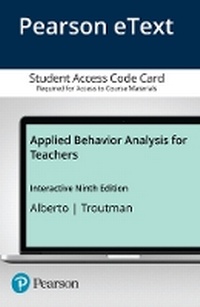
Applied Behavior Analysis for Teachers Interactive Ninth Edition, Enhanced Pearson eText -- Access Card
9th Edition
Published on 19. June 2017
Software
Product license key
480 pages
978-0-13-422837-2 (ISBN)
Description
Applied Behavior Analysis for Teachers will help you apply the principles of behavior analysis to deal appropriately with some of the most challenging student behaviors. The text uses relatable examples of students of various abilities from preschool to young adulthood.
For courses in Applied Behavior Analysis Behavior Management, and Behavior Modification
Pearson eText is an easy-to-use digital textbook that you can purchase on your own or instructors can assign for their course. The mobile app lets you keep on learning, no matter where your day takes you -- even offline. You can also add highlights, bookmarks, and notes in your Pearson eText to study how you like.
NOTE: This ISBN is for the Pearson eText access card. Pearson eText is a fully digital delivery of Pearson content. Before purchasing, check that you have the correct ISBN. To register for and use Pearson eText, you may also need a course invite link, which your instructor will provide. Follow the instructions provided on the access card to learn more.
For courses in Applied Behavior Analysis Behavior Management, and Behavior Modification
Pearson eText is an easy-to-use digital textbook that you can purchase on your own or instructors can assign for their course. The mobile app lets you keep on learning, no matter where your day takes you -- even offline. You can also add highlights, bookmarks, and notes in your Pearson eText to study how you like.
NOTE: This ISBN is for the Pearson eText access card. Pearson eText is a fully digital delivery of Pearson content. Before purchasing, check that you have the correct ISBN. To register for and use Pearson eText, you may also need a course invite link, which your instructor will provide. Follow the instructions provided on the access card to learn more.
More details
Edition
9th edition
Language
English
Place of publication
United States
Publishing group
Pearson Education (US)
Target group
College/higher education
Dimensions
Height: 279 mm
Width: 216 mm
Thickness: 2 mm
Weight
27 gr
ISBN-13
978-0-13-422837-2 (9780134228372)
Copyright in bibliographic data and cover images is held by Nielsen Book Services Limited or by the publishers or by their respective licensors: all rights reserved.
Schweitzer Classification
Persons
Paul A. Alberto
After receiving his undergraduate degree from Hunter College in New York City he taught elementary aged students with intellectual disabilities in the south Bronx. While teaching he completed a master's degree in Special Education: mental retardation at Fordham University. He moved to Atlanta and completed his PhD in Special Education: Severe Disabilities at Georgia State University. His professional career in higher education has been at GSU in the Department of Educational Psychology and Special Education. He is coordinator of the teacher education program in Multiple and Severe Disabilities. He is Co-Director of the program in Applied Behavior Analysis, and is Co-Director of the University Initiative on Language and Literacy. Since 2003 he has served as co-editor of the journal Focus on Autism and Other Developmental Disabilities. Currently he is Principal Investigator on a grant from the Institute on Education Sciences entitled "Integrated Literacy for Students with Moderate and Severe Disabilities.
Anne C. Troutman
After receiving her undergraduate degree in elementary education from the University of Georgia in 1964 Anne taught elementary grades for 5 years. She completed her Master's Degree in special education from Georgia State University and taught students with behavior disorders in self-contained and resource settings and served as a crisis intervention specialist and special education supervisor. After receiving her Ph.D. from Georgia State in 1977 she taught graduate and undergraduate students in general and special education at The University of Memphis until her retirement in 2009.
After receiving his undergraduate degree from Hunter College in New York City he taught elementary aged students with intellectual disabilities in the south Bronx. While teaching he completed a master's degree in Special Education: mental retardation at Fordham University. He moved to Atlanta and completed his PhD in Special Education: Severe Disabilities at Georgia State University. His professional career in higher education has been at GSU in the Department of Educational Psychology and Special Education. He is coordinator of the teacher education program in Multiple and Severe Disabilities. He is Co-Director of the program in Applied Behavior Analysis, and is Co-Director of the University Initiative on Language and Literacy. Since 2003 he has served as co-editor of the journal Focus on Autism and Other Developmental Disabilities. Currently he is Principal Investigator on a grant from the Institute on Education Sciences entitled "Integrated Literacy for Students with Moderate and Severe Disabilities.
Anne C. Troutman
After receiving her undergraduate degree in elementary education from the University of Georgia in 1964 Anne taught elementary grades for 5 years. She completed her Master's Degree in special education from Georgia State University and taught students with behavior disorders in self-contained and resource settings and served as a crisis intervention specialist and special education supervisor. After receiving her Ph.D. from Georgia State in 1977 she taught graduate and undergraduate students in general and special education at The University of Memphis until her retirement in 2009.
Content
Brief Contents
1. Roots of Applied Behavior Analysis
2. Responsible Use of Applied Behavior Analysis Procedures
3. Preparing Behavioral Objectives
4. Procedures for Collecting Data
5. Graphing Data
6. Single-Subject Designs
7. Determining the Function of Behavior
8. Arranging Consequences That Increase Behavior
9. Arranging Consequences That Decrease Behavior
10. Differential Reinforcement: Antecedent Control and Shaping
11. Providing for Generalization of Behavior Change
12. Teaching Students to Manage Their Own Behavior
13. Putting It All Together
1. Roots of Applied Behavior Analysis
2. Responsible Use of Applied Behavior Analysis Procedures
3. Preparing Behavioral Objectives
4. Procedures for Collecting Data
5. Graphing Data
6. Single-Subject Designs
7. Determining the Function of Behavior
8. Arranging Consequences That Increase Behavior
9. Arranging Consequences That Decrease Behavior
10. Differential Reinforcement: Antecedent Control and Shaping
11. Providing for Generalization of Behavior Change
12. Teaching Students to Manage Their Own Behavior
13. Putting It All Together