

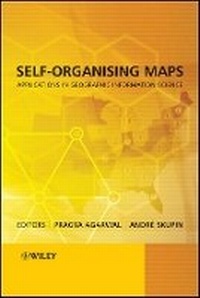
Self-Organising Maps - Applications in Geographic Information Science
Published on 29. February 2008
Software
Other digital
214 pages
978-0-470-02169-9 (ISBN)
Description
Self-Organising Maps: Applications in GI Science brings together the latest geographical research where extensive use has been made of the SOM algorithm, and provides readers with a snapshot of these tools that can then be adapted and used in new research projects. The book begins with an overview of the SOM technique and the most commonly used (and freely available) software; it is then sectioned to look at the different uses of the technique, namely clustering, data mining and cartography, from a range of application-areas in the biophysical and socio-economic environments.* Only book that takes SOM algorithm to the GIS and Geography research communities* The Editors draw together expert contributors from the UK, Europe, USA, New Zealand, and South Africa* Covers a range of techniques in clustering, data mining cartography, all featuring an appropriate case study
More details
Language
English
Place of publication
Hoboken
United Kingdom
Publishing group
John Wiley and Sons Ltd
Target group
Professional and scholarly
Dimensions
Height: 254 mm
Width: 178 mm
Thickness: 18 mm
Weight
570 gr
ISBN-13
978-0-470-02169-9 (9780470021699)
Copyright in bibliographic data and cover images is held by Nielsen Book Services Limited or by the publishers or by their respective licensors: all rights reserved.
Schweitzer Classification
Other editions
Additional editions
E-Book
08/2008
Wiley
€147.99
Available for download
Persons
Content
List of Contributors. 1. Introduction: What is a Self-Organizing Map? (Andre Skupin and Pragya Agarwal). 2. Applications of Different Self-Organizing Map Variants to Geographical Information Science Problems (Fernando Bacao, Victor Lobo and Marco Painho). 3. An Integrated Exploratory Geovisualization Environment Based on Self-Organizing Map (Etien L. Koua and Menno-Jan Kraak). 4. Visual Exploration of Spatial Interaction Data with Self-Organizing Maps (Jun Yan and Jean-Claude Thill). 5. Detecting Geographic Associations in English Dialect Features in North America within a Visual Data Mining Environment Integrating Self-Organizing Maps (Jean-Claude Thill, William A. Kretzschmar Jr, Irene Casas and Xiaobai Yao). 6. Self-Organizing Maps for Density-Preserving Reduction of Objects in Cartographic Generalization (Monika Sester). 7. Visualizing Human Movement in Attribute Space (Andre Skupin). 8. Climate Analysis, Modelling, and Regional Downscaling Using Self-Organizing Maps (Bruce C. Hewitson). 9. Prototyping Broad-Scale Climate and Ecosystem Classes by Means of Self-Organising Maps (Jurgen P. Kropp and Hans Joachim Schellnhuber). 10. Self-Organising Map Principles Applied Towards Automating Road Extraction from Remotely Sensed Imagery (Pete Doucette, Peggy Agouris and Anthony Stefanidis). 11. Epilogue: Intelligent Systems for GIScience: Where Next? A GIScience Perspective (Michael Goodchild). Index.