

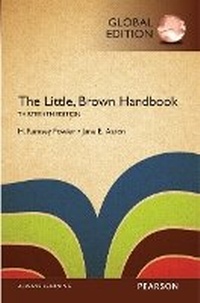
Little, Brown Handbook, Global Edition -- MyLab Writing with Pearson eText
13th Edition
Published on 14. July 2015
Software
Product license key
4 pages
978-1-292-11091-2 (ISBN)
More details
Edition
13th edition
Language
English
Place of publication
Harlow
United Kingdom
Target group
College/higher education
Professional and scholarly
Dimensions
Height: 132 mm
Width: 130 mm
Thickness: 1 mm
Weight
8 gr
ISBN-13
978-1-292-11091-2 (9781292110912)
Copyright in bibliographic data and cover images is held by Nielsen Book Services Limited or by the publishers or by their respective licensors: all rights reserved.
Schweitzer Classification
Other editions
New editions
Jane Aaron | H. Fowler
Little, Brown Handbook, The, Global Edition + MyLab Writing with Pearson eText
Book
07/2015
13th Edition
Pearson Education Limited
€119.67
Shipment within 10-20 days
Content
Preface for Students: Using This Book
Preface for Instructors
PART 1: The Process of Writing
1. Assessing the Writing Situation
a. Understanding how writing happens
b. Analyzing the writing situation
c. Discovering and limiting a subject
d. Defining a purpose
e. Considering the audience
f. Understanding genres
2. Discovering and Shaping Ideas
a. Discovering ideas
b. Developing a thesis
c. Organizing ideas
SAMPLE INFORMATIVE ESSAY
3. Drafting, Revising, and Editing
a. Writing the first draft
b. Revising a draft
c. Giving and receiving comments
d. Examining a sample revision
e. Editing the revised draft
f. Preparing and proofreading the final draft
g. SAMPLE FINAL DRAFT (RESPONSE ESSAY)
h. Preparing a writing portfolio
4. Writing and Revising Paragraphs
a. Relating paragraphs in the essay
b. Maintaining paragraph unity
c. Achieving paragraph coherence
d. Developing the paragraph
e. Writing special kinds of paragraphs
5. Presenting Writing
a. Formatting academic writing
SAMPLE MARKETING REPORT
b. Using visuals and other media in multimodal writing
c. Presenting writing on the Web
SAMPLE WEB SITE
SAMPLE LITERACY NARRATIVE POSTED TO A BLOG
d. Making oral presentations
SAMPLE POWERPOINT SLIDES
PART 2: Reading and Writing in and out of College
6. Writing in Academic Situations
a. Determining purpose and audience
b. Using an academic genre
c. Choosing structure and content
d. Using sources with integrity
e. Using academic language
f. Communicating with instructors and classmates
7. Critical Reading and Writing
a. Using techniques of critical reading
b. Summarizing
c. Developing a critical response
d. Viewing visuals critically
e. Writing critically
f. Examining sample critical analyses
SAMPLE CRITICAL ANALYSIS OF A TEXT
SAMPLE CRITICAL ANALYSIS OF AN IMAGE
8. Reading Arguments Critically
a. Recognizing the elements of argument
b. Testing claims
c. Weighing evidence
d. Discovering assumptions
e. Watching language, hearing tone
f. Judging reasonableness
g. Recognizing fallacies
h. Reading visual arguments
9. Writing an Argument
a. Finding a subject
b. Conceiving a thesis statement
c. Analyzing your purpose and your audience
d. Using reason
e. Using evidence
f. Reaching your readers
g. Organizing your argument
h. Revising your argument
i. SAMPLE PROPOSAL ARGUMENT
10. Taking Essay Exams
a. Preparing for an essay examination
b. Planning your time and your answer
c. Starting the essay
d. Developing the essay
e. Rereading the essay
11. Pu
Preface for Instructors
PART 1: The Process of Writing
1. Assessing the Writing Situation
a. Understanding how writing happens
b. Analyzing the writing situation
c. Discovering and limiting a subject
d. Defining a purpose
e. Considering the audience
f. Understanding genres
2. Discovering and Shaping Ideas
a. Discovering ideas
b. Developing a thesis
c. Organizing ideas
SAMPLE INFORMATIVE ESSAY
3. Drafting, Revising, and Editing
a. Writing the first draft
b. Revising a draft
c. Giving and receiving comments
d. Examining a sample revision
e. Editing the revised draft
f. Preparing and proofreading the final draft
g. SAMPLE FINAL DRAFT (RESPONSE ESSAY)
h. Preparing a writing portfolio
4. Writing and Revising Paragraphs
a. Relating paragraphs in the essay
b. Maintaining paragraph unity
c. Achieving paragraph coherence
d. Developing the paragraph
e. Writing special kinds of paragraphs
5. Presenting Writing
a. Formatting academic writing
SAMPLE MARKETING REPORT
b. Using visuals and other media in multimodal writing
c. Presenting writing on the Web
SAMPLE WEB SITE
SAMPLE LITERACY NARRATIVE POSTED TO A BLOG
d. Making oral presentations
SAMPLE POWERPOINT SLIDES
PART 2: Reading and Writing in and out of College
6. Writing in Academic Situations
a. Determining purpose and audience
b. Using an academic genre
c. Choosing structure and content
d. Using sources with integrity
e. Using academic language
f. Communicating with instructors and classmates
7. Critical Reading and Writing
a. Using techniques of critical reading
b. Summarizing
c. Developing a critical response
d. Viewing visuals critically
e. Writing critically
f. Examining sample critical analyses
SAMPLE CRITICAL ANALYSIS OF A TEXT
SAMPLE CRITICAL ANALYSIS OF AN IMAGE
8. Reading Arguments Critically
a. Recognizing the elements of argument
b. Testing claims
c. Weighing evidence
d. Discovering assumptions
e. Watching language, hearing tone
f. Judging reasonableness
g. Recognizing fallacies
h. Reading visual arguments
9. Writing an Argument
a. Finding a subject
b. Conceiving a thesis statement
c. Analyzing your purpose and your audience
d. Using reason
e. Using evidence
f. Reaching your readers
g. Organizing your argument
h. Revising your argument
i. SAMPLE PROPOSAL ARGUMENT
10. Taking Essay Exams
a. Preparing for an essay examination
b. Planning your time and your answer
c. Starting the essay
d. Developing the essay
e. Rereading the essay
11. Pu