

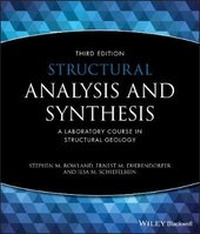
Structural Analysis and Synthesis
A Laboratory Course in Structural Geology
3rd Edition
Published on 15. December 2006
Loose-leaf edition
320 pages
978-1-4051-1652-7 (ISBN)
Description

This widely used, highly readable introduction to structural analysis is specifically designed to support the laboratory work of undergraduates in structural geology courses.
The new third edition includes:
New and amended exercises and redrafted figures to improve clarity
A single fold-out map of the Bree Creek Quadrangle - a mythical site used to help students analyze various aspects of the geologic structures exposed within this quadrangle and ultimately to develop a grand synthesis
A user-friendly spiral binding ideal for work in the lab or out in the field
An Instructor manual CD-ROM for this title is available. Please contact our Higher Education team at HigherEducation@wiley.com for more information.
The new third edition includes:
New and amended exercises and redrafted figures to improve clarity
A single fold-out map of the Bree Creek Quadrangle - a mythical site used to help students analyze various aspects of the geologic structures exposed within this quadrangle and ultimately to develop a grand synthesis
A user-friendly spiral binding ideal for work in the lab or out in the field
An Instructor manual CD-ROM for this title is available. Please contact our Higher Education team at HigherEducation@wiley.com for more information.
More details
Edition
3rd edition
Language
English
Place of publication
Hoboken
United Kingdom
Publishing group
John Wiley and Sons Ltd
Target group
Professional and scholarly
Product notice
Loose leaf - sheets only
Dimensions
Height: 274 mm
Width: 236 mm
Thickness: 18 mm
Weight
1066 gr
ISBN-13
978-1-4051-1652-7 (9781405116527)
Copyright in bibliographic data and cover images is held by Nielsen Book Services Limited or by the publishers or by their respective licensors: all rights reserved.
Schweitzer Classification
Other editions
New editions
Stephen M. Rowland | Ernest M. Duebendorfer
Structural Analysis and Synthesis: A Laboratory Course in Structural Geology
A Laboratory Course in Structural Geology
Book
12/2020
4th Edition
Wiley-Blackwell
€53.00
Shipment within 15-20 days
Previous edition

Stephen M. Rowland | Ernest Duebendorfer
Structural Analysis and Synthesis
Laboratory Course in Structured Geology
Book
04/1994
2nd Edition
Blackwell Science Ltd
€55.89
Article exhausted; check for reprint
Persons
STEPHEN M. ROWLAND, is a Professor of Geology at the University of Nevada, Las Vegas. He began teaching a structural geology laboratory course as a PhD student at the University of California, Santa Cruz. The Bree Creek map and the core exercises in this book evolved from field exercises in the Santa Cruz Mountains of California.
ERNEST M. DUEBENDORFER, is a Professor of Geology at Northern Arizona University in Flagstaff. His research focuses on Proterozoic accretionary tectonics and Cenozoic extensional tectonism in the western US. He has also published papers on contractional deformation in Antarctica, Australia, and California. He received his PhD from the University of Wyoming.
ILSA M. SCHIEFELBEIN, is a Senior Geologist currently employed by ExxonMobil Corporation in Houston, Texas. She received an MS at the University of Nevada, Las Vegas where she studied extensional tectonics in the Basin and Range Province and taught structural geology laboratories.
ERNEST M. DUEBENDORFER, is a Professor of Geology at Northern Arizona University in Flagstaff. His research focuses on Proterozoic accretionary tectonics and Cenozoic extensional tectonism in the western US. He has also published papers on contractional deformation in Antarctica, Australia, and California. He received his PhD from the University of Wyoming.
ILSA M. SCHIEFELBEIN, is a Senior Geologist currently employed by ExxonMobil Corporation in Houston, Texas. She received an MS at the University of Nevada, Las Vegas where she studied extensional tectonics in the Basin and Range Province and taught structural geology laboratories.
Content
Preface. Read this First.
1. Attitudes of Lines and Planes.
Objectives.
Apparent-dip problems.
Orthographic projection.
Trigonometric solutions.
Alignment diagrams.
2. Outcrop Patterns and Structure Contours.
Objectives.
Structure contours.
The three-point problem.
Determining outcrop patterns with structure contours.
Bree Creek Quadrangle map.
3. Interpretation of Geologic Maps.
Objectives.
Determining exact attitudes from outcrop patterns.
Determining stratigraphic thickness in flat terrain.
Determining stratigraphic thickness on slopes.
Determining stratigraphic thickness by orthographic projection.
Determining the nature of contacts.
Constructing a stratigraphic column.
4. Geologic Structure Sections.
Objective.
Structure sections of folded layers.
Structure sections of intrusive bodies.
The arc method.
Drawing a topographic profile.
Structure-section format.
5. Stereographic Projection.
Objective.
A plane.
A line.
Pole of a plane.
Line of intersection of two planes.
Angles within a plane.
True dip from strike and apparent dip.
Strike and dip from two apparent dips.
Rotation of lines.
The two-tilt problem.
Cones: the drill-hole problem.
6. Folds.
Objectives.
Fold classification based on dip isogons.
Outcrop patterns of folds.
Down-plunge viewing.
7. Stereographic Analysis of Folded Rocks.
Objectives.
Beta diagrams.
Pi diagrams.
Determining the orientation of the axial plane.
Constructing the profile of a fold exposed in flat terrain.
Simple equal-area diagrams of fold orientation.
Contour diagrams.
Determining the Fold style and interlimb angle from contoured pi diagrams.
8. Parasitic Folds, Axial-Planar Foliations, and Superposed Folds.
Objectives.
Parastic folds.
Axial-planar foliations.
Superposed folds.
9. Faults.
Objectives.
Measuring slip.
Rotational (scissor) faulting.
Tilting of fault blocks.
Map patterns of faults.
Timing of faults.
10. Dynamic and Kinematic Analysis of Faults.
Objectives.
Dynamic analysis.
Kinematic analysis.
11. A Structural Synthesis.
Objective.
Structural synthesis of the Bree Creek Quadrangle.
Writing style.
Common errors in geologic reports.
12. Rheologic Models.
Objective.
Equipment required for this chapter.
Elastic deformation: instantaneous, recoverable strain.
Viscous deformation: continuous strain under any stress.
Plastic deformation: continuous strain above a yield stress.
Elasticoplastic deformation.
Elasticoviscous deformation.
Firmoviscous deformation.
Within every rock is a little dashpot.
13. Brittle Failure.
Objective.
Equipment required for this chapter.
Quantifying two-dimensional stress.
The Mohr diagram.
The Mohr circle of stress.
The failure envelope.
The importance of pore pressure.
14. Strain Measurement.
Objectives.
Equipment required for this chapter.
Longitudinal strain.
Shear strain.
The strain ellipse.
Three strain fields.
The coaxial deformation path.
The coaxial total strain ellipse.
Noncoaxial strain.
The noncoaxial total strain ellipse.
Deformed fossils as strain indicators.
Strain in three dimensions.
Quantifying the strain ellipsoid.
15. Construction of Balanced Cross Sections.
Objectives.
Thrust-belt "rules".
Recognizing ramps and flats.
Relations between folds and thrusts.
Requirements of a balanced cross section.
Constructing a restored cross section.
Constructing a balanced cross section.
16. Deformation Mechanisms and Microstructures.
Objectives.
Deformation mechanisms.
Fault rocks.
Kinemative indicators.
S-C fabrics.
Asymmetric porphyroclasts.
Oblique grain shapes in recrystallized quartz aggregates.
Antithetic shears.
17. Introduction to Plate Tectonics.
Objectives.
Fundamental principles.
Plate boundaries.
Triple junctions.
Focal-mechanism solutions ("beach-ball" diagrams).
Earth magnetism.
Apparent polar wander.
Appendices.
A: Measuring attitudes with a Brunton compass.
B: Geologic timescale.
C: Greek letters and their use in this book.
D: Graph for determining exaggerated dips on structure sections with vertical exaggeration.
E: Conversion factors.
F: Common symbols used on geologic maps.
G: Diagrams for use in problems.
References.
Further Reading.
Index
1. Attitudes of Lines and Planes.
Objectives.
Apparent-dip problems.
Orthographic projection.
Trigonometric solutions.
Alignment diagrams.
2. Outcrop Patterns and Structure Contours.
Objectives.
Structure contours.
The three-point problem.
Determining outcrop patterns with structure contours.
Bree Creek Quadrangle map.
3. Interpretation of Geologic Maps.
Objectives.
Determining exact attitudes from outcrop patterns.
Determining stratigraphic thickness in flat terrain.
Determining stratigraphic thickness on slopes.
Determining stratigraphic thickness by orthographic projection.
Determining the nature of contacts.
Constructing a stratigraphic column.
4. Geologic Structure Sections.
Objective.
Structure sections of folded layers.
Structure sections of intrusive bodies.
The arc method.
Drawing a topographic profile.
Structure-section format.
5. Stereographic Projection.
Objective.
A plane.
A line.
Pole of a plane.
Line of intersection of two planes.
Angles within a plane.
True dip from strike and apparent dip.
Strike and dip from two apparent dips.
Rotation of lines.
The two-tilt problem.
Cones: the drill-hole problem.
6. Folds.
Objectives.
Fold classification based on dip isogons.
Outcrop patterns of folds.
Down-plunge viewing.
7. Stereographic Analysis of Folded Rocks.
Objectives.
Beta diagrams.
Pi diagrams.
Determining the orientation of the axial plane.
Constructing the profile of a fold exposed in flat terrain.
Simple equal-area diagrams of fold orientation.
Contour diagrams.
Determining the Fold style and interlimb angle from contoured pi diagrams.
8. Parasitic Folds, Axial-Planar Foliations, and Superposed Folds.
Objectives.
Parastic folds.
Axial-planar foliations.
Superposed folds.
9. Faults.
Objectives.
Measuring slip.
Rotational (scissor) faulting.
Tilting of fault blocks.
Map patterns of faults.
Timing of faults.
10. Dynamic and Kinematic Analysis of Faults.
Objectives.
Dynamic analysis.
Kinematic analysis.
11. A Structural Synthesis.
Objective.
Structural synthesis of the Bree Creek Quadrangle.
Writing style.
Common errors in geologic reports.
12. Rheologic Models.
Objective.
Equipment required for this chapter.
Elastic deformation: instantaneous, recoverable strain.
Viscous deformation: continuous strain under any stress.
Plastic deformation: continuous strain above a yield stress.
Elasticoplastic deformation.
Elasticoviscous deformation.
Firmoviscous deformation.
Within every rock is a little dashpot.
13. Brittle Failure.
Objective.
Equipment required for this chapter.
Quantifying two-dimensional stress.
The Mohr diagram.
The Mohr circle of stress.
The failure envelope.
The importance of pore pressure.
14. Strain Measurement.
Objectives.
Equipment required for this chapter.
Longitudinal strain.
Shear strain.
The strain ellipse.
Three strain fields.
The coaxial deformation path.
The coaxial total strain ellipse.
Noncoaxial strain.
The noncoaxial total strain ellipse.
Deformed fossils as strain indicators.
Strain in three dimensions.
Quantifying the strain ellipsoid.
15. Construction of Balanced Cross Sections.
Objectives.
Thrust-belt "rules".
Recognizing ramps and flats.
Relations between folds and thrusts.
Requirements of a balanced cross section.
Constructing a restored cross section.
Constructing a balanced cross section.
16. Deformation Mechanisms and Microstructures.
Objectives.
Deformation mechanisms.
Fault rocks.
Kinemative indicators.
S-C fabrics.
Asymmetric porphyroclasts.
Oblique grain shapes in recrystallized quartz aggregates.
Antithetic shears.
17. Introduction to Plate Tectonics.
Objectives.
Fundamental principles.
Plate boundaries.
Triple junctions.
Focal-mechanism solutions ("beach-ball" diagrams).
Earth magnetism.
Apparent polar wander.
Appendices.
A: Measuring attitudes with a Brunton compass.
B: Geologic timescale.
C: Greek letters and their use in this book.
D: Graph for determining exaggerated dips on structure sections with vertical exaggeration.
E: Conversion factors.
F: Common symbols used on geologic maps.
G: Diagrams for use in problems.
References.
Further Reading.
Index