

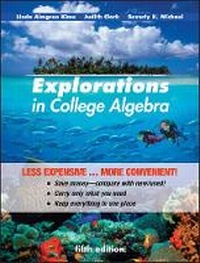
Explorations in College Algebra
5th Edition
Published on 15. November 2010
Loose-leaf edition
768 pages
978-0-470-91761-9 (ISBN)
Description

This text is an unbound, binder-ready edition.
Explorations in College Algebra, 5th edition and its accompanying ancillaries are designed to make algebra interesting and relevant to the student. The text adopts a problem-solving approach that motivates students to grasp abstract ideas by solving real-world problems. The problems lie on a continuum from basic algebraic drills to open-ended, non-routine questions. The focus is shifted from learning a set of discrete mathematical rules to exploring how algebra is used in the social, physical, and life sciences. The NEW KIME WileyPLUS Technology Update, 5e, was created to optimize student interactions in WileyPLUS with the addition of the new Math Enhancements including Intelligent Tutoring and graphing questions. The materials were developed in the spirit of the reform movement and reflect the guidelines issued by the various professional mathematics societies (including AMATYC, MAA, and NCTM).
WileyPLUS sold separately from text.
Explorations in College Algebra, 5th edition and its accompanying ancillaries are designed to make algebra interesting and relevant to the student. The text adopts a problem-solving approach that motivates students to grasp abstract ideas by solving real-world problems. The problems lie on a continuum from basic algebraic drills to open-ended, non-routine questions. The focus is shifted from learning a set of discrete mathematical rules to exploring how algebra is used in the social, physical, and life sciences. The NEW KIME WileyPLUS Technology Update, 5e, was created to optimize student interactions in WileyPLUS with the addition of the new Math Enhancements including Intelligent Tutoring and graphing questions. The materials were developed in the spirit of the reform movement and reflect the guidelines issued by the various professional mathematics societies (including AMATYC, MAA, and NCTM).
WileyPLUS sold separately from text.
More details
Edition
5th edition
Language
English
Place of publication
New York
United States
Target group
College/higher education
Product notice
Loose leaf - sheets only
Dimensions
Height: 274 mm
Width: 211 mm
Thickness: 31 mm
Weight
1542 gr
ISBN-13
978-0-470-91761-9 (9780470917619)
Copyright in bibliographic data and cover images is held by Nielsen Book Services Limited or by the publishers or by their respective licensors: all rights reserved.
Schweitzer Classification
Other editions
New editions
Linda Almgren Kime | Judith Clark | Beverly K. Michael
Explorations in College Algebra
Loose-leaf edition
10/2017
6th Edition
Wiley
€148.50
No shipping information available
Previous edition

Linda Almgren Kime | Judy Clark | Beverly K. Michael
Explorations in College Algebra
Loose-leaf edition
11/2007
4th Edition
Wiley
€112.50
Shipment within 10-20 days
Persons
Dr. Linda Kime was formerly a professor at the University of Massachusetts-Boston.
Content
CHAPTER 1. AN INTRODUCTION TO DATA AND FUNCTIONS. 1.1 Describing Single-Variable Data.
1.2 Describing Relationships between Two Variables.
1.3 An Introduction to Functions.
1.4 The Language of Functions.
1.5 Visualizing Functions.
CHAPTER 2. RATES OF CHANGE AND LINEAR FUNCTIONS.
2.1 Average Rates of Change.
2.2 Change in the Average Rate of Change.
2.3 The Average Rate of Change Is a Slope.
2.4 Putting a Slant on Data.
2.5 Linear Functions: When Rates of Change Are Constant.
2.6 Visualizing Linear Functions.
2.7 Constructing Graphs and Equations of Linear Functions.
2.8 Special Cases.
2.9 Breaking the Line: Piecewise Linear Functions.
2.10 Constructing Linear Models of Data.
2.11 Looking for Links between Education and Earnings: A Case Study on Using Regression Lines.
CHAPTER 3. WHEN LINES MEET: LINEAR SYSTEMS.
3.1 Interpreting Intersection Points: Linear and Nonlinear Systems.
3.2 Visualizing and Solving Linear Systems.
3.3 Reading between the Lines: Linear Inequalities.
3.4 Systems with Piecewise Linear Functions: Tax Plans.
CHAPTER 4. THE LAWS OF EXPONENTS AND LOGARITHMS: MEASURING THE UNIVERSE.
4.1 The Numbers of Science: Measuring Time and Space.
4.2 Positive Integer Exponents.
4.3 Zero, Negative, and Fractional Exponents.
4.4 Converting Units.
4.5 Orders of Magnitude.
4.6 Logarithms as Numbers.
CHAPTER 5. GROWTH AND DECAY: AN INTRODUCTION TO EXPONENTIAL FUNCTIONS.
5.1 Exponential Growth.
5.2 Exponential Decay.
5.3 Comparing Linear and Exponential Functions.
5.4 Visualizing Exponential Functions.
5.5 Exponential Functions: A Constant Percent Change.
5.6 More Examples of Exponential Growth and Decay.
5.7 Compound Interest and the Number e.
5.8 Semi-Log Plots of Exponential Functions.
CHAPTER 6. LOGARITHMIC LINKS: LOGARITHMIC AND EXPONENTIAL FUNCTIONS.
6.1 Using Logarithms to Solve Exponential Equations.
6.2 Using Natural Logarithms to Solve Exponential Equations Base e.
6.3 Visualizing and Applying Logarithmic Functions.
6.4 Using Semi-Log Plots to Construct Exponential Models for Data.
CHAPTER 7. POWER FUNCTIONS.
7.1 The Tension between Surface Area and Volume.
7.2 Direct Proportionality: Power Functions with Positive Powers.
7.3 Visualizing Positive Integer Power Functions.
7.4 Comparing Power and Exponential Functions.
7.5 Inverse Proportionality: Power Functions with Negative Powers.
7.6 Visualizing Negative Integer Power Functions.
7.7 Using Logarithmic Scales to Find the Best Functional Model.
CHAPTER 8. QUADRATICS AND THE MATHEMATICS OF MOTION.
8.1 An Introduction to Quadratic Functions: The Standard Form.
8.2 Visualizing Quadratics: The Vertex Form.
8.3 The Standard Form vs. the Vertex Form.
8.4 Finding the Horizontal Intercepts: The Factored Form.
8.5 The Average Rate of Change of a Quadratic Function.
8.6 The Mathematics of Motion.
CHAPTER 9. NEW FUNCTIONS FROM OLD.
9.1 Transformations.
9.2 The Algebra of Functions.
9.3 Polynomials: The Sum of Power Functions.
9.4 Rational Functions: The Quotient of Polynomials.
9.5 Composition and Inverse Functions.
9.6 Exploring, Extending & Expanding.
APPENDIX Student Data Tables for Exploration 2.1.
Data Dictionary for FAM1000 Data.
SOLUTIONS For all Algebra Aerobics and Check Your Understanding problems; for odd-numbered problems in the Exercises and Chapter Reviews.
All solutions are grouped by chapter ANS-1.
INDEX.
1.2 Describing Relationships between Two Variables.
1.3 An Introduction to Functions.
1.4 The Language of Functions.
1.5 Visualizing Functions.
CHAPTER 2. RATES OF CHANGE AND LINEAR FUNCTIONS.
2.1 Average Rates of Change.
2.2 Change in the Average Rate of Change.
2.3 The Average Rate of Change Is a Slope.
2.4 Putting a Slant on Data.
2.5 Linear Functions: When Rates of Change Are Constant.
2.6 Visualizing Linear Functions.
2.7 Constructing Graphs and Equations of Linear Functions.
2.8 Special Cases.
2.9 Breaking the Line: Piecewise Linear Functions.
2.10 Constructing Linear Models of Data.
2.11 Looking for Links between Education and Earnings: A Case Study on Using Regression Lines.
CHAPTER 3. WHEN LINES MEET: LINEAR SYSTEMS.
3.1 Interpreting Intersection Points: Linear and Nonlinear Systems.
3.2 Visualizing and Solving Linear Systems.
3.3 Reading between the Lines: Linear Inequalities.
3.4 Systems with Piecewise Linear Functions: Tax Plans.
CHAPTER 4. THE LAWS OF EXPONENTS AND LOGARITHMS: MEASURING THE UNIVERSE.
4.1 The Numbers of Science: Measuring Time and Space.
4.2 Positive Integer Exponents.
4.3 Zero, Negative, and Fractional Exponents.
4.4 Converting Units.
4.5 Orders of Magnitude.
4.6 Logarithms as Numbers.
CHAPTER 5. GROWTH AND DECAY: AN INTRODUCTION TO EXPONENTIAL FUNCTIONS.
5.1 Exponential Growth.
5.2 Exponential Decay.
5.3 Comparing Linear and Exponential Functions.
5.4 Visualizing Exponential Functions.
5.5 Exponential Functions: A Constant Percent Change.
5.6 More Examples of Exponential Growth and Decay.
5.7 Compound Interest and the Number e.
5.8 Semi-Log Plots of Exponential Functions.
CHAPTER 6. LOGARITHMIC LINKS: LOGARITHMIC AND EXPONENTIAL FUNCTIONS.
6.1 Using Logarithms to Solve Exponential Equations.
6.2 Using Natural Logarithms to Solve Exponential Equations Base e.
6.3 Visualizing and Applying Logarithmic Functions.
6.4 Using Semi-Log Plots to Construct Exponential Models for Data.
CHAPTER 7. POWER FUNCTIONS.
7.1 The Tension between Surface Area and Volume.
7.2 Direct Proportionality: Power Functions with Positive Powers.
7.3 Visualizing Positive Integer Power Functions.
7.4 Comparing Power and Exponential Functions.
7.5 Inverse Proportionality: Power Functions with Negative Powers.
7.6 Visualizing Negative Integer Power Functions.
7.7 Using Logarithmic Scales to Find the Best Functional Model.
CHAPTER 8. QUADRATICS AND THE MATHEMATICS OF MOTION.
8.1 An Introduction to Quadratic Functions: The Standard Form.
8.2 Visualizing Quadratics: The Vertex Form.
8.3 The Standard Form vs. the Vertex Form.
8.4 Finding the Horizontal Intercepts: The Factored Form.
8.5 The Average Rate of Change of a Quadratic Function.
8.6 The Mathematics of Motion.
CHAPTER 9. NEW FUNCTIONS FROM OLD.
9.1 Transformations.
9.2 The Algebra of Functions.
9.3 Polynomials: The Sum of Power Functions.
9.4 Rational Functions: The Quotient of Polynomials.
9.5 Composition and Inverse Functions.
9.6 Exploring, Extending & Expanding.
APPENDIX Student Data Tables for Exploration 2.1.
Data Dictionary for FAM1000 Data.
SOLUTIONS For all Algebra Aerobics and Check Your Understanding problems; for odd-numbered problems in the Exercises and Chapter Reviews.
All solutions are grouped by chapter ANS-1.
INDEX.