

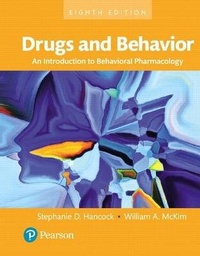
Drugs and Behavior
An Introduction to Behavioral Pharmacology, Books a la Carte
8th Edition
Published on 3. May 2017
Loose-leaf edition
480 pages
978-0-13-440502-5 (ISBN)
Description

For courses in Drugs and Behavior
A contemporary survey of behavioral pharmacology
Drugs and Behavior: An Introduction to Behavioral Pharmacology provides a clear overview of this intriguing discipline, as it helps students understand human behaviors and reflect on developments in the field. Taking over from longtime author William McKim, and continuing the personalized style and enthusiastic approach for which the text has been known, new lead author Stephanie Hancock describes basic pharmacological concepts of drug administration and pharmacokinetics, research methodology and clinical trials, tolerance and withdrawal, drug conditioning, addiction processes, and the neuroscience of drug action. In each chapter, these concepts are applied to different classes of recreational and therapeutic drugs within a historical and social backdrop. The Eighth Edition has been substantially revised and updated to include the newest research findings and real-world examples related to drug use and addiction.
NOTE: This ISBN is for a Pearson Books a la Carte edition: a convenient, three-hole-punched, loose-leaf text. In addition to the flexibility offered by this format, Books a la Carte editions offer students great value, as they cost significantly less than a bound textbook.
A contemporary survey of behavioral pharmacology
Drugs and Behavior: An Introduction to Behavioral Pharmacology provides a clear overview of this intriguing discipline, as it helps students understand human behaviors and reflect on developments in the field. Taking over from longtime author William McKim, and continuing the personalized style and enthusiastic approach for which the text has been known, new lead author Stephanie Hancock describes basic pharmacological concepts of drug administration and pharmacokinetics, research methodology and clinical trials, tolerance and withdrawal, drug conditioning, addiction processes, and the neuroscience of drug action. In each chapter, these concepts are applied to different classes of recreational and therapeutic drugs within a historical and social backdrop. The Eighth Edition has been substantially revised and updated to include the newest research findings and real-world examples related to drug use and addiction.
NOTE: This ISBN is for a Pearson Books a la Carte edition: a convenient, three-hole-punched, loose-leaf text. In addition to the flexibility offered by this format, Books a la Carte editions offer students great value, as they cost significantly less than a bound textbook.
More details
Edition
8th edition
Language
English
Place of publication
United States
Publishing group
Pearson Education (US)
Target group
Professional and scholarly
Dimensions
Height: 269 mm
Width: 213 mm
Thickness: 20 mm
Weight
870 gr
ISBN-13
978-0-13-440502-5 (9780134405025)
Copyright in bibliographic data and cover images is held by Nielsen Book Services Limited or by the publishers or by their respective licensors: all rights reserved.
Schweitzer Classification
Other editions
Previous edition
Book
08/2012
7th Edition
Pearson
€205.00
Article exhausted; check for reprint
Persons
Stephanie Hancock holds a Doctorate in Experimental Psychology with a focus on Behavioral Neuroscience. She is a seasoned lecturer, having taught a wide range of psychology courses - including introductory classes on general themes; topic-specific courses on drugs and behavior, biopsychology, abnormal psychology, social psychology, and educational psychology; and upper-level classes in research methods and statistics. Stephanie's research interests include drug and behavioral addictions; psychological disorders, especially stress-related and eating disorders; and the impact of early-life experiences on the development of psychopathologies. She collaborates with neuroscientists, psychologists, social workers, educators, and pharmacists on a variety of research projects, some involving laboratory animals and others involving people.
Stephanie grew up in Labrador, Canada, where her natural curiosity and independent spirit were nurtured in one of North America's last truly wild places. She currently resides in St. John's, Newfoundland, where she conducts research in the School of Pharmacy at Memorial University. Stephanie has a deep appreciation for rats, loves the British spelling of "behaviour", and greatly values the capacity of red wine and dark chocolate to hijack the brain's reward system. She is eternally grateful for the guidance and encouragement of her colleagues (Bill McKim among them), and for the love and support of her family.
Stephanie grew up in Labrador, Canada, where her natural curiosity and independent spirit were nurtured in one of North America's last truly wild places. She currently resides in St. John's, Newfoundland, where she conducts research in the School of Pharmacy at Memorial University. Stephanie has a deep appreciation for rats, loves the British spelling of "behaviour", and greatly values the capacity of red wine and dark chocolate to hijack the brain's reward system. She is eternally grateful for the guidance and encouragement of her colleagues (Bill McKim among them), and for the love and support of her family.
Content
1. Some Basic Pharmacology
2. Behavioral Analysis of Drug Effects
3. How We Adapt to Drugs: Tolerance, Sensitization, and Expectation
4. Neurophysiology, Neurotransmitters, and the Nervous System
5. Substance Use and Addictive Disorders
6. Alcohol
7. Anxiolytics and Sedative-Hypnotics
8. Tobacco and Nicotine
9. Caffeine and the Methylxanthines
10. Psychomotor Stimulants
11. Opioids
12. Antipsychotic Drugs
13. Antidepressants
14. Cannabis
15. Hallucinogens, Psychedelics, and Club Drugs
2. Behavioral Analysis of Drug Effects
3. How We Adapt to Drugs: Tolerance, Sensitization, and Expectation
4. Neurophysiology, Neurotransmitters, and the Nervous System
5. Substance Use and Addictive Disorders
6. Alcohol
7. Anxiolytics and Sedative-Hypnotics
8. Tobacco and Nicotine
9. Caffeine and the Methylxanthines
10. Psychomotor Stimulants
11. Opioids
12. Antipsychotic Drugs
13. Antidepressants
14. Cannabis
15. Hallucinogens, Psychedelics, and Club Drugs