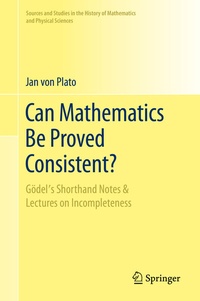
Can Mathematics Be Proved Consistent?
Description

This book offers the first examination of Gödel's preserved notebooks from 1930, written in a long-forgotten German shorthand, that show his way to the results: his first ideas, how they evolved, and how the jewel-like final presentation in his famous publication On formally undecidable propositions was composed.The book also contains the original version of Gödel's incompleteness article, as handed in for publication with no mentioning of the second incompleteness theorem, as well as six contemporary lectures and seminars Gödel gave between 1931 and 1934 in Austria, Germany, and the United States. The lectures are masterpieces of accessible presentations of deep scientific results, readable even for those without special mathematical training, and published here for the first time.
Reviews / Votes
"The present volume, an early fruit of a long-term project to publish all of the material in Gödel's mathematical workbooks, gives a foretaste of the riches that . should whet the appetites of scholars interested in the history of modern logic . . The reviewer deems this book to be a significant addition to the literature on Gödel and his life and work. It should have broad appeal to historians of logic, and its low price should encourage its purchase." (John W. Dawson, Philosophia Mathematica, July 9, 2022)
"This is an interesting book showing how Gödel came to his famous result on incompleteness. It will be appreciated by logicians and historians of logic and the foundations of mathematics." (Roman Murawski, Mathematical Reviews, December, 2021)
"The very many interesting historical facts about and around the discovery of the incompleteness theorems, discussed in this fascinating book. . The book is very well-written, historically, mathematically, and philosophically. . I strongly recommend reading this book for anyone interested in the incompleteness phenomenon, which is one of the greatest achievements of science in the 20th century." (Saeed Salehi, zbMATH 1466.03001, 2021)More details
Other editions
Additional editions