

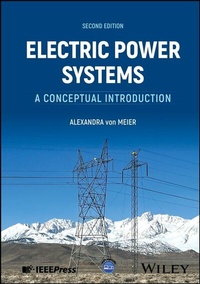
Electric Power Systems
Description

Discover the technology for producing and delivering electricity in this easily accessible introduction to power systems
Electric Power Systems underlie virtually every aspect of modern life. In the face of an unprecedented transition from fossil fuels to clean energy, it has never been more essential for engineers and other professionals from diverse disciplines to understand the electric grid and help chart its future. Since its original publication, Electric Power Systems has served as a uniquely accessible and qualitative introduction to the subject, offering a foundational overview with an emphasis on key concepts and building physical intuition. Now revised and updated to bring even greater rigor and incorporate the latest technologies, it remains an indispensable introduction to this vital subject.
Readers of the revised and expanded second edition of Electric Power Systems will also find:
- End-of-chapter problems to facilitate and reinforce learning
- New discussions of subjects including load frequency control, protection, voltage stability, and many others
- More quantitative treatment of topics such as voltage regulation, power flow analysis, generator and transformer modeling with numerical examples
- Entirely new chapters on generation and storage resources, power electronics, and the analysis of transmission lines
Electric Power Systems is an ideal textbook for graduate and advanced undergraduate students in engineering, as well as for a broad range of professionals, such as computer and data scientists, solar and wind energy manufacturers and installers, energy storage providers, economists, policy makers, legal and regulatory staff, and advocacy organizations.
More details
Other editions
Additional editions
Person
Alexandra von Meier, PhD, is an independent consultant since her retirement as Director of Electric Grid Research at the California Institute for Energy and Environment and as a faculty member in the Department of Electrical Engineering and Computer Science, both at the University of California, Berkeley.
Content
List of Figures xvii
Preface xxv
Acknowledgments xxix
About the Companion Website xxxi
1 Physics of Electricity 1
1.1 Basic Quantities 1
1.2 Ohm's Law 7
1.3 Circuit Fundamentals 10
1.4 Resistive Heating 13
1.5 Electric and Magnetic Fields 17
2 DC Circuit Analysis 29
2.1 Modeling Circuits 29
2.2 Series and Parallel Circuits 30
2.3 Kirchhoff's Laws 35
2.4 The Superposition Principle 39
2.5 Thévenin and Norton Equivalent Circuits 41
2.6 Magnetic Circuits 48
3 AC Power55
3.1 Alternating Current and Voltage 55
3.2 Power for the Resistive Case 60
3.3 Impedance 63
3.4 Complex Power 77
3.5 Phasors 86
4 Three-Phase Power 101
4.1 Three-Phase Basics 101
4.2 Symmetrical Components 111
4.3 Direct and Quadrature Components 117
5 Power Quality 121
5.1 Voltage 121
5.2 Frequency 125
5.3 Waveform and Harmonics 126
6 Loads135
6.1 Types of Loads 135
6.2 Single- and Multiphase Connections 144
6.3 Voltage Response of Loads 146
6.4 Load in Aggregate 150
7 Transmission and Distribution Systems 159
7.1 System Structure 159
7.2 Qualitative Characteristics of Power Lines 174
7.3 Loading 182
7.4 Voltage Control 185
7.5 Protection 190
8 Transformers 203
8.1 General Properties 203
8.2 Transformer Heating 205
8.3 Delta andWye Transformers 206
8.4 Autotransformers 208
8.5 Transformer Modeling 210
8.6 Voltage Regulation 216
8.7 Per-unit System 218
9 Analyzing Transmission Lines 225
9.1 Transmission Line Inductance 225
9.2 Transmission Line Capacitance 234
9.3 ABCD Parameters 238
10 Machines 257
10.1 The Simple Generator 258
10.2 D.C. Machine 261
10.3 The Synchronous Generator 264
10.4 Operational Control 270
10.5 Operating Limits 283
10.6 The Induction Machine 285
10.7 Modeling Generators 291
11 Matching Generation and Load 299
11.1 Load Frequency Control 299
11.2 Economic Dispatch 312
12 Power Flow 321
12.1 Introduction 321
12.2 The Power Flow Problem 322
12.3 Example with Interpretation of Results 331
12.4 Power Flow Equations and Solution Methods 339
12.5 Applications 360
12.6 LinDistFlow 363
13 Limits 369
13.1 Adequacy 369
13.2 Reliability 370
13.3 Security 374
13.4 Stability 376
13.5 Power Transfer Limits 394
Problems and Questions 403
14 Power Electronics 405
14.1 Power Conversion: Introduction 405
14.2 Legacy Power Conversion Technologies 406
14.3 Solid-State Technology 408
14.4 Inverters 415
14.5 FACTS 423
15 Resources 425
15.1 Generation Resources 425
15.2 Distributed Generation 437
15.3 Storage 443
15.4 Microgrids 449
16 Making the System Work 453
16.1 Time Scales for Operation and Control 454
16.2 Measurement and Data 460
16.3 Human Factors 469
16.4 Strategic Perspectives 479
Appendix A Symbols, Units, Abbreviations, and Acronyms 487
Index 493
List of Figures
- Figure 1.1 Electric field of (a) a single charge and (b) two opposite charge.
- Figure 1.2 Magnetic field around a current-carrying wire.
- Figure 1.3 The Lorentz force acting on charges moving through a magnetic field.
- Figure 1.4 An electromagnetic wave.
- Figure 2.1 Resistors in series.
- Figure 2.2 Resistors in parallel.
- Figure 2.3 Network reduction.
- Figure 2.4 Kirchhoff's voltage law.
- Figure 2.5 Kirchhoff's current law.
- Figure 2.6 Superposition. (a) Full circuit. (b) Circuit with only the voltage source. (c) Circuit with only the current source.
- Figure 2.7 A one-port representing a relationship between voltage and current , governed by whatever is inside the box.
- Figure 2.8 A simple, linear battery operating characteristic (a) and Thévenin equivalent circuit (b).
- Figure 2.9 (a) The current-voltage operating characteristic or - curve for an ideal photovoltaic cell, and (b) the circuit model that reproduces this behavior using an ideal current source and diode. A more realistic model would include a series and parallel resistance for losses within the cell.
- Figure 2.10 Operating characteristic for a linear one-port with Thévenin and Norton equivalents.
- Figure 2.11 Sample linear circuit.
- Figure 2.12 Thévenin (a) and Norton (b) equivalents of the circuit in Figure 2.11.
- Figure 2.13 A magnetic circuit.
- Figure 2.14 Network of resistors.
- Figure 3.1 A sine function plotted against time or, equivalently, angle .
- Figure 3.2 Sinusoidal alternating current with phase shift.
- Figure 3.3 Derivation of the rms value.
- Figure 3.4 A basic inductor, or solenoid.
- Figure 3.5 Current lagging voltage by 90. These functions could be written as and . Note that the relative amplitudes are unimportant, because they are measured in different units.
- Figure 3.6 A basic capacitor, with arrows indicating the electric field.
- Figure 3.7 Current leading voltage by .
- Figure 3.8 The number in the complex plane. In polar notation,
- Figure 3.9 The impedance Z represented in the complex plane, with resistance R in the real direction and reactance in the imaginary direction. Here the reactance is inductive and points upward; a capacitive reactance would point downward in the direction of . The length of the hypotenuse is .
- Figure 3.10 Simple series circuit to illustrate the addition of impedances.
- Figure 3.11 Parallel circuit to illustrate the addition of admittances, using the same elements as in Figure 3.10.
- Figure 3.12 Power as the product of voltage and current, with current lagging behind voltage by a phase angle difference .
- Figure 3.13 Complex power S with real power in the real and reactive power in the imaginary direction. The positive angle in the figure indicates an inductive load, with current lagging voltage.
- Figure 3.14 A phasor in the complex plane.
- Figure 3.15 Phasors in relation to each other.
- Figure 3.16 Complex exponentials. An increasing imaginary exponent corresponds to counterclockwise rotation in the complex plane.
- Figure 3.17 Series circuit to illustrate KVL for the complex case.
- Figure 3.18 Phasor addition of voltages associated with Figure 3.17 in the complex plane. Note that the length of the current phasor is arbitrary since it is in different units; it is shown for angle reference only.
- Figure 3.19 Parallel circuit to illustrate KCL for the complex case.
- Figure 3.20 Phasor addition in the complex plane of currents associated with Figure 3.19.
- Figure 3.21 Two voltage sources that could be acting as generators or loads.
- Figure 4.1 Three balanced single-phase a.c. currents.
- Figure 4.2 Three phases with and without neutral return; (a) three phases with common return; (b) three phases with neutral removed.
- Figure 4.3 (a) Delta and (b) wye connections.
- Figure 4.4 Phase-to-phase (line-to-line) voltage, seen in the time domain as the difference between a pair of phase-to-neutral (line-to-neutral) voltages.
- Figure 4.5 Line-to-line and line-to-neutral voltages represented in the phasor domain. The two different graphic arrangements are functionally identical: although the right diagram appears to "connect" voltages of the same value to support intuition, a phasor diagram is not a circuit diagram.
- Figure 4.6 Currents in a wye connection.
- Figure 4.7 Currents in a delta connection.
- Figure 4.8 Current phasors showing the relationships between line currents (, and ) and the currents through a delta-connected load (, and ).
- Figure 4.9 Positive-, negative-, and zero-sequence components. Each trio includes three phasors of equal magnitude, imagined as rotating counterclockwise.
- Figure 4.10 Vector addition of the symmetrical components in Figure 4.10, corresponding to Eq. 4.6.
- Figure 4.11 Various international practices for delta connections.
- Figure 5.1 ITIC curve.
- Figure 5.2 Transient voltage waveform disturbance, as seen with a PQube power quality recorder.
- Figure 5.3 Simulated current drawn by a highly nonlinear load and its effect on voltage due to source impedance, visualized in the Power Quality Teaching Toy.
- Figure 5.4 The third harmonic of all three phases coincides.
- Figure 6.1 Standard U.S. electrical outlet or wall socket.
- Figure 6.2 Transformer taps and multiphase service.
- Figure 6.3 Example of a load profile from California ISO. Source: Adapted from California Independent System Operator.
- Figure 6.4 Example of a load duration curve.
- Figure 6.5 Load profile on a mild, sunny day.
- Figure 7.1 Historical growth of generation unit size and transmission voltage.
- Figure 7.2 Regions and interconnections of the U.S. electric grid. Source: U.S. Energy Information Agency, 2016/Public Domain.
- Figure 7.3 Real-time frequency in the major synchronous interconnections in North America, as seen on FNET (University of Tennessee, Knoxville and Oak Ridge National Laboratory). The variations indicated on the color legend represent fractions of a hertz above or below the nominal 60.00 Hz. Source: The University of Tennessee Knoxville/https://fnetpublic.utk.edu/frequencymap.
- Figure 7.4 One-line diagram showing basic power system structure.
- Figure 7.5 North American (a) and European (b) distribution systems.
- Figure 7.6 Distribution substation layout.
- Figure 7.7 Distribution substation with transformers of different vintage, supplied from 60 kV subtransmission (left). Also visible are voltage regulators (back right), small service transformers (far right), and simple mechanical switches (operated with a hookstick).
- Figure 7.8 Radial distribution system.
- Figure 7.9 Loop system.
- Figure 7.10 Networked topology.
- Figure 7.11 Loop flow.
- Figure 7.12 Sample transmission-line dimensions.
- Figure 7.13 Transposition tower for a 380-kV line in Germany, carrying two three-phase circuits. For example, the middle phase at the front left is moved to the top position on the right. Also discernible on the photo are bundled conductors with two subconductors per bundle, and corona rings at the ends of the insulators.
- Figure 7.14 The 500 kV Pacific DC Intertie (PDCI) and a three-phase 230 kV a.c. transmission line near Bishop, California.
- Figure 7.15 Real power flow as a function of voltage phase angle difference.
- Figure 7.16 Thermal and stability limits for a hypothetical line.
- Figure 7.17 Voltage drop along a distribution feeder.
- Figure 7.18 Effect of a line voltage regulator on the voltage profile of a radial distribution feeder.
- Figure 7.19 Effect of a capacitor on the voltage profile of a radial distribution feeder.
- Figure 7.20 Sample time-current characteristic of a relay.
- Figure 7.21 Recloser operation with transient fault.
- Figure 7.22 Recloser operation with a permanent fault. There could be several additional reclosing attempts (fast or slow) before locking out.
- Figure 7.23 Example of protection zones with oil circuit breakers (OCB) and recloser (REC).
- Figure 7.24 Protection zones-fuses.
- Figure 7.25 Protection zones-reclosers.
- Figure 7.26 Protection...
