

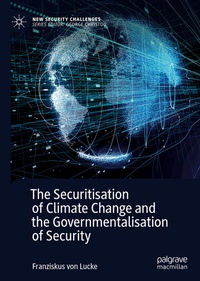
The Securitisation of Climate Change and the Governmentalisation of Security
Description

'In this important book, Franziskus von Lucke provides a theoretically sophisticated and empirically rich account of the relationship between security and climate change. Developing a Foucauldian-inspired account of securitization, the book rejects blanket or universal claims about the climate change- security relationship, instead insisting on the need to critically examine how the securitization of climate change plays out in particular empirical contexts. Exploring the cases of the US, Germany and Mexico, von Lucke points to distinctive dynamics of securitization in these settings, with different implications for the practices these in turn encourage. Ultimately, this book constitutes an important addition to literature on the relationship between climate change and security, while developing a distinct and nuanced account of securitization that will be of interest to a wide range of scholars of security in international relations.'
-Associate Professor Matt McDonald is a Reader in International Relations at the University of Queensland, Australia
'In 2019 a number of states and other actors (notably the European Union) have made climate emergency declarations. It is therefore more important than ever to understand what the securitization of the climate means. That is: Who can securitize? What security measures are likely/ deemed legitimate by relevant audiences? How does securitization affect the population within and outside a securitizing state? And perhaps most importantly of all, will it succeed? Franziskus von Lucke's carefully researched book offers answers to all of these questions and many others besides. von Lucke proceeds by examining with the US, Mexico and Germany, three real-life empirical cases of climate securitization. Each one provides unique insights that enable a fuller understanding of climate security. Accessibly written this is a must read for scholars and practitioners alike.'
-Dr Rita Floyd, University of Birmingham, UK, author of The Morality of Security: A theory of just Securitization, CUP, 2019
With great empirical detail and conceptual clarity, the book compares discourses and practices of climate security in different contexts. An essential reading for anyone interested in international climate politics, securitization theory, governmentality and the notion of power in International Relations.
-Dr Delf Rothe, Institute for Peace Research and Security Policy Hamburg at the University of Hamburg, Germany
Reviews / Votes
'In this important book, Franziskus von Lucke provides a theoretically sophisticated and empirically rich account of the relationship between security and climate change. Developing a Foucauldian-inspired account of securitization, the book rejects blanket or universal claims about the climate change- security relationship, instead insisting on the need to critically examine how the securitization of climate change plays out in particular empirical contexts. Exploring the cases of the US, Germany and Mexico, von Lucke points to distinctive dynamics of securitization in these settings, with different implications for the practices these in turn encourage. Ultimately, this book constitutes an important addition to literature on the relationship between climate change and security, while developing a distinct and nuanced account of securitization that will be of interest to a wide range of scholars of security in international relations.' -Associate Professor Matt McDonaldis a Reader in International Relations at the University of Queensland, Australia 'In 2019 a number of states and other actors (notably the European Union) have made climate emergency declarations. It is therefore more important than ever to understand what the securitization of the climate means. That is: Who can securitize? What security measures are likely/ deemed legitimate by relevant audiences? How does securitization affect the population within and outside a securitizing state? And perhaps most importantly of all, will it succeed? Franziskus von Lucke's carefully researched book offers answers to all of these questions and many others besides. von Lucke proceeds by examining with the US, Mexico and Germany, three real-life empirical cases of climate securitization. Each one provides unique insights that enable a fuller understanding of climate security. Accessibly written this is a must read for scholars and practitioners alike.' -Dr Rita Floyd, University of Birmingham, UK, author of The Morality of Security: A theory of just Securitization, CUP, 2019 With great empirical detail and conceptual clarity, the book compares discourses and practices of climate security in different contexts. An essential reading for anyone interested in international climate politics, securitization theory, governmentality and the notion of power in International Relations. -Dr Delf Rothe, Institute for Peace Research and Security Policy Hamburg at the University of Hamburg, GermanyMore details
Other editions
Additional editions
Person
Franziskus von Lucke is a Researcher in International Relations at the University of Tübingen, Germany. His research focuses on critical security studies, climate politics, and climate justice and he has worked extensively on the securitisation of climate change. His works have appeared in Geopolitics, the Journal of International Relations and Development and in the Zeitschrift für Internationale Beziehungen.
