

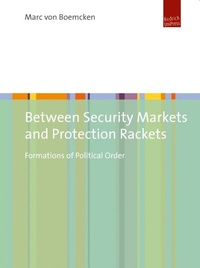
Between Security Markets and Protection Rackets
Formations of Political Order
1st Edition
Published on 20. February 2013
323 pages
978-3-86388-189-4 (ISBN)
Description

Security is a social practice, which constitutes different formations of political order. Developing a political economy of security practice, the author distinguishes these formations with a view to the actual exchanges between various providers and receivers of security services. He thus departs from a popular perspective in political science, which charts ongoing transformations in the global security landscape along a series of categorical divisions between state and non-state or between the public and the private. A more rewarding analytical perspective conceives the two most dominant security formations in the contemporary world as either based on commercial or on compulsory relations.
Reviews / Votes
Insgesamt bietet [von Boemcken] mit diesem Buch eine tiefgehende Beschäftigung mit dem Phänomen Sicherheit und führt dazu ein Modell ein, das mit weiten Teilen der Disziplin bricht und ein Verständnis der Bereitstellung und Produktion von Sicherheit anbietet, das den heute existierenden komplexen Akteursverhältnissen gerechter zu werden verspricht. pw-portal.de, 29.01.2015 Die Ambition der Arbeit besteht darin, den Blick auf die Struktur von Sicherheitspraktiken zu richten, statt durch normative Prädispositionen, eine Webersche Staatsfixiertheit oder die Einteilung der Welt in vermeintlich gute und böse Akteure blind für empirische Heterogenität zu werden. Diese Ambition löst das Buch mit nimmermüdem Aufwand und überzeugenden Nachweisen ein. [...] Die Arbeit ist ein anregender, streckenweise brillanter Beitrag, der über die konstruktivistische Entgrenzung des Sicherheitsbegriffs, vor allem aber die politikwissenschaftliche unfruchtbare "9/11"-Agenda hinausweist. Andreas Heinemann-Grüder in: Politische Vierteljahresschrift 3/2013More details
Language
English
Place of publication
Leverkusen-Opladen
Germany
Target group
Professional and scholarly
College/higher education
graduate and postgraduate students, junior and senior scholars and academics in Security Studies, Political Studies, Critical Geography, Political Economy
File size
2,22 MB
ISBN-13
978-3-86388-189-4 (9783863881894)
Schweitzer Classification
Other editions
Additional editions
Book
02/2013
1st Edition
Budrich UniPress
€36.00
No shipping information available
Person
Content
- Cover
- Acknowledgements
- Table of Contents
- German Summary/ Deutsche Zusammenfassung
- Introduction
- Context
- Problem
- Structure of Argument
- Methodological Considerations
- 1. Security. What is it? What does it do?
- 1.1. Substantivist Perspectives: Security as Condition
- 1.2. Costructisist Perspectives: Security as Practice
- 1.3. Poststructuralist Perspectives: Security as Power
- 1.3.2. The Constitutive Function of Security
- 1.3.3. Poststructuralism and the Widening-Debate
- 1.4. Security as Formation
- 2. Governing Security
- 2.1. The Disversification of Security Providers
- 2.2. The "Governance" Approach
- 2.3. "Security Governance": The State of Analysis
- 2.4. Analyses beyond the State
- 2.4.1. "Oligopolies of Violence
- 2.4.2. "Social Order
- 2.4.3. "Nodal Governance
- 2.4.4. "Security Assemblages
- 3. Security Networks
- 3.1. The Security Field
- 3.2. From Field to Networks
- 3.2.1. Network Dis/Integration
- 3.2.2. Network De/Centralization
- 3.3. From Networks to Formations
- 3.3.1. Coercive Alignments
- 3.3.2. Cooperative Alignments
- 3.3.3. Enrolment
- 4. The Political Economy of Security
- 4.1. Security Markets
- 4.1.1. Self-Governing Formations
- 4.1.2. Provision and Reception of Security
- 4.1.3. Security and Capital Accumulation
- 4.2. The De/Commodification of Security
- 4.2.1. Use-Value and Exchange-Value
- 4.2.2. Modalities of Exchange
- 4.2.3. Modes of Production
- 4.3. Defining Compulsory Security Formations
- 4.4. Defining Commercial Security Formations
- 5. Compulsory Security Formations
- 5.1. Compulsory Security and States
- 5.1.1. Governing Extortion: European State-Building
- 5.1.2. Governing Exploitation: Rentier States
- 5.2. Compulsory Security beyond States
- 5.2.1. Going Local: Municipal Security Arrangements
- 5.2.2. Going Illegal: Protection Rackets
- 5.2.3. Getting Down to Business: Corporate Security
- 6. Commercial Security Formations
- 6.1. Consumers
- 6.1.1. State Consumption
- 6.1.2. Non-State Consumption
- 6.2. Producers
- 6.2.1. The Rise of the Commercial Security Industry
- 6.2.2. Types of Security Companies
- 6.2.3. The State as Commercial Security Provider
- 6.2.4. Commercial Security Provision by Non-State Groups
- 6.3. Rgulatory Auspices
- 6.3.1. Third-Party Regulation
- 6.3.2 Regulation by Producers
- 6.3.3. Regulation by Costumers
- 7. Conceptual Variations
- 7.1. Who is to be secured? Against which threats?
- 7.2. Compulsory Security Concepts
- 7.2.1. Securitas Publica Interna et Externa
- 7.2.2. From Citizen-Security to the Nation-State
- 7.2.3. 20th Century Security Concepts
- 7.2.4. Security and Freedom
- 7.3. Commercial Security Concepts
- 7.3.1. Conceptual Disaggregation
- 7.3.2. Infinite Exclusion
- 7.3.3. Postmodern Security
- 8. Strategic Variations
- 8.1. How to go about the securing?
- 8.1.1. Surviving Threats
- 8.1.2. Overcoming Threats
- 8.1.3. Managing Threats
- 8.2. Ancient Security Strategies
- 8.2.1. Nuances of Survival: Asphaleia, Asylia and Sôteria
- 8.2.2. Hallucinations of Empire: The Pax Romana
- 8.3. Compulsory Security Strategies
- 8.3.1. International Balance
- 8.3.2. Comestic Discipline
- 8.3.3. The "Apparatus of Security
- 8.4. Commercial Security Strategies
- 8.4.1. Market- Risks...
- 8.4.2. ... ans Risk-Markets
- 8.4.3. The Neoliberal Order
- 8.4.4. The Return of Survival
- 9. Structural Variations
- 9.1 Sites of Conflict
- 9.2. Sites of Convergence
- Conclusion
- Bibliography
