

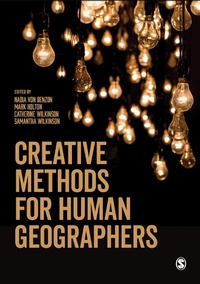
Creative Methods for Human Geographers
1st Edition
Published on 13. January 2021
432 pages
978-1-5297-3725-7 (ISBN)
Description

Introducing a broad range of innovative and creative qualitative methods, this accessible book shows you how to use them in research project while providing straightforward advice on how to approach every step of the process, from planning and organisation to writing up and disseminating research. It offers:
Demonstration of creative methods using both primary or secondary data.
Practical guidance on overcoming common hurdles, such as getting ethical clearance and conducting a risk assessment.
Encouragement to reflect critically on the processes involved in research.
The authors provide a complete toolkit for conducting research in geography, while ensuring the most cutting-edge methods are unintimidating to the reader.
Demonstration of creative methods using both primary or secondary data.
Practical guidance on overcoming common hurdles, such as getting ethical clearance and conducting a risk assessment.
Encouragement to reflect critically on the processes involved in research.
The authors provide a complete toolkit for conducting research in geography, while ensuring the most cutting-edge methods are unintimidating to the reader.
Reviews / Votes
This exciting volume shows how students, and anyone else, can tap into the wealth of new technologies available today along with their own creativity to produce different kinds of research projects that account for a diverse and dynamic world. -- Russell Prince This collection does two main things. Firstly, it invigorates methodological discussion in Human Geography by bringing together an exciting range of new approaches which will inspire (as well as guide) students through their research adventures. Secondly, it provides an in depth revision of some more familiar methods, through exciting updates and empirical examples. -- Michael Joseph Richardson The title itself produces high expectations that are fully met. This book reflects the current debates about methods in geography in the context of cultural turn, postmodern identities, othering, positionality and research ethics, creatively implements them and promotes methodical innovation within the geographical application of methods. -- Jeannine Wintzer * Geographica Helvetica, the Swiss Journal of Geography *More details
Edition
1. Auflage
Language
English
Place of publication
London
United Kingdom
Publishing group
Sage Publications Ltd (Digital)
Target group
College/higher education
Product notice
Reflowable
ISBN-13
978-1-5297-3725-7 (9781529737257)
Copyright in bibliographic data and cover images is held by Nielsen Book Services Limited or by the publishers or by their respective licensors: all rights reserved.
Schweitzer Classification
Other editions
Additional editions
Nadia von Benzon | Mark Holton | Catherine Wilkinson
Creative Methods for Human Geographers
Book
02/2021
1st Edition
SAGE Publications Ltd
€56.75
Shipment within 15-20 days
Nadia von Benzon | Mark Holton | Catherine Wilkinson
Creative Methods for Human Geographers
Book
02/2021
1st Edition
SAGE Publications Ltd
€154.40
Shipment within 15-20 days
Persons
Nadia von Benzon is a Lecturer in Human Geography at Lancaster University with particular interest in the social geographies of childhood, youth and motherhood, and in disability and health geography and therapeutic landscapes. She recently edited the volumes Intersectionality and Difference in Childhood and Youth: Global Perspectives with Catherine Wilkinson, published in Routledge's Spaces of Childhood and Youth series. Nadia is currently writing up recent research in the area of children's historical geography exploring Victorian reformatory farms and child migration to New Zealand and embarking in online research exploring birth stories. Mark Holton is a social and cultural geographer at the University of Plymouth. His research interests address the geographies of higher education students and focuses on mobility, belonging and identity. Mark's publications have covered a range of topics, from mobilities and belonging in 21st Century higher education, to youth transitions, international student mobility and traditional or non-traditional student identities. He recently co-authored a book entitled Everyday Mobile Belonging: Theorising Higher Education Student Mobilities (Bloomsbury Academic). Catherine Wilkinson is a Senior Lecturer in Education at Liverpool John Moores University. Catherine works at the intersection of a range of research approaches, including: mixed methods, ethnographic and participatory research. Catherine's primary research interests are children's health experiences; young people and identity; community radio; and innovative methods. Catherine has an established reputation for making cutting-edge contributions, conceptually and methodologically, to research 'with' children and young people and uses this research to inspire teaching she delivers. Samantha Wilkinson is a senior lecturer in Childhood, Youth and Education Studies at Manchester Metropolitan University. Samantha has written extensively of a range of themes including children and young people's geographies and mobilities; young men's performances of masculinities; home care for people with dementia; animal geographies; and home sharing network Airbnb. Through the research she conducts she uses innovative methodological approaches, including: joint ethnography; diaries; drawing elicitation interviews; mobile phone methods; and (auto)ethnography.
Content
Part I: Preparing to research
Chapter 1: Introduction - Nadia von Benzon, Mark Holton, Catherine Wilkinson and Samantha Wilkinson
Chapter 2: Centring reflexivity, positionality and autoethnographic practices in creative research - John Horton
Chapter 3: Researching 'our' people and researching 'other' people - Chris Philo, Louise Boyle and Mark Lucherini
Chapter 4: Ethical considerations in creative research: Design, delivery and dissemination - Sarah Marie Hall, Gemma Sou and Laura Pottinger
Chapter 5: The practicalities of researching creatively - Tracy Hayes
Part II: Creative and innovative methods
Chapter 6: Photography and photo elicitation as visual methods - Noora Pyyry, Markus Hilander and Sirpa Tani
Chapter 7: Moodboards and LEGO: Principles and practice in social research - Helena Pimlott-Wilson and Jo Hickman-Dunne
Chapter 8: Creative approaches to mapping - Amy Mulvenna and Chris Perkins
Chapter 9: Drawing and graffiti-based approaches - Robin Kearns, Kyle Eggleton, Annie van der Plas and Tara Coleman
Chapter 10: Research with sound: An audio guide - Geraint Rhys Whittaker and Kimberley Peters
Chapter 11: Mobile interviews by land, air and sea - Mark Riley, Jennifer Turner, Sam Hayes and Kimberley Peters
Chapter 12: Psychogeography and urban exploration - Morag Rose and Jane Samuels
Chapter 13: Crafting - Cassie Ogden and Katherine Harrison
Chapter 14: Creative performance and practice - Sofie Narbed
Chapter 15: Working with literary texts - Nichola Harmer
Chapter 16: Poetic methods - Gabriel Eshun and Clare Madge
Chapter 17: Research music: listening and composing - Gerraint Rhys Whittaker and Kimberley Peters
Chapter 18: Working creatively with biographies and life histories - Laura Fenton and Signe Ravn
Chapter 19: Mobile technology, spatial and locative media - Mike Duggan
Chapter 20: Mobile phones, text messaging and social media - Jamie Halliwell and Samantha Wilkinson
Chapter 21: Creating and reappropriating apps - Mark Holton
Chapter 22: Gaming and VR in geographical research - Phil Jones and Tess Osborne
Chapter 23: Video ethnography - Thomas Aneurin Smith and Ria Ann Dunkley
Chapter 24: Creative research in and with archives - Matthew F. Rech
Chapter 25: Selecting and analysing publicly-generated online content - Catherine Wilkinson and Nadia von Benzon
Chapter 26: Curation as method - Francesca Church, Hilary Geoghegan and Rhi Smith
Part III: Handling creative data
Chapter 27: Analyzing messy data - Nadia von Benzon and Kimberley O'Sullivan
Chapter 28: Showcasing creative methods in your dissertation research - Pearlin Teow and Mark Holton
Chapter 29: Creative dissemination - Catherine Wilkinson with Matthew Benwell, Bernie Carter, Lorna Brooks, Andy Davies, Bethan Evans, Sergio A. Silverio and Greg Thomas
Chapter 1: Introduction - Nadia von Benzon, Mark Holton, Catherine Wilkinson and Samantha Wilkinson
Chapter 2: Centring reflexivity, positionality and autoethnographic practices in creative research - John Horton
Chapter 3: Researching 'our' people and researching 'other' people - Chris Philo, Louise Boyle and Mark Lucherini
Chapter 4: Ethical considerations in creative research: Design, delivery and dissemination - Sarah Marie Hall, Gemma Sou and Laura Pottinger
Chapter 5: The practicalities of researching creatively - Tracy Hayes
Part II: Creative and innovative methods
Chapter 6: Photography and photo elicitation as visual methods - Noora Pyyry, Markus Hilander and Sirpa Tani
Chapter 7: Moodboards and LEGO: Principles and practice in social research - Helena Pimlott-Wilson and Jo Hickman-Dunne
Chapter 8: Creative approaches to mapping - Amy Mulvenna and Chris Perkins
Chapter 9: Drawing and graffiti-based approaches - Robin Kearns, Kyle Eggleton, Annie van der Plas and Tara Coleman
Chapter 10: Research with sound: An audio guide - Geraint Rhys Whittaker and Kimberley Peters
Chapter 11: Mobile interviews by land, air and sea - Mark Riley, Jennifer Turner, Sam Hayes and Kimberley Peters
Chapter 12: Psychogeography and urban exploration - Morag Rose and Jane Samuels
Chapter 13: Crafting - Cassie Ogden and Katherine Harrison
Chapter 14: Creative performance and practice - Sofie Narbed
Chapter 15: Working with literary texts - Nichola Harmer
Chapter 16: Poetic methods - Gabriel Eshun and Clare Madge
Chapter 17: Research music: listening and composing - Gerraint Rhys Whittaker and Kimberley Peters
Chapter 18: Working creatively with biographies and life histories - Laura Fenton and Signe Ravn
Chapter 19: Mobile technology, spatial and locative media - Mike Duggan
Chapter 20: Mobile phones, text messaging and social media - Jamie Halliwell and Samantha Wilkinson
Chapter 21: Creating and reappropriating apps - Mark Holton
Chapter 22: Gaming and VR in geographical research - Phil Jones and Tess Osborne
Chapter 23: Video ethnography - Thomas Aneurin Smith and Ria Ann Dunkley
Chapter 24: Creative research in and with archives - Matthew F. Rech
Chapter 25: Selecting and analysing publicly-generated online content - Catherine Wilkinson and Nadia von Benzon
Chapter 26: Curation as method - Francesca Church, Hilary Geoghegan and Rhi Smith
Part III: Handling creative data
Chapter 27: Analyzing messy data - Nadia von Benzon and Kimberley O'Sullivan
Chapter 28: Showcasing creative methods in your dissertation research - Pearlin Teow and Mark Holton
Chapter 29: Creative dissemination - Catherine Wilkinson with Matthew Benwell, Bernie Carter, Lorna Brooks, Andy Davies, Bethan Evans, Sergio A. Silverio and Greg Thomas
