

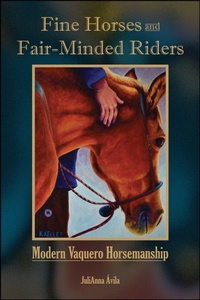
Fine Horses and Fair-Minded Riders
Description

What we currently call "horse whispering" has roots in a form of western horsemanship that traveled from Europe to Mexico and the United States, and was then transformed by Native Americans and working cowboys into Vaquero horsemanship. Fine Horses and Fair-Minded Riders: Modern Vaquero Horsemanship documents the learning and practice of Vaquero horsemanship, which has survived as a vibrant part of horse culture. In her study, Ávila first focused on participants in the southeastern United States before expanding to include their mentors from across the United States.
Ávila characterizes what she found as "a collapse of distance" between geographical and cultural boundaries, digital and physical spaces, and, most significantly, horses and humans. Influenced by New Literacies scholarship and employing a sociocultural theoretical framework, Ávila explores self-directed learning journeys; the flexibility of apprentice and expert positions; the influence of consumer culture; the philosophy and significance of the cultural roots of Vaquero horsemanship; the role of technology; and what the future of this continually evolving horsemanship might include. At the heart of this volume are personal stories and firsthand accounts from those who have studied modern Vaquero horsemanship, which can help to create exceptional and powerful bonds between horses and humans.
More details
Other editions
Additional editions
Person
Content
INTRODUCTION: Studying Vaquero Horsemanship in the Southeastern United States and Beyond
CHAPTER 1: An Overview of Historical and Modern Vaquero Horsemanship
INTERLUDE 1: Joe Wolter and Curly
CHAPTER 2: Learning Vaquero Horsemanship: Motivations, Desire Lines, and Turning Points
INTERLUDE 2: Alicia Byberg-Landman and Marlin
CHAPTER 3: The Flexibility of Expertise and Apprenticeship in Vaquero Horsemanship
INTERLUDE 3: Bruce Sandifer and Mooney
CHAPTER 4: The Crossroads of Vaquero Horsemanship and Consumer Culture
INTERLUDE 4: Rodolfo Lara Sr. and Jefe
CHAPTER 5: The Philosophy of Modern Vaquero Horsemanship
INTERLUDE 5: Linda Hoover and Ally
CHAPTER 6: The Cultural Roots of Vaquero Horsemanship
INTERLUDE 6: Tom Curtin and Dusty
CHAPTER 7: A Virtual Gallop: Using Technology to Learn Vaquero Horsemanship
INTERLUDE 7: Kathleen Kelley, Red, and Twinkle Toes
CONCLUSION: Evolution, Blending, and a Hopeful Future
Appendix: Participants Identified by Name
Acknowledgments
References
Index
