

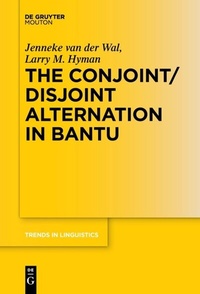
The Conjoint/Disjoint Alternation in Bantu
Conjoint/Disjoint Alternation in Bantu
1st Edition
Published on 19. December 2016
X, 458 pages
978-3-11-049083-1 (ISBN)
Description

This volume brings together descriptions and analyses of the conjoint/disjoint alternation, a typologically significant phenomenon found in many Bantu languages. The chapters provide in-depth documentation, comparative studies and theoretical analyses of the alternation from a range of Bantu languages, showing its crosslinguistic variation in constituent structure, morphology, prosody and information structure.
More details
Other editions
Additional editions
Jenneke van der Wal | Larry M. Hyman
The Conjoint/Disjoint Alternation in Bantu
Book
11/2018
1st Edition
De Gruyter Mouton
€39.95
Shipment within 7-9 days
Jenneke van der Wal | Larry M. Hyman
The Conjoint/Disjoint Alternation in Bantu
Book
12/2016
1st Edition
De Gruyter Mouton
€149.95
Shipment within 7-9 days
Jenneke van der Wal | Larry M. Hyman
The Conjoint/Disjoint Alternation in Bantu
Conjoint/Disjoint Alternation in Bantu
E-Book
12/2016
1st Edition
De Gruyter Mouton
€149.95
Available for download
Persons
Jenneke van der Wal, University of Cambridge, UK & Larry M. Hyman , University of California at Berkeley, USA.
Content
- Intro
- Table of contents
- Contributors
- 1 Introduction
- 2 What is the conjoint/disjoint alternation? Parameters of crosslinguistic variation
- 3 Locating the Bantu conjoint/disjoint alternation in a typology of focus marking
- 4 Disentangling conjoint, disjoint, metatony, tone cases, augments, prosody, and focus in Bantu
- 5 Shangaji paired tenses: Emergence of a CJ /DJ system?
- 6 The Kikuyu focus marker ni : Formal and functional similarities to the conjoint/disjoint alternation
- 7 Conjoint and disjoint verb forms in Gur? Evidence from Yom
- 8 The conjoint/disjoint distinction in the tonal morphology of Tswana
- 9 The conjoint/disjoint alternation in Símákonde
- 10 The conjoint/disjoint alternation and phonological phrasing in Bemba
- 11 Prosodic evidence for syntactic phrasing in Zulu
- 12 Prosody/syntax mismatches in the Zulu conjoint/disjoint alternation
- 13 The conjoint/disjoint alternation in Kinyarwanda
- 14 The conjoint/disjoint alternation in Kirundi (JD62): A case for its abolition
- 15 Conjoint/disjoint distinction and focus in Matengo (N13)
- Language Index
- Subject Index
