

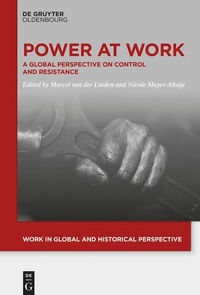
Power At Work
Description

Between working men and women (which may include "free" wage earners, chattel slaves, indentured labourers, sharecroppers, domestic servants, and many others) and those employing them, there has always been a constant - mostly silent but sometimes overt - struggle concerning employers' discretionary power and over the interpretation of formal and informal rules. There is a constantly shifting frontier of control , that is, an ongoing struggle for control in the workplace, with managers and supervisors trying to increase their power over their subordinates, and their subordinates, in reaction, trying to maintain and increase their relative autonomy. The detailed case studies in this volume span three centuries and cover different parts of the world. Still, they speak to each other in many ways, highlighting the fact that power at work, whether on the shopfloor or beyond, results from a wide range of complex interrelations. Between technological innovations and the ways in which they are actually implemented. Between the division of labour at the site of production or service provision and changing standards of social segmentation beyond the premises of the company, which can be reinforced - or weakened - by management strategies of utilizing labour power as well as workers' reaction to these strategies. And finally, between politics in production, which shape the relations between capital and labour on the shopfloor, and state politics of production, which cannot be understood without reference to broader developments in economy and society.
More details
Other editions
Additional editions
Persons
Nicole Mayer-Ahuja , University of Goettingen; Marcel van der Linden , International Institute of Social History, Amsterdam
Content
- Intro
- Table of Contents
- Acknowledgments
- Tables and Figures
- 1 Introduction
- 2 Burra Sahibs versus Coolies: Discipline and Resistance. Labour in the Assam Valley Tea Plantations
- 3 Remote Control: Field Management Regimes and the Agricultural Labour Process on Chinese Collective Farms, 1956 to 1980
- 4 Facing the Market and Fighting without Union: Labour Resistance History of Chinese State Workers
- 5 Between State Feminism and Work Intensification: Gendered Labour Control Regimes in Turkish Textile and Tobacco Industries
- 6 The Politics of and in (Re-)Production in an Eastern Indian Company Town
- 7 Destructuring the Dis-assembly Line: The Reversal of Power Relations in the Aotearoa/New Zealand Meat Processing Industry
- 8 Resistance and Regulation on the Self-managed Shop Floor in Yugoslavia
- 9 Industrial "Cyclopes" and "Native" Stokers: British Steamshipping and the Attractions of "Racial Management" (c. 1880-1930)
- 10 Southern Africa, Maritime Labour, and Steamship Imperialism c. 1875 to 1948
- 11 Power after Work: The Un-free Time of Congolese Seafarers in the Belgian Empire (1910-1940)
- 12 Power at Work: Approaching a Global Perspective
- Notes on Contributors
- Index
