

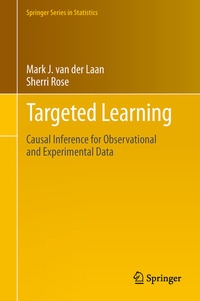
Targeted Learning
Description

The statistics profession is at a unique point in history. The need for valid statistical tools is greater than ever; data sets are massive, often measuring hundreds of thousands of measurements for a single subject. The field is ready to move towards clear objective benchmarks under which tools can be evaluated. Targeted learning allows (1) the full generalization and utilization of cross-validation as an estimator selection tool so that the subjective choices made by humans are now made by the machine, and (2) targeting the fitting of the probability distribution of the data toward the target parameter representing the scientific question of interest.
This book is aimed at both statisticians and applied researchers interested in causal inference and general effect estimation for observational and experimental data. Part I is an accessible introduction to super learning and the targeted maximum likelihood estimator, including related concepts necessary to understand and apply these methods. Parts II-IX handle complex data structures and topics applied researchers will immediately recognize from their own research, including time-to-event outcomes, direct and indirect effects, positivity violations, case-control studies, censored data, longitudinal data, and genomic studies.
Reviews / Votes
From the reviews:
"This book is a timely fit and is expected to draw much attention from researchers in the field of causal inference. The book explains the concept of targeted learning, which is an enhanced procedure for estimating targeted causal estimands under the potential outcome framework. . Excellent summaries of complex estimation procedures and methods are ubiquitous, which will be helpful for the nontechnical readers of the book. . This book appears to be a useful reference for Ph.D. students in biostatistics programs." (Joseph Kang, Journal of the American Statistical Association, June, 2013)More details
Other editions
Additional editions
Persons
Mark J. van der Laan is a Hsu/Peace Professor of Biostatistics and Statistics at the University of California, Berkeley. His research concerns causal inference, prediction, adjusting for missing and censored data, and estimation based on high-dimensional observational and experimental biomedical and genomic data. He is the recipient of the 2005 COPSS Presidents' and Snedecor Awards, as well as the 2004 Spiegelman Award, and is a Founding Editor for the International Journal of Biostatistics.
Sherri Rose is currently a PhD candidate in the Division of Biostatistics at the University of California, Berkeley. Her research interests include causal inference, prediction, and applications in rare diseases. Upon completion of her doctoral degree, she will begin an NSF Mathematical Sciences Postdoctoral Research Fellowship at Johns Hopkins Bloomberg School of Public Health.
