

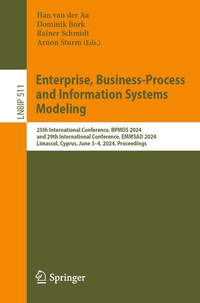
Enterprise, Business-Process and Information Systems Modeling
Description

This book contains the refereed proceedings of two long-running events held along with the CAiSE conference relating to the areas of enterprise, business-process and information systems modeling:
- the 25th International Conference on Business Process Modeling, Development and Support, BPMDS 2024, and
- the 29th International Conference on Exploring Modeling Methods for Systems Analysis and Development, EMMSAD 2024.
The conferences were taking place in Limassor, Cyprus, during June 3-4, 2024.
For BPMDS 8 full papers and 3 short papers were carefully reviewed and selected for publication from a total of 25 submissions; for EMMSAD 11 full papers and 5 short papers were accepted from a total of 32 submissions after thorough reviews.
The BPMDS papers deal with a broad range of theoretical and applications-based research in business process modeling, development and support. EMMSAD focusses on modeling methods for systems analysis and development.
More details
Other editions
Additional editions
Content
- Intro
- Preface
- BPMDS 2024
- EMMSAD 2024
- BPMDS 2024 Organization
- EMMSAD 2024 Organization
- Contents
- Joint BPMDS/EMMSAD 2024 Keynote
- Resource Optimization in Business Processes
- 1 Introduction
- 2 Framework for Business Process Resource Optimization
- 3 Advances in Business Process Resource Optimization
- 4 Conclusions
- References
- Large Language Model Applications (BPMDS 2024)
- Evaluating Large Language Models in Process Mining: Capabilities, Benchmarks, and Evaluation Strategies
- 1 Introduction
- 2 Background
- 2.1 Process Mining Tasks for LLMs
- 2.2 Implementation Paradigms of Process Mining on LLMs
- 3 Evaluating LLMs in Process Mining
- 3.1 LLMs Capabilities Needed for Process Mining
- 3.2 Relevant LLMs Benchmarks
- 3.3 How to Evaluate LLMs Outputs
- 4 Conclusion
- References
- Mapping the Landscape: Exploring Large Language Model Applications in Business Process Management
- 1 Introduction
- 2 Preliminary Concepts
- 2.1 Business Process Management Lifecycle
- 2.2 Large Language Models
- 3 Review Method
- 3.1 Inclusion and Exclusion Criteria
- 3.2 Sources and Search Strategy
- 4 Results
- 4.1 Positioning Articles
- 4.2 Articles that Contribute to the BPM Lifecycle Phases
- 5 Discussion and Conclusions
- References
- Process Model Extraction, Analysis, and Visualization (BPMDS 2024)
- Designing a User Interface to Explore Collections of Directly-Follows Graphs for Process Mining Analysis
- 1 Introduction
- 2 Related Work
- 3 Research Methodology
- 4 Results
- 4.1 Context Creation
- 4.2 Results Information
- 4.3 Pattern Search
- 5 Discussion and Limitations
- 6 Conclusions
- References
- Precision-Guided Minimization of Arbitrary Declarative Process Models
- 1 Introduction
- 2 Preliminaries
- 3 Minimizing Arbitrary Declarative Models
- 4 Experimental Evaluation
- 5 Related Work
- 6 Conclusion
- References
- Leveraging Data Augmentation for Process Information Extraction
- 1 Introduction
- 2 Background
- 3 Related Work
- 4 Experiment Setup
- 4.1 Data Augmentation Effects
- 4.2 Finding Optimal Configurations
- 5 Results
- 6 Conclusion and Future Work
- References
- User Preferences and Agile Processes (BPMDS 2024)
- A Generic Approach Towards Adapting User Preferences in Business Process Execution
- 1 Motivation
- 2 Background
- 3 Related Work
- 4 Research Contribution
- 5 Design and Development of Artifact
- 6 Demonstration and Evaluation
- 7 Conclusion and Future Work
- References
- Introducing Agile Controllability in Temporal Business Processes
- 1 Introduction
- 2 Motivating Example
- 3 STNUs and Oracles
- 4 Checking Agile Controllability
- 5 An Alternative Approach to Avoid Backtracking
- 6 Proof of Concept
- 7 Discussion and Conclusion
- References
- Reviewing Conformance Checking Uses for Run-Time Regulatory Compliance
- 1 Introduction
- 2 Background and Related Work
- 2.1 Conformance Checking
- 2.2 Compliance Checking
- 2.3 Related Work
- 3 Research Method
- 4 Results
- 4.1 Preparation
- 4.2 Action
- 4.3 Reflection
- 5 Discussion
- 5.1 RQ1-Identification of Existing Contributions
- 5.2 RQ2-Characteristics of Existing Contributions
- 5.3 RQ3-Research Opportunities
- 5.4 Threats to Validity
- 6 Conclusion and Future Work
- References
- Process Discovery and Analysis (BPMDS 2024)
- Visual Representation of Resource Analysis Insights for Process Mining
- 1 Introduction
- 2 Background
- 2.1 Resource Analysis in Process Mining
- 2.2 Visualization of Resource-Related Indicators
- 2.3 Requirements
- 3 Approach
- 3.1 Preliminaries
- 3.2 Implementation
- 4 Evaluation
- 4.1 Event Log
- 4.2 User Evaluation
- 4.3 Discussion
- 4.4 Limitations
- 5 Conclusion
- References
- Process Variant Analysis Across Continuous Features: A Novel Framework
- 1 Introduction
- 2 Related Work
- 3 Preliminaries
- 4 Process Variant Identification Framework
- 4.1 Control Flow Change Detection
- 4.2 Segmentation and Pairwise Comparison
- 5 Case Study
- 5.1 UWV Event Log
- 5.2 Process Variant Analysis Using UWV Event Log
- 5.3 A Deeper Analysis Considering Rejected Cases
- 6 Conclusion
- References
- A Novel Contextualization Method for Process Discovery Using Activity Specialization Hierarchies
- 1 Introduction
- 2 Related Work
- 2.1 Contextualization in Process Mining
- 2.2 Hierarchical Process Mining
- 3 Preliminaries
- 4 Running Case Study
- 5 Process Discovery with Activity Specialization Hierarchies
- 5.1 Create Activity Specialization Hierarchies (Phase 1)
- 5.2 Process Discovery Using Hierarchies (Phase 2)
- 5.3 Interpret Results (Phase 3)
- 6 Discussion
- 7 Conclusion
- References
- Evaluation of Modeling Methods (EMMSAD 2024)
- Enhancing Our Understanding of Business Process Model Comprehension Using Biometric Data
- 1 Introduction
- 2 Background and Related Work
- 3 Method
- 3.1 Data Preprocessing
- 4 Results
- 5 Discussion
- 6 Concluding Remarks
- References
- A Method for Digital Business Ecosystem Design: Evaluation of Two Cases in the Maritime Dataspaces
- 1 Introduction
- 2 Background to DBEs and the DBEmap Method
- 3 Research Design
- 4 Method Application and Evaluation
- 4.1 Modelling the Marispace-X DBE
- 4.2 Modelling the Skippo DBE
- 4.3 Evaluation
- 5 Discussion and Conclusions
- References
- Technology for Automatic Usability Evaluation Using Model Driven Engineering
- 1 Introduction
- 2 Related Work
- 3 Model-Driven Usability Evaluation Process and Tool
- 3.1 FENIkS
- 3.2 Extended Presentation Model
- 3.3 Usability Evaluation Procedure
- 3.4 Usability Evaluation Tool
- 4 Evaluation by Experts
- 5 Conclusion and Further Work
- References
- Model-driven Engineering & AI 1 (EMMSAD 2024)
- Building BESSER: An Open-Source Low-Code Platform
- 1 Introduction
- 2 Overview of the BESSER Platform
- 2.1 B-UML Language
- 2.2 Code Generators
- 2.3 Running Example
- 2.4 Roadmap
- 3 BESSER Verticals
- 4 Discussion
- 5 Conclusion
- References
- Towards Taming Large Language Models with Prompt Templates for Legal GRL Modeling
- 1 Introduction
- 2 Challenges to Motivate Legal GRL Prompt Templates
- 3 Designing Legal GRL Prompt Templates
- 3.1 Preparations
- 3.2 Develop a Hohfeldian Model of Law
- 3.3 Generate a Legal GRL Model
- 4 Evaluation
- 4.1 Datasets for Scenarios
- 4.2 Results
- 4.3 Lessons Learned
- 5 Related Work
- 6 Conclusion and Outlook
- References
- Process Modeling with Large Language Models
- 1 Introduction
- 2 Related Work
- 3 LLM-Based Process Modeling Framework
- 3.1 Framework Overview
- 3.2 Process Representation
- 3.3 Prompt Engineering
- 3.4 Model Generation and Refinement
- 3.5 Error Handling
- 4 Evaluation
- 5 Limitations and Future Directions
- 6 Conclusion
- References
- Could a Large Language Model Contribute Significantly to Requirements Analysis?
- 1 Applying Large Language Models Despite Their Known Shortcomings
- 2 The Quasi-Experiment
- 2.1 The Quasi-Experiment's Goal and Form
- 2.2 Creation of Usable MS Word Documents Representing Three Cases
- 2.3 The Treatments
- 2.4 Execution of the Quasi-Experiment
- 3 Evaluation of Results Generated by ChatGPT-4
- 4 Conclusions
- References
- Model-driven Engineering & AI 2 (EMMSAD 2024)
- Fast & Sound: Accelerating Synthesis-Rules-Based Process Discovery
- 1 Introduction
- 2 Related Work
- 3 Preliminaries
- 4 Approach
- 4.1 The Synthesis Miner and Its Limitations
- 4.2 Extensions
- 5 Experimental Evaluation
- 5.1 Experimental Setup
- 5.2 Results and Discussion
- 6 Conclusion
- References
- Navigating the Data Model Divide in Smart Manufacturing: An Empirical Investigation for Enhanced AI Integration
- 1 Introduction
- 2 Background and Related Work
- 3 Stage 1: Empirical Study of Data Model Practices
- 3.1 Research Design
- 3.2 Results
- 3.3 Discussion and Implications for Data Model Design
- 4 Stage 2: Design and Preliminary Evaluation of an Intermediary Machine Data Model
- 4.1 Formal and Technical Design Criteria for Bridging Data Models: Insights from OCEL 2.0
- 4.2 MAED: A Bridging Data Model for Harmonizing Sensor-Generated Industrial Measurement Data
- 4.3 Preliminary Evaluation
- 5 Conclusions, Limitations, and Future Work
- References
- A Multi-dimensional Model for the Design and Development of Analytical Information Systems
- 1 Introduction
- 2 Related Work
- 3 Model for the Design and Development of AIS
- 3.1 Domain Knowledge Dimension
- 3.2 Data Provider and Consumer Dimension
- 3.3 Analytical Requirements Dimension
- 3.4 Data Architecture Dimension
- 3.5 Data Processing and Analytics Dimension
- 4 Demonstration Case: The TPC-H Data Set
- 5 Conclusions
- References
- Modeling and Sustainability (EMMSAD 2024)
- Situational Environmental, Social and Governance Accounting: From Ethical Value Elicitation to Sustainability Reporting
- 1 Introduction
- 2 Background
- 2.1 ESG Accounting with Situational Method Engineering
- 2.2 The OpenESEA Framework for Developing ESGA ISs
- 3 Research Approach
- 4 A Meta-method for the Creation of Situational ESG Accounting Methods
- 4.1 Process Fragments
- 4.2 Product and Tool Fragments
- 4.3 Assembly Strategy and Good Practices
- 5 ESG4Orgs Evaluation
- 6 Discussion and Conclusion
- References
- Realizing the Accountability of Algorithms in the Public Sector: A Reference Method for Managing Algorithm Registers
- 1 Introduction
- 2 Related Work
- 2.1 Implementation and Adoption of AI in Organizations
- 2.2 The Necessity of Algorithm Registers
- 2.3 Reference Method Construction
- 3 Research Approach
- 3.1 Problem Investigation: Literature Study and Observations
- 3.2 Treatment Design: Theory-Building Case Studies and Reference Method Design
- 3.3 Treatment Validation: Expert Interviews
- 3.4 Mitigating Threats to Validity
- 4 Reference Method
- 4.1 A Reference Method for Managing an Algorithm Register
- 4.2 A Method Comparison
- 4.3 Validation
- 5 Discussion and Conclusion
- 5.1 Traceability
- 5.2 Implications
- 5.3 Limitations
- 5.4 Future Research
- References
- Requirements for a Digital Twin for Energy, Social, and Governance Data of Commercial Buildings
- 1 Introduction
- 2 Background
- 2.1 Building Information Systems
- 2.2 Adoption of Building Information Systems
- 3 Research Method
- 4 Results
- 4.1 Baseline
- 4.2 Drivers for Change
- 4.3 Requirement Gathering
- 4.4 Change Management
- 5 Discussion
- 5.1 Baseline
- 5.2 Drivers for Change
- 5.3 Requirement Gathering
- 5.4 Change Management
- 6 Conclusions
- References
- Enterprise Modeling (EMMSAD 2024)
- Understanding Capability Progression: A Model for Defining Maturity Levels for Organizational Capabilities
- 1 Introduction
- 2 Background and Related Work
- 3 Research Design
- 4 Capability Maturity Level Model
- 5 Application of the Model
- 6 Evaluation Results
- 7 Conclusion
- References
- Using Enterprise Modeling to Analyze and Design a "Fit" Between Activities in an Enterprise
- 1 Introduction
- 2 Background
- 2.1 Research Approach
- 2.2 Michael Porter's View on Competition and Strategy
- 2.3 Fractal Enterprise Model
- 2.4 How Our Approach Differs from Others
- 3 How the Fit Can Be Analyzed Using an Enterprise Model
- 3.1 Competitive Advantage: Having the Best Consultants
- 3.2 Competitive Advantage: Having the Best Methods and Tools
- 3.3 Summary of the Two Examples
- 4 A Historical Example
- 5 Discussion and Plans for the Future
- References
- Technology-Aware Enterprise Modeling: Challenging the Model-Driven Architecture Paradigm
- 1 Introduction
- 2 Background
- 3 Technology-Aware Enterprise Modeling
- 3.1 TEAEM: Steps
- 3.2 TEAEM: Implementation
- 4 Illustrative Example
- 5 Conclusion and Future Work
- References
- Author Index
