

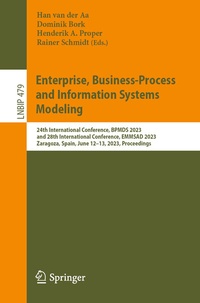
Enterprise, Business-Process and Information Systems Modeling
Description

This book contains the refereed proceedings of two long-running events held along with the CAiSE conference relating to the areas of enterprise, business-process and information systems modeling:
* the 24th International Conference on Business Process Modeling, Development and Support, BPMDS 2023, and
* the 28th International Conference on Exploring Modeling Methods for Systems Analysis and Development, EMMSAD 2023.
The conferences were taking place in Zaragoza, Spain, during June 12-13, 2023.
For BPMDS 9 full papers and 2 short papers were carefully reviewed and selected for publication from a total of 26 submissions; for EMMSAD 9 full papers and 3 short papers were accepted from 26 submissions after thorough reviews.
The BPMDS papers deal with a broad range of theoretical and applications-based research in business process modeling, development and support. EMMSAD focusses on modeling methods for systems analysis and development.
More details
Other editions
Additional editions
Content
BPMDS 2023.- Just Tell Me: Prompt Engineering in Business Process Management.- Reinforcement Learning-supported AB Testing of Business Process Improvements: An Industry Perspective.- Modelling and Execution of Data-Driven Processes with JSON-Nets.- Aligning object-centric event logs with data-centric conceptual models.- From Network Traffic Data to a business-level Event Log.- A Novel Decision Mining Method Considering Multiple Model Paths.- Modeling, Executing and Monitoring IoT-Driven Business Rules.- A Generic Approach towards Location-aware Business Process Execution.- Time-aware Contract Model for Legal Smart Contracts.- Efficient Computation of Behavioral Changes in Declarative Process Models Nicolai Schützenmeier.- Beyond Temporal Dependency: An Ontology-Based Approach to Modeling Causal Structures in Business Processes.- EMMSAD 2023 .- Principles of universal conceptual modeling.- Supporting Method Creation, Adaptation and Execution with a Low-code Approach.- IAT/ML: A Domain-Specific Approach for Discourse Analysis and Processing.- A First Validation of the Enterprise Architecture Debts Concept.- Modeling heterogeneous IT infrastructures: a collaborative component-oriented approach.- Exploring Capability Mapping as a Tool for Digital Transformation: insights from a Case Study.- TEC-MAP: a Taxonomy of Evaluation Criteria for Multi-Modeling Approaches.- Integrating Physical, Digital, and Virtual Modeling Environments in a Collaborative Design Thinking Tool.- Opportunities in Robotic Process Automation by and for Model-Driven Software Engineering.- A Requirements-Driven Framework for Automatic Data Visualization.- Comparing different visualizations for feedback on test execution in a Model-Driven Engineering environment.- Unblocking Inductive Miner - While Preserving Desirable Properties.
