

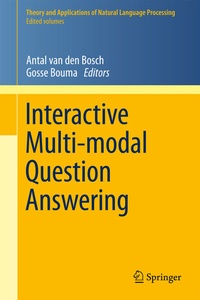
Interactive Multi-modal Question-Answering
Description

Reviews / Votes
From the reviews:
"Researchers in broad disciplines . usually conduct their research by breaking the general problem down into many small problems. . It is rare for many researchers to coordinate their efforts and demonstrate what progress has been made to solve the general problem. This book documents one such effort. . The book is a collection of chapters written by various researchers in the IMIX project. . Anyone who wants to know about the state of the art in question answering will be interested in this book." (D. L. Chester, ACM Computing Reviews, August, 2011)
More details
Other editions
Additional editions
Content
Part I Introduction to the IMIX Programme.- Introduction. Antal van den Bosch and Gosse Bouma.- IMIX: Good Questions, Promising Answers. Eduard Hovy, Jon Oberlander, and Norbert Reithinger.- The IMIX demonstrator: an information search assistant for the medical domain. Dennis Hofs and Boris van Schooten and Rieks op den Akker.- Part II Interaction Management.- Vidiam: Corpus-based Development of a Dialogue Manager for Multimodal Question Answering. Boris van Schooten and Rieks op den Akker.- Multidimensional Dialogue Management. Simon Keizer, Harry Bunt, and Volha Petukhova.- Part III Fusing Text, Speech, and Images. Experiments in Multimodal Information Presentation. Charlotte van Hooijdonk, Wauter Bosma, Emiel Krahmer, Alfons Maes, and Mariët Theune.- Text-to-text generation for question answering. Wauter Bosma, Erwin Marsi, Emiel Krahmer and Mariët Theune.- Part IV Text Analysis for Question Answering Automatic Extraction of Medical Term Variants from Mutilingual Parallel Translations. Lonneke van der Plas, Jörg Tiedemann, and Ismail Fahmi.- Relation Extraction for Open and Closed Domain Question Answering . Gosse Bouma, Ismail Fahmi, and Jori Mur.- Constraint-Satisfaction Inference for Entity Recognition. Sander Canisius, Antal van den Bosch, and Walter Daelemans.- Extraction of Hypernymy Information from Text. Erik Tjong Kim Sang, Katja Hofmann and Maarten de Rijke.-Towards a Discourse-driven Taxonomic Inference Model . Piroska Lendvai.
