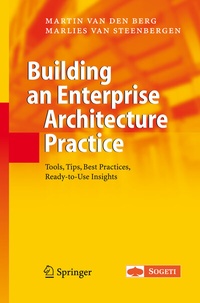
Building an Enterprise Architecture Practice
Description

Is your enterprise architecture making a difference? Does it contribute to the goals of your company? Are the architects your best paid employees? If you are striving for a full-hearted yes to these questions, this is the book for you.
Building an Enterprise Architecture Practice provides practical advice on how to develop your enterprise architecture practice. The authors developed different tools and models to support organizations in implementing and professionalizing an enterprise architecture function. The application of these tools and models in many different organizations forms the basis for this book. The result is a hands-on book that will help you to avoid certain pitfalls and achieve success with enterprise architecture.
A lot of organizations nowadays have a team of enterprise architects at work but struggle with questions like:
How do I show the added value of enterprise architecture?
How do I determine what specific architectures are necessary for my organization?
What steps do I need to take to improve my enterprise architecture practice?
How do I fulfill the role of enterprise architect?
These questions are answered in this book and illustrated with a lot of best practices.
After reading the book the reader will have a better understanding of what makes enterprise architecture successful and will possess the tools to analyse his own situation and build an enterprise architecture practice accordingly .
----------------------------------------------------------------------------------------------------
This book clearly describes how to establish an architecture practice that delivers value for an organization. The authors demonstrate a wealth of experience and a deep understanding of the multifaceted nature of this challenging task and they provide sound advice on how to avoid the many pitfalls that may be encountered along the way.
Recognising that there is no 'one-size-fits-all' approach, they show how to deploy a range of practical tools and approaches that will enable each organization to create its own road map to success. In particular, their Maturity Matrix is invaluable for balancing architecture priorities and targeting improvements. The book makes a significant contribution to the professionalization of the architect role.
Sally Bean
Enterprise Architecture Consultant
----------------------------------------------------------------------------------------------------
Too many books on enterprise architecture leave one in a state of mental fuzziness: After reading them, the reader has learned a lot of impressive words but still does not know how to design an enterprise architecture. This step by step guide to DYA is different.
It provides pragmatic guidelines for developing enterprise architecture and presents a maturity model that helps the users of DYA to state realistic goals and to outline feasible steps to achieve these goals. Particularly useful is the emphasis on a coherent enterprise architecture vision, including the value added by the architecture. I warmly recommend this book to practicing enterprise architects.
Prof. Dr. Roel Wieringa
Universiteit Twente
Reviews / Votes
"This book clearly describes how to establish an architecture practice that delivers value for an organization. The authors demonstrate a wealth of experience and a deep understanding of the multifaceted nature of this challenging task and they provide sound advice on how to avoid the many pitfalls that may be encountered along the way. Recognising that there is no 'one-size-fits-all' approach, they show how to deploy a range of practical tools and approaches that will enable each organization to create its own road map to success. In particular, their Maturity Matrix is invaluable for balancing architecture priorities and targeting improvements. The book makes a significant contribution to the professionalization of the architect role." (Sally Bean, Enterprise Architecture Consultant)
"Too many books on enterprise architecture leave one in a state of mental fuzziness: After reading them, the reader has learned a lot of impressive words but still does not know how to design an enterprise architecture. This step by step guide to DYA is different. It provides pragmatic guidelines for developing enterprise architecture and presents a maturity model that helps the users of DYA to state realistic goals and to outline feasible steps to achieve these goals. Particularly useful is the emphasis on a coherent enterprise architecture vision, including the value added by the architecture. I warmly recommend this book to practicing enterprise architects." (Prof. Dr. Roel Wieringa, Universiteit Twente)
More details
Other editions
Additional editions