

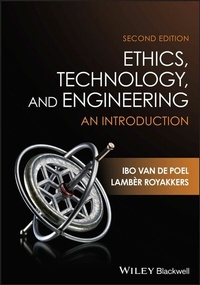
Ethics, Technology, and Engineering
Description

Explore the moral and ethical issues which arise at the intersection of novel technology and engineering
In Ethics, Technology, and Engineering: An Introduction, a team of distinguished researchers delivers an insightful and thought-provoking exploration of some of the toughest ethical questions found at the crossroads of engineering and technology. The book demonstrates the skills necessary to effectively grapple with ethical issues that arise from the practice of engineering.
The authors introduce the "ethical cycle," a unique and systematic approach to dealing with ethical problems. They utilize numerous real-life case studies from the United States, Europe, and elsewhere to shed important light on the ethical issues that arise in the daily work of practicing engineers. They also provide a comprehensive overview of various ethical frameworks used in engineering, including utilitarianism, deontological ethics, virtue ethics, Ubuntu, and Confucianism.
Readers will also find:
- A thorough introduction to a practice-oriented approach to ethical decision-making in engineering
- Comprehensive explorations of the "ethical cycle," an approach that encourages students to consider a diversity of ethical viewpoints and come to reasoned and justified judgments
- Practical discussions of ethical issues in engineering design, technological risks, and moral responsibility
- Treatments of sustainability and how it affects professionals working in engineering, as well as responsible innovation
Perfect for engineers, technologists, and entrepreneurs, Ethics, Technology, and Engineering: An Introduction will also benefit businesspeople and founders interested in the ethical implications of a variety of fascinating new technologies.
More details
Other editions
Additional editions
Persons
Ibo van de Poel is the Anthoni van Leeuwenhoek Professor in Ethics and Technology in the Faculty of Technology, Policy and Management at Delft University of Technology. His research is focused on the ethics of new technologies, design for values and responsible innovation.
Lambèr Royakkers is a Professor in Ethics and Technology in the School of Innovation Sciences at Eindhoven University of Technology. His research is focused on the ethical issues of digitization. He is the co-author of Just Ordinary Robots.
Content
Acknowledgments x
Introduction 1
1 The Responsibilities of Engineers 6
2 Codes of Conduct 37
3 Normative Ethics 70
4 The Ethical Cycle 121
5 Design for Values 145
6 Ethical Aspects of Technical Risks 182
7 The Distribution of Responsibility in Engineering 213
8 Sustainability, Ethics, and Technology 241
9 Responsible Innovation 265
Appendix I: Engineering Qualifications and Organizations in a Number of Countries 294
Appendix II: NSPE Code of Ethics for Engineers 301
Appendix III: ENGINEERS EUROPE Position Paper on Code of Conduct: Ethics and Conduct of Professional Engineers 306
Appendix IV: Examples of Corporate Codes of Conduct 308
Appendix V: DSM Alert Royal DSM Whistleblower Policy 314
Appendix VI: Cases 321
References 336
Index of Cases 352
Index 353
