

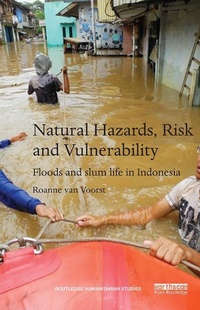
Natural Hazards, Risk and Vulnerability
Floods and slum life in Indonesia
1st Edition
Published on 5. February 2016
178 pages
978-1-317-50692-8 (ISBN)
Description

Different people handle risk in different ways. The current lack of understanding about this heterogeneity in risk behaviour makes it difficult to intervene effectively in risk-prone communities.
Natural Hazards, Risk and Vulnerability offers a unique insight in the everyday life of a group of riverbank settlers in Jakarta - one of the most vulnerable areas worldwide in terms of exposure to natural hazards. Based on long-term fieldwork, the book portrays the often creative and innovative ways in which slum dwellers cope with recurrent floods. The book shows that behaviour that is often described as irrational or ineffective by outside experts can be highly pragmatic and often effective. This book argues that human risk behaviour cannot be explained by the risk itself, but instead by seemingly unrelated factors such as trust in authorities and aid-institutions and unequal power structures. By considering a risk as a lens that exposes these factors, a completely new type of analysis is proposed that offers useful insights for everyone concerned about how people cope with the currently increasing amount of natural hazard.
This is a valuable resource for academics, researchers and policy makers in the areas of risk studies, disaster and natural hazard, urban studies, anthropology, development, Southeast Asian studies and Indonesia studies.
Natural Hazards, Risk and Vulnerability offers a unique insight in the everyday life of a group of riverbank settlers in Jakarta - one of the most vulnerable areas worldwide in terms of exposure to natural hazards. Based on long-term fieldwork, the book portrays the often creative and innovative ways in which slum dwellers cope with recurrent floods. The book shows that behaviour that is often described as irrational or ineffective by outside experts can be highly pragmatic and often effective. This book argues that human risk behaviour cannot be explained by the risk itself, but instead by seemingly unrelated factors such as trust in authorities and aid-institutions and unequal power structures. By considering a risk as a lens that exposes these factors, a completely new type of analysis is proposed that offers useful insights for everyone concerned about how people cope with the currently increasing amount of natural hazard.
This is a valuable resource for academics, researchers and policy makers in the areas of risk studies, disaster and natural hazard, urban studies, anthropology, development, Southeast Asian studies and Indonesia studies.
Reviews / Votes
"Riverbank settlers in Jakarta face risk every day and, what Roanne van Voorst refers to as, 'normal uncertainty'. Power relations can drive this risk and people have developed strategies in order to deal with nature and the powerful elite. Readers of this highly informative book will have greater understanding and compassion the next time they see media coverage of bulldozers pulling down houses." - Ben Wisner, UCL Hazard Research Centre, University College London, UK"Uncovering just how differently people behave and why they behave differently in a crisis is the central concern of this study of a flood-prone community in Jakarta. Finding theory in daily life, Roanne Voorst has written a masterful work of discovery, analysis and empathy." - Greg Bankoff, University of Hull, UK
"This book is an outstanding account of how poor people strategize, in the confines of the limited resources at hand, to deal with recurring disaster. It conveys a powerful message to politicians and aid programmes about the crucial importance to build policy and intervention on grounded research into people's everyday realities." - Dorothea Hilhorst, professor of humanitarian aid and reconstruction at the International Institute of Social Studies of Erasmus University Rotterdam, the Netherlands.
"This book fills strategic gaps in disaster studies, showing how vulnerable people see risks as part of regular life experiences. The author shows how the diversity of coping strategies reflects people's responses to existing structural constraints and their own agency. The book is excellently written and will appeal to academics, professionals and the wider public." - I.S.A. Baud, University of Amsterdam, the Netherlands and President of the European Association of Development Institutes (EADI), Germany
''For these impoverished slum dwellers, flood risk is not a one-off natural disaster but a normal part of their daily struggle to survive. Roanne van Voorst's 'thick' account of their lives is peopled with unforgettable characters and written in a fluid, literary style. I found it deeply moving.'' - Gerry van Klinken, University of Amsterdam, senior researcher KITLV Leiden, The Netherlands
"This is an innovative book about the urban poor that challenges simple categorizations. Based on fieldwork under very difficult circumstances, Roanne van Voorst applies a view from below which foregrounds the agency and the heterogeneity of various groups of people who try to determine their future." - Henk Schulte Nordholt, KITLV/Leiden University, The Netherlands
More details
Series
Edition
1. Auflage
Language
English
Place of publication
London
United Kingdom
Publishing group
Taylor & Francis Ltd
Target group
College/higher education
Illustrations
3 s/w Abbildungen, 3 s/w Zeichnungen
3 Line drawings, black and white; 3 Illustrations, black and white
File size
1,41 MB
ISBN-13
978-1-317-50692-8 (9781317506928)
Copyright in bibliographic data and cover images is held by Nielsen Book Services Limited or by the publishers or by their respective licensors: all rights reserved.
Schweitzer Classification
Other editions
Additional editions
Book
12/2017
1st Edition
Routledge
€76.00
Shipment within 15-20 days
Book
02/2016
1st Edition
Routledge
€232.70
Shipment within 10-20 days
Person
Roanne van Voorst is a postdoctoral researcher and lecturer in the Anthropology of Development at the University of Amsterdam, The Netherlands.
Content
Introduction: Get Ready for the Flood! 1. Doing research in Bantaran Kali 2. Orang antisipasi: an autonomous & licit business 3. Orang ajar: cooperation with the government 4. Orang susah: dependent of aid 5. Orang siap: challenging the government, altering structures Conclusion
