

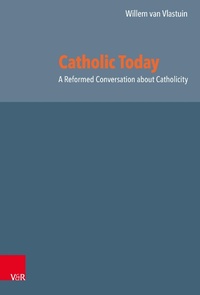
Catholic Today
A Reformed Conversation about Catholicity
1st Edition
Published on 11. May 2020
252 pages
978-3-647-54081-8 (ISBN)
Description

What is the real meaning of the church for Christian life? If we confess Christian faith, the church is one of the twelve articles, which implies that the church is rather important. In the creeds of the early church catholicity is confessed as characteristic for the church. This means that the church cannot exist without catholicity. What does this qualification mean? In this study the author listens to the understanding of the concept of catholicity in the theology of Ignatius, Cyprian, Cyril, Augustine and Vincent. In the second part of the book some representatives of the reformed tradition are analyzed, namely John Calvin, James Ussher, John Owen, Herman Bavinck and Gerrit Berkouwer. This analysis leads to a comparison between the early church and the reformed tradition. Listening to theologians from the early church and the reformed tradition, Van Vlastuin presents an up-to-date concept of the catholicity of the church which clarifies among others that the visibility of the church belongs to the essence of Christ's body, that practicing the catholicity of the church is necessary against denominationalism and party formation, that loss of catholicity leads to spiritual and theological impoverishment, that the understanding of catholicity implies also orthodoxy with consequences for the interpretation of 'semper reformanda' and that the consciousness of catholicity is related to the citizenship of two worlds.
More details
Other editions
Additional editions
Book
05/2020
1st Edition
Vandenhoeck & Ruprecht
from
€140.00
Shipment within 5-7 days
Person
Willem van Vlastuin is professor of Theology and Spirituality of Reformed Protestantism at Vrije Universiteit Amsterdam and dean of the Hersteld Hervormd Seminary there.
Content
- Intro
- Title page
- Copyright
- Table of contents
- Body
- Contents
- Introduction
- A. Historical part. Catholicity in the Early Church
- 1. Ignatius (ca. 35-107)
- 1.1 The epistle to Smyrna
- 1.2 One Christ
- 1.3 The visible church
- 1.4 Assessment
- 2. Cyprian (ca. 205-258)
- 2.1 Bishop of Carthage
- 2.2 One Christ
- 2.3 Spirit, baptism and orthodoxy
- 2.4 Assessment
- 3. Cyril (ca. 315-386)
- 3.1 Catechetical lectures
- 3.2 Catholicity comprises the whole world
- 3.3 Catholicity comprises all doctrines
- 3.4 Catholicity comprises all categories of people
- 3.5 Catholicity comprises the remission of all sins
- 3.6 Catholicity comprises all virtues
- 3.7 Assessment
- 4. Augustine (354-430)
- 4.1 Confrontation with Donatism
- 4.2 The universality of the church
- 4.3 The church as a community of sinners
- 4.4 The church as the body of Christ
- 4.5 The church as the temple of the Holy Spirit
- 4.6 Assessment
- 5. Vincent (┼ between 434 and 450)
- 5.1 Commonitorium
- 5.2 Catholicity as normative
- 5.3 Catholicity as identity
- 5.4 Assessment
- Review and reflection
- a. Difference and development
- b. The body of Christ
- c. One Christ
- d. Whole body and individual
- e. Spirit, baptism and orthodoxy
- f. Being a holy stranger and pilgrim
- B. Historical part. Catholicity in the Reformed Tradition
- 6. John Calvin (1509-1564)
- 6.1 From person to church
- 6.2 Called to unity
- 6.3 Orthodox besides the mediaeval church
- 6.4 Anonymous catholicity
- 6.5 Assessment
- 7. Confessional intermezzo
- 7.1 The Belgic Confession of Faith (1561)
- 7.2 The Heidelberg Catechism (1563)
- 7.3 The Second Helvetic Confession (1566)
- 7.4 The Westminster Confession (1647)
- 7.5 Assessment
- 8. James Ussher (1581-1656)
- 8.1 One Christ
- 8.2 From visible to invisible
- 8.3 An orthodox Christ
- 8.4 Spirit, baptism and offices
- 8.5 Assessment
- 9. John Owen (1616-1683)
- 9.1 From invisible to visible
- 9.2 Pluriform unity
- 9.3 Orthodoxy
- 9.4 Spirit, baptism and offices
- 9.5 Assessment
- 10. Herman Bavinck (1854-1921)
- 10.1 Catholic despite discord
- 10.2 The cosmic Christ
- 10.3 Assessment
- 11. Gerrit Cornelis Berkouwer (1903-1996)
- 11.1 One Christ
- 11.2 Qualitative catholicity
- 11.3 Assessment
- Review and Reflection
- a. Difference and development
- b. The body of Christ
- c. One Christ
- d. Whole body and individual
- e. Spirit, baptism and orthodoxy
- f. Being a holy stranger and pilgrim
- C. Systematic part
- 12. Catholicity as a term
- 12.1 The use of the term 'catholic'
- 12.2 Qualitative catholicity
- 12.3 Universal, but not common
- 13. The body of Christ
- 13.1 The body of the living Christ
- 13.2 Confession of the living Christ
- 13.3 The church is Christologically determined
- 14. One Christ
- 14.1 Catholicity breaks through borders
- 14.2 From church to denomination
- 14.3 Ten Times Reformed
- 14.4 Exploration concerning the covenant
- 14.5 No simple solution
- 15. Whole body and individual
- 15.1 A living member in Christ's church
- 15.2 Re-appraisal of the tradition
- 15.3 Old is better
- 16. Spirit, baptism and orthodoxy
- 16.1 The indwelling of the Spirit
- 16.2 Reformed exclusivity
- 16.3 Reformed 2.0
- 16.4 Ecclesia reformata semper reformanda
- 17. Being a holy stranger and pilgrim
- 17.1 Forgiveness of all sins
- 17.2 All virtues
- 17.3 Citizen of two worlds
- Bibliography
