

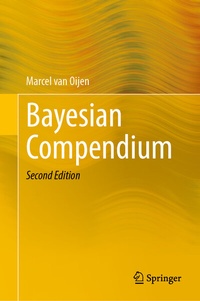
Bayesian Compendium
Description

This book describes how Bayesian methods work. Aiming to demystify the approach, it explains how to parameterize and compare models while accounting for uncertainties in data, model parameters and model structures. Bayesian thinking is not difficult and can be used in virtually every kind of research. How exactly should data be used in modelling? The literature offers a bewildering variety of techniques (Bayesian calibration, data assimilation, Kalman filtering, model-data fusion, .). This book provides a short and easy guide to all these approaches and more. Written from a unifying Bayesian perspective, it reveals how these methods are related to one another. Basic notions from probability theory are introduced and executable R codes for modelling, data analysis and visualization are included to enhance the book's practical use. The codes are also freely available online.
This thoroughly revised second edition has separate chapters on risk analysis and decision theory. It also features an expanded text on machine learning with an introduction to natural language processing and calibration of neural networks using various datasets (including the famous iris and MNIST). Literature references have been updated and exercises with solutions have doubled in number.
More details
Other editions
Additional editions
Previous edition
Person
Marcel van Oijen studied mathematical biology at the University of Utrecht. He completed his PhD in plant disease epidemiology at Wageningen University, where he worked on modelling the impacts of environmental change on crops. He moved to the U.K. in 1999, becoming a Senior Scientist at the Natural Environment Research Council. There he focused on the use of Bayesian methods in the modelling of ecosystem services provided by grasslands, forests and agroforestry systems. He now works as an independent scientist and as such has written two books: Bayesian Compendium (first edition in 2020) and Probabilistic Risk Analysis and Bayesian Decision Theory (2022).
Content
- 1. Science and Uncertainty.- 2. Bayesian Inference.- 3. Assigning a Prior Distribution.- 4. Assigning a Likelihood Function.- 5. Deriving the Posterior Distribution.- 6. Markov Chain Monte Carlo Sampling (MCMC).- 7. Sampling from the Posterior Distribution by MCMC.- 8. MCMC and Multivariate Models.- 9. Bayesian Calibration and MCMC: Frequently Asked Questions.- 10. After the Calibration: Interpretation, Reporting, Visualisation.- 11. Model Ensembles: BMC and BMA.- 12. Discrepancy.- 13. Approximations to Bayes.- 14.Thirteen Ways to Fit a Straight Line.- 15. Gaussian Processes and Model Emulation.- 16. Graphical Modelling.- 17. Bayesian Hierarchical Modelling.- 18. Probabilistic Risk Analysis.- 19. Bayesian Decision Theory.- 20. Linear Modelling: LM, GLM, GAM and Mixed Models.- 21. Machine Learning.- 22. Time Series and Data Assimilation.- 23. Spatial Modelling and Scaling Error.- 24. Spatio-Temporal Modelling and Adaptive Sampling.- 25. What Next?.
