

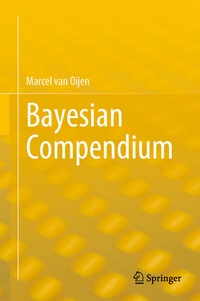
Bayesian Compendium
Description

This book describes how Bayesian methods work. Its primary aim is to demystify them, and to show readers: Bayesian thinking isn't difficult and can be used in virtually every kind of research. In addition to revealing the underlying simplicity of statistical methods, the book explains how to parameterise and compare models while accounting for uncertainties in data, model parameters and model structures.
How exactly should data be used in modelling? The literature offers a bewildering variety of techniques and approaches (Bayesian calibration, data assimilation, Kalman filtering, model-data fusion, etc). This book provides a short and easy guide to all of these and more. It was written from a unifying Bayesian perspective, which reveals how the multitude of techniques and approaches are in fact all related to one another. Basic notions from probability theory are introduced. Executable code examples are included to enhance the book's practical use for scientific modellers, and all code is available online as well.
Reviews / Votes
"The writing is succinct and easy to understand. . The book does cover a wide range of topics in Bayesian science, and that is indeed one of its best features. I do see it serving as a starting point for most non statistically minded researchers, who can get a basic idea about their topic of interest from consulting the book, and then consult references provided to get a more in-depth knowledge. Overall, I do congratulate the author on writing this book." (Sayan Dasgupta, Biometrics, Vol. 78 (2), July, 2022)More details
Other editions
New editions
Additional editions
Person
Marcel van Oijen studied Mathematical Biology at the University of Utrecht and completed his PhD in Plant Disease Epidemiology at Wageningen University, where he subsequently worked on modelling the impacts of environmental change on crops. He is currently a Senior Scientist at the UK's Natural Environment Research Council, focusing on the use of Bayesian methods in the modelling of ecosystem services provided by grasslands, forests and agroforestry systems.
