

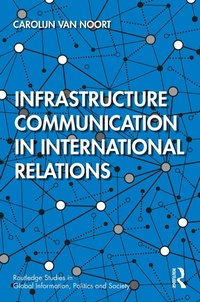
Infrastructure Communication in International Relations
1st Edition
Published on 9. November 2020
154 pages
978-1-000-20582-4 (ISBN)
Description

This book demonstrates how infrastructure projects and the communications thereof are strategized by rising powers to envision progress, to enhance the actor's international identity, and to substantiate and leverage the actor's vision of international order. While the physical aspects of infrastructure are important, infrastructure communication in international relations demands more scholarly attention.
Using a case-study approach, Carolijn van Noort examines how rising powers communicate about infrastructure internationally and discusses the significance of these communication practices. The four case studies include BRICS's summit communications about infrastructure, Brazil's infrastructure promises to Africa, China's communication of the Belt and Road Initiative in East Africa, and Kazakhstan's news media coverage of China's Belt and Road Initiative. Van Noort highlights the fact that the link between infrastructure, identity, and order-making is arbitrary and thus contested in practice, with rising powers operationalizing infrastructure communication in international relations in varied ways. She argues that both communication organization and the visuality of strategic narratives on infrastructure influence the international communication of infrastructure vision and action plans, with different levels of success.
Infrastructure Communication in International Relations is a welcome and timely book of interest to students and scholars in the fields of international relations, global communications, and the politics of infrastructure.
Using a case-study approach, Carolijn van Noort examines how rising powers communicate about infrastructure internationally and discusses the significance of these communication practices. The four case studies include BRICS's summit communications about infrastructure, Brazil's infrastructure promises to Africa, China's communication of the Belt and Road Initiative in East Africa, and Kazakhstan's news media coverage of China's Belt and Road Initiative. Van Noort highlights the fact that the link between infrastructure, identity, and order-making is arbitrary and thus contested in practice, with rising powers operationalizing infrastructure communication in international relations in varied ways. She argues that both communication organization and the visuality of strategic narratives on infrastructure influence the international communication of infrastructure vision and action plans, with different levels of success.
Infrastructure Communication in International Relations is a welcome and timely book of interest to students and scholars in the fields of international relations, global communications, and the politics of infrastructure.
Reviews / Votes
"In this fascinating study, Carolijn van Noort explores the communication strategies of Brazil and China in international affairs, through an in-depth study of major international infrastructure projects. Van Noort argues that rising powers seek to enhance their status in international affairs, to articulate their vision for the emerging international order, and thereby to enhance their power and influence, through their strategic narratives of infrastructure politics. This will be required reading for those wishing to understand the importance of international political communication in the emerging international order."Alister Miskimmon, Queen's University Belfast
"Though a series of meticulously researched case studies, Carolijn van Noort convincingly demonstrates how emerging state powers strategically use textual and visual narratives to advance their interests and their standing in international politics."
Roland Bleiker, University of Queensland
"Carolijn van Noort provides an original and innovative reading on the politics of infrastructures. Focusing on rising powers, she powerfully demonstrates the intertwinement of material, narrative, and aspirational aspects of infrastructures, and masterfully analyses strategic communication on infrastructure development and the contestations that spin around the promise of progress, the formation of political identities, and the discursive making of international order. A must-read."
Jutta Bakonyi, University of Durham
"Infrastructure stands at the center stage of international politics today. Carolijn Van Noort's book addresses the very important question of how rising powers use strategic communications to promote their infrastructure initiatives, with the aim of burnishing their image and influence abroad. With the use of case studies on China, the BRICS countries, and Kazakhstan, van Noort skillfully brings us through the diverse ways in which infrastructure communication is operationalized and received in target countries, and assesses the success and failure of these narrative strategies. A must-read for students and researchers interested in current affairs and strategic communications."
Selina Ho, National University of Singapore
More details
Series
Edition
1. Auflage
Language
English
Place of publication
London
United Kingdom
Publishing group
Taylor & Francis Ltd
Target group
College/higher education
Illustrations
4 Tables, black and white
ISBN-13
978-1-000-20582-4 (9781000205824)
Copyright in bibliographic data and cover images is held by Nielsen Book Services Limited or by the publishers or by their respective licensors: all rights reserved.
Schweitzer Classification
Other editions
Additional editions
Carolijn van Noort
Infrastructure Communication in International Relations
Book
05/2022
1st Edition
Routledge
€65.10
Shipment within 15-20 days
Carolijn van Noort
Infrastructure Communication in International Relations
Book
11/2020
1st Edition
Routledge
€205.80
Shipment within 15-20 days
Person
Carolijn van Noort is a Lecturer in Politics and Public Policy in the School of Education and Social Sciences at the University of the West of Scotland, UK. In 2018, she obtained her PhD from the University of Otago, New Zealand. Her research interests include strategic narratives, rising powers, and the politics of infrastructure.
Content
1. Strategic Narratives on Infrastructure 2. BRICS and Infrastructure 3. Brazil, Africa, and Infrastructure 4. China, East Africa, and the Belt and Road Initiative 5. Kazakhstan, China, and the Belt and Road Initiative 6. Conclusion
