

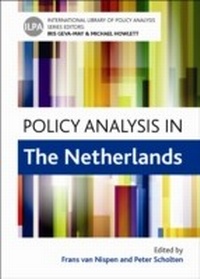
Policy Analysis in the Netherlands
1st Edition
Published on 26. November 2014
368 pages
978-1-4473-1334-2 (ISBN)
Description

This comprehensive study, part of the International Library of Policy Analysis, edited by Iris Geva-May and Michael Howlett, brings together for the first time a systemic overview of policy analysis activities in the Netherlands. The Netherlands is internationally regarded as one of the front-runners of policy analysis and evaluation in Europe. This book provides a much-needed overview of developments in policy analysis in both academia and practice at various levels of governance. It brings together contributions from key scholars as well as from professionals in the field. The book captures the diversity of modes of policy analysis which have evolved since the 1970s. Above all, it provides an overview of the current state of affairs and is, as such, suitable for anyone who is interested in governance and performance.
Features of the ILPA series include:
* a systematic study of policy analysis systems by government and non-governmental actors
* a history of the country's policy analysis, empirical case studies and a comparative overview
* a key reference collection for research and teaching in comparative policy analysis and policy studies
Features of the ILPA series include:
* a systematic study of policy analysis systems by government and non-governmental actors
* a history of the country's policy analysis, empirical case studies and a comparative overview
* a key reference collection for research and teaching in comparative policy analysis and policy studies
Reviews / Votes
"The book offers a wealth of material for comparative policy analysis scholars." Asia Pacific Journal of Public Administration "This book is useful not only to policy analysts in the Netherlands but to readers across the globe who are looking for diverse models of the policy analysis enterprise. The interrelationship between the academic and practice aspects of the field in the Dutch setting is very important and instructive to readers." Beryl Radin, Georgetown University "Perhaps more so than in any other country, professional policy analysis has been institutionalized and integrated into policy making in The Netherlands. The distinguished contributors provide a rich and fascinating account of this integration and speculate on its viability in the face of changing politics." David L. Weimer, University of Wisconsin-Madison "The contributions to the volume reflect the fact that much of policy analysis appears to be in a productive state of multidisciplinary turmoil. Thoughtful students and practitioners of policy analysis, whether situated in universities, public agencies, or independent centers of research, will want to have this distinguished volume in their libraries." Professor William Dunn, University of PittsburghMore details
Series
Edition
First Edition
Language
English
Place of publication
Bristol
United Kingdom
Publishing group
Bristol University Press
Target group
Professional and scholarly
Illustrations
19 s/w Abbildungen, 13 s/w Tabellen
13 Tables, black and white; 19 Illustrations, black and white
ISBN-13
978-1-4473-1334-2 (9781447313342)
DOI
https://doi.org/10.51952/9781447313342
Copyright in bibliographic data and cover images is held by Nielsen Book Services Limited or by the publishers or by their respective licensors: all rights reserved.
Schweitzer Classification
Other editions
Additional editions
Frans van Nispen | Peter Scholten
Policy Analysis in the Netherlands
E-Book
03/2018
1st Edition
Policy Press
€68.49
Available for download
Frans van Nispen | Peter Scholten
Policy Analysis in the Netherlands
Book
11/2014
1st Edition
Policy Press
€141.80
Shipment within 15-20 days
Persons
Peter Scholten is Associate Professor of Public Policy & Politics at the Erasmus University Rotterdam.
Frans van Nispen is currently Associate Professor of Public Administration at the Erasmus University Rotterdam, having worked previously as policy analyst for the Dutch government.
Frans van Nispen is currently Associate Professor of Public Administration at the Erasmus University Rotterdam, having worked previously as policy analyst for the Dutch government.
Content
One: Policy analysis in the Netherlands: an introduction ~ Frans van Nispen and Peter Scholten;
Part One: Policy styles and modes of policy analysis;
Two: Policy analysis in practice: reinterpreting the quest for evidence-based policy ~ Mark van Twist, Rien Rouw and Martijn van der Steen;
Three: Policy analysis in networks: the battle of analysis and the potentials of joint fact-finding ~ Arwin van Buuren and Joop Koppenjan;
Four: Patterns of science-policy interaction ~ Robert Hoppe;
Five: Interpretive policy analysis in the Netherlands ~ Severine van Bommel, Merlijn van Hulst and Dvora Yanow;
Part Two: Policy analysis in government;
Six: Policy analysis and evaluation in national government ~ Frans van Nispen;
Seven: Policy analysis at the local government level ~ Frank Hilterman and Henk Klaassen;
Eight: Policy analysis and performance audit at the 'highest level': looking for evidence and responsiveness ~ Peter van der Knaap;
Part Three: Advisory boards, consultancy firms, research institutes and think tanks;
Nine: Advisory boards and planning bureaus ~ Peter Scholten and Frans van Nispen;
Ten: The Dutch policy research industry ~ Peter van Hoesel;
Part Four: Policy analysis in politics and by interest groups in society;
Eleven: Policy analysis in the Dutch Parliament ~ Karin Zaal;
Twelve: Policy analysis and political party think tanks ~ Arco Timmermans, Edwin van Rooyen and Gerrit Voerman;
Thirteen: Policy analysis by negotiation: trade unions, employers' organisations and the Social and Economic Council ~ Menno Fenger and Pierre Koning;
Part Five: Policy analysis in the academic world;
Fourteen: Policy analysis as instruction ~ Wil Thissen;
Fifteen: Contested knowledge in theory-driven policy analysis: setting the Dutch stage ~ Victor Bekkers;
Part Six: Conclusion;
Sixteen Institutionalisation and performance of policy analysis and evaluation in the Netherlands ~ Peter Scholten and Frans van Nispen;
Part One: Policy styles and modes of policy analysis;
Two: Policy analysis in practice: reinterpreting the quest for evidence-based policy ~ Mark van Twist, Rien Rouw and Martijn van der Steen;
Three: Policy analysis in networks: the battle of analysis and the potentials of joint fact-finding ~ Arwin van Buuren and Joop Koppenjan;
Four: Patterns of science-policy interaction ~ Robert Hoppe;
Five: Interpretive policy analysis in the Netherlands ~ Severine van Bommel, Merlijn van Hulst and Dvora Yanow;
Part Two: Policy analysis in government;
Six: Policy analysis and evaluation in national government ~ Frans van Nispen;
Seven: Policy analysis at the local government level ~ Frank Hilterman and Henk Klaassen;
Eight: Policy analysis and performance audit at the 'highest level': looking for evidence and responsiveness ~ Peter van der Knaap;
Part Three: Advisory boards, consultancy firms, research institutes and think tanks;
Nine: Advisory boards and planning bureaus ~ Peter Scholten and Frans van Nispen;
Ten: The Dutch policy research industry ~ Peter van Hoesel;
Part Four: Policy analysis in politics and by interest groups in society;
Eleven: Policy analysis in the Dutch Parliament ~ Karin Zaal;
Twelve: Policy analysis and political party think tanks ~ Arco Timmermans, Edwin van Rooyen and Gerrit Voerman;
Thirteen: Policy analysis by negotiation: trade unions, employers' organisations and the Social and Economic Council ~ Menno Fenger and Pierre Koning;
Part Five: Policy analysis in the academic world;
Fourteen: Policy analysis as instruction ~ Wil Thissen;
Fifteen: Contested knowledge in theory-driven policy analysis: setting the Dutch stage ~ Victor Bekkers;
Part Six: Conclusion;
Sixteen Institutionalisation and performance of policy analysis and evaluation in the Netherlands ~ Peter Scholten and Frans van Nispen;
