

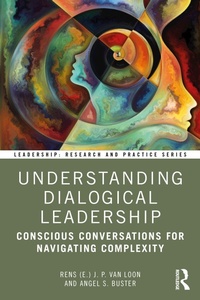
Understanding Dialogical Leadership
Conscious Conversations for Navigating Complexity
1st Edition
Published on 25. August 2025
212 pages
978-1-040-39898-2 (ISBN)
Description

Understanding Dialogical Leadership emphasizes the power of dialogue, self-reflection, and shared decision-making in navigating the complexities of collaborative leadership, especially in the face of evolving challenges in modern life.
The book underscores the importance of being conscious and open to diverse perspectives. The four pillars of dialogical leadership, which form the foundation of its philosophy, focus on flexible application of internal and external dialogues, self-awareness in leadership roles, proactive interchange of influence styles, and creating conditions for meaningful dialogues. A dialogue approach can provide answers to critical questions and wicked issues in the contemporary world, such as the balance between intellect and wisdom in the age of advanced technologies. The book positions dialogue as a dynamic force that brings people together, fostering an environment where valuable insights can emerge. The authors intertwine the ideas of Yuval Harari, David Bohm, Kenneth Gergen, Hubert Hermans, and other leadership authorities, highlighting the importance of relational reflection, with the practice of self-observation, meta-consciousness, and meditation. The objective is to create a collaborative and empowering environment that fosters innovation, trust, and the well-being of others.
Transcending traditional leadership models by acknowledging the need for adaptability, self-awareness, and open communication, and including a chapter on dialogical leadership and artificial intelligence, this book encourages leaders to engage in conversations that bridge diverse perspectives and foster a deeper understanding of the self in a relational world and the complex challenges faced by humanity. It will appeal to leaders, coaches, and HR professionals, as well as those studying and looking to develop leadership.
The book underscores the importance of being conscious and open to diverse perspectives. The four pillars of dialogical leadership, which form the foundation of its philosophy, focus on flexible application of internal and external dialogues, self-awareness in leadership roles, proactive interchange of influence styles, and creating conditions for meaningful dialogues. A dialogue approach can provide answers to critical questions and wicked issues in the contemporary world, such as the balance between intellect and wisdom in the age of advanced technologies. The book positions dialogue as a dynamic force that brings people together, fostering an environment where valuable insights can emerge. The authors intertwine the ideas of Yuval Harari, David Bohm, Kenneth Gergen, Hubert Hermans, and other leadership authorities, highlighting the importance of relational reflection, with the practice of self-observation, meta-consciousness, and meditation. The objective is to create a collaborative and empowering environment that fosters innovation, trust, and the well-being of others.
Transcending traditional leadership models by acknowledging the need for adaptability, self-awareness, and open communication, and including a chapter on dialogical leadership and artificial intelligence, this book encourages leaders to engage in conversations that bridge diverse perspectives and foster a deeper understanding of the self in a relational world and the complex challenges faced by humanity. It will appeal to leaders, coaches, and HR professionals, as well as those studying and looking to develop leadership.
More details
Series
Edition
1. Auflage
Language
English
Place of publication
London
United Kingdom
Publishing group
Taylor & Francis Ltd
Target group
College/higher education
Professional and scholarly
Illustrations
12 Line drawings, color; 8 Line drawings, black and white; 3 Halftones, black and white; 12 Illustrations, color; 11 Illustrations, black and white
File size
4,16 MB
ISBN-13
978-1-040-39898-2 (9781040398982)
Copyright in bibliographic data and cover images is held by Nielsen Book Services Limited or by the publishers or by their respective licensors: all rights reserved.
Schweitzer Classification
Other editions
Additional editions
Rens (E.) J. P. van Loon | Angel S. Buster
Understanding Dialogical Leadership
Conscious Conversations for Navigating Complexity
Book
08/2025
1st Edition
Routledge
€223.10
Shipment within 10-20 days
Rens (E.) J. P. van Loon | Angel S. Buster
Understanding Dialogical Leadership
Conscious Conversations for Navigating Complexity
Book
08/2025
1st Edition
Routledge
€76.00
Shipment within 10-20 days
Persons
Rens (E.) J. P. van Loon is Emeritus Professor of Dialogical Leadership at the Tilburg School of Humanities and Digital Sciences (TSHD) in the Department of Philosophy (Ethics of Profession and Organization) at Tilburg University, the Netherlands. Currently he teaches in several courses at TIAS, the Tilburg University Business School. Since 2018, he has been working from his consulting office &Dialogue. In his consultancy work, he guides individuals, leaders, and their teams and organizations in developing and implementing ambitions in the field of leadership and change.
Angel S. Buster has a private psychotherapy and coaching practice in the Netherlands where she works with individuals, couples, and groups. She is trained as a somatic psychotherapist, existential psychologist, trauma therapist, and health researcher. Her coaching practice includes working with individuals and leaders during times of transition and crisis to help restore connection to self, others, and society. In addition to her current roles, she has worked extensively in the past in a variety of organizational settings as leadership consultant, educator, and facilitator.
Angel S. Buster has a private psychotherapy and coaching practice in the Netherlands where she works with individuals, couples, and groups. She is trained as a somatic psychotherapist, existential psychologist, trauma therapist, and health researcher. Her coaching practice includes working with individuals and leaders during times of transition and crisis to help restore connection to self, others, and society. In addition to her current roles, she has worked extensively in the past in a variety of organizational settings as leadership consultant, educator, and facilitator.
Content
1. Always in Dialogue
2. Dialogical Self Applied to Leadership
3. Forms of Conversation
4. Transforming
5. 'Boiling Rice in Still Water'
Epilogue: Dialogical Leadership and Artificial Intelligence
2. Dialogical Self Applied to Leadership
3. Forms of Conversation
4. Transforming
5. 'Boiling Rice in Still Water'
Epilogue: Dialogical Leadership and Artificial Intelligence
