

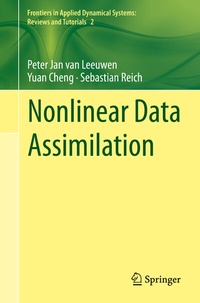
Nonlinear Data Assimilation
Description

The first contribution by Jan van Leeuwen focuses on the potential of proposal densities. It discusses the issues with present-day particle filters and explorers new ideas for proposal densities to solve them, converging to particle filters that work well in systems of any dimension, closing the contribution with a high-dimensional example. The second contribution by Cheng and Reich discusses a unified framework for ensemble-transform particle filters. This allows one to bridge successful ensemble Kalman filters with fully nonlinear particle filters, and allows a proper introduction of localization in particle filters, which has been lacking up to now.
Reviews / Votes
"In the present volume two solutions are presented to deal with high-dimensional systems, where both methods start from 'particle filters', i.e., from sequential Monte Carlo methods in which the samples are called 'particles'. . The volume, containing many figures and references, can be recommended to readers interested in the design and application of data assimilation algorithms." (Kurt Marti, zbMATH 1330.62004, 2016)
More details
Other editions
Additional editions
Persons
Peter Jan van Leeuwen is a Professor of Data Assimilation at the University of Reading. His research interests include nonlinear data assimilation, geophysical fluid dynamics, interaction thermohaline and wind-driven ocean circulation, and perturbation theory.
Sebastian Reich is a Professor in the Department of Numerical Mathematics at Universität Potsdam. His research interests include uncertainty quantification, geophysical fluid dynamics, molecular dynamics, and geometric integration.
