

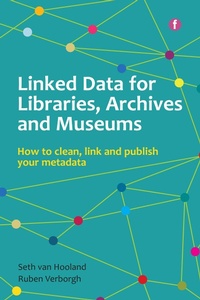
Linked Data for Libraries, Archives and Museums
Description

This highly practical handbook teaches you how to unlock the value of your existing metadata through cleaning, reconciliation, enrichment and linking and how to streamline the process of new metadata creation.
Libraries, archives and museums are facing up to the challenge of providing access to fast growing collections whilst managing cuts to budgets. Key to this is the creation, linking and publishing of good quality metadata as Linked Data that will allow their collections to be discovered, accessed and disseminated in a sustainable manner.
This highly practical handbook teaches you how to unlock the value of your existing metadata through cleaning, reconciliation, enrichment and linking and how to streamline the process of new metadata creation. Metadata experts Seth van Hooland and Ruben Verborgh introduce the key concepts of metadata standards and Linked Data and how they can be practically applied to existing metadata, giving readers the tools and understanding to achieve maximum results with limited resources. Readers will learn how to critically assess and use (semi-)automated methods of managing metadata through hands-on exercises within the book and on the accompanying website. Each chapter is built around a case study from institutions around the world, demonstrating how freely available tools are being successfully used in different metadata contexts.
This handbook delivers the necessary conceptual and practical understanding to empower practitioners to make the right decisions when making their organisations resources accessible on the Web
Key topics include
- The value of metadata
- Metadata creation - architecture, data models and standards
- Metadata cleaning
- Metadata reconciliation
- Metadata enrichment through Linked Data and named-entity recognition
- Importing and exporting metadata
- Ensuring a sustainable publishing model
Readership: This will be an invaluable guide for metadata practitioners and researchers within all cultural heritage contexts, from library cataloguers and archivists to museum curatorial staff. It will also be of interest to students and academics within information science and digital humanities fields. IT managers with responsibility for information systems, as well as strategy heads and budget holders, at cultural heritage organisations, will find this a valuable decision-making aid.
More details
Other editions
Additional editions
Persons
Seth van Hooland is associate professor at the Information and Communication Science department of the Universite libre de Bruxelles, where he holds the chair in Digital Information. Van Hooland is also active as a consultant for clients such as the European Commission and occasionally works for leading companies in the SemanticWeb industry such as Mondeca and Poolparty.
Ruben Verborgh is a PhDresearcher in semantic hypermedia at Multimedia Lab - GhentUniversity - iMinds, Belgium. As a Master in Computer Science Engineering, he closely follows and participates in the latest evolutions on the Web. He is particularly fascinated by the Semantic Web, Linked Data, Web APIs and autonomous Web agents, and has authored more than 40 papers on these topics.
Content
Foreword - Sebastian Chan
1. Introduction
- Metadata at the crossroads
- Definition and scope of key concepts
- Position and originality of the handbook
- Structure and learning objectives
- Get in touch!
- Note
- References
2. Modelling
- Introduction
- Tabular data
- Relational model
- Meta-markup languages
- Linked data
- Conclusion
- Case study: linked data at your fingertips
- Notes
- References
3. Cleaning
- Introduction
- A new field of data quality
- Data profiling
- Conclusion
- Case study: Schoenberg Database of Manuscripts
- Notes
- Bibliography
4. Reconciling
- Introduction
- Controlled vocabularies
- Semantics and machines
- Bringing controlled vocabularies to the web
- Enabling interconnections
- Conclusion
- Case study: Powerhouse Museum
- Notes
- References
5. Enriching
- Introduction
- The potential of crowdsourcing
- Embracing scale
- Gold mining for semantics
- Managing ambiguous uRLs
- Conclusion
- Case study: the british Library
- Notes
- References
6. Publishing
- Introduction
- Identifying content with URLs
- Marking up content
- A web for humans and machines
- Conclusion
- Case study: Cooper-hewitt National Design Museum
- Notes
- References
7. Conclusions
- Statistics, probability and the humanities
- Market forces
- Use of URLs
- Engage
- Note
- References
