

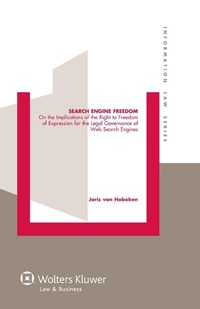
Search Engine Freedom
On the Implications of the Right to Freedom of Expression for the Legal Governance of Web Search Engines
Published on 1. October 2012
432 pages
978-90-411-4138-5 (ISBN)
Description

In this book, the author explores how search media can be incorporated into freedom of expression doctrine, as well as media and communications law and policy more generally. And the book develops a theory of the legal relations between national governments and search media providers on the one hand and between end-users and information providers on the other. Among the many issues covered are the following: role of government under the right to freedom of expression; lack of transparency about the ranking and selection of search results; search engine and ISP intermediary liability; filtering by access providers; freedom of expression and the governance of public libraries; the search engine market, its business model and the separation rule for advertising; search engine self-regulation; user profiling and personalization; decisions and actions for which search engines should be able to claim protection. The analysis draws on specific legal developments under Article 10 of the European Convention on Human Rights and the United States First Amendment, and investigates issues of diversity, pluralism, and freedom of expression as they relate to editorial control in other media. The author concludes with recommendations regarding search engine governance and the proper role of government, indicating which existing elements of the regulatory framework for search media can be improved and offering directions for future legal and empirical research. Considering the ever-growing cultural, political, and economic importance of the Internet and the World Wide Web in our societies, and the societal interests involved in the availability of effective search tools, this first in-depth legal analysis of search engine freedom will prove indispensable to the many practitioners and policymakers concerned with freedom of expression in the digital age.
More details
Other editions
Additional editions
Joris van Hoboken
Search Engine Freedom
On the Implications of the Right to Freedom of Expression for the Legal Governance of Web Search Engines
Book
10/2012
1st Edition
Kluwer Law International
€350.59
Shipment within 10-20 days
Content
- Intro
- Title Page
- Copyright
- Table of Contents
- List of Abbreviations
- Acknowledgements
- Chapter 1 Introduction
- 1.1. General Introduction
- 1.2. Search Engine Governance and Freedom of Expression
- 1.3. General Research Question and Scope of the Study
- 1.4. Structure and Methodology
- Part I Web Search Engines: Functioning, Background and Context
- Chapter 2 A Short History of Search Engines and Related Market Developments
- 2.1. The Internet, the Web and the Rise of Navigational Media
- 2.1.1. Early Visions of Navigation in Digitized Information Environments
- 2.1.2. The Internet: Connecting the Nodes
- 2.1.3. The World Wide Web: Browsers, Hyperlinks and Spiders
- 2.2. The Web Search Engine
- 2.2.1. Web Search Engines: The Birth of an Industry-1993-1998
- 2.2.2. The Birth of Google
- 2.2.3. Consolidation of the Web Search Industry: 2000-2011
- 2.2.4. The Web Search Industry in Europe
- 2.2.5. Alternatives and the Future of Web Search Services
- 2.3. Conclusion
- Chapter 3 Web Search Engines in the Public Networked Information Environment
- 3.1. Web Search Engines: Basics
- 3.1.1. Definition
- 3.1.2. Basic Information Flows
- 3.1.3. Basic Architecture
- 3.2. Search Engines in Their Context
- 3.2.1. Search Engines and the Layered Model for the Networked Communications Environment
- 3.2.2. Search Engines in the Internet Communications 'Chain'
- 3.3. Web Search Engines: A Functional Perspective
- 3.3.1. End-Users: Information, Navigation and Transaction
- 3.3.2. Search Engines as Forums for Information Providers and Marketing Platforms
- 3.4. Conclusion
- Part II Freedom of Expression Theories
- Chapter 4 The Right to Freedom of Expression
- 4.1. Introduction
- 4.2. Freedom of Expression Theories
- 4.2.1. Democracy
- 4.2.2. The 'Marketplace of Ideas' or the 'Truth Theory'
- 4.2.3. Individual Dignity, Self-fulfillment and Autonomy
- 4.3. Freedom of Expression Provisions
- 4.3.1. The Right to Freedom of Expression in International Human Rights Treaties
- 4.3.2. Article 10 ECHR and the EU Charter
- 4.3.3. The First Amendment
- 4.4. Freedom of Expression Doctrine: Further Clarifications
- 4.4.1. The Proper Role of Government under Freedom of Expression
- 4.4.2. The Role of Government under Freedom of Expression and Different 'Means of Communication'.
- 4.4.3. What Actions and Which Issues Are (Still) Relevant under Freedom of Expression?
- 4.4.4. Selection of the Press, Internet Access Providers and Libraries
- Chapter 5 Press Freedom
- 5.1. Introduction
- 5.2. The Regulatory Framework for the Press
- 5.3. Freedom of Expression and the Press
- 5.3.1. Status of the Press under the Right to Freedom of Expression
- 5.3.2. Article 10 ECHR and the Press' Role in Serving the Interests of Speakers and Readers
- 5.3.3. Press Freedom and the Duties and Responsibilities under Article 10
- 5.3.4. Press Freedom and the Permissibility of Prior Restraints
- 5.4. The Press as Gatekeeper: Editorial Freedom and Access to the Press
- 5.4.1. Background to the Debate about Access to the Press
- 5.4.2. Access Regulation and Editorial Freedom
- 5.5. The Press and Its Audience: The Right to Be Informed, the Role of Advertising and the Reader's Privacy
- 5.5.1. Press Freedom and the Right to Be Informed
- 5.5.2. Press Freedom and Commercial Communications
- 5.5.3. Press Freedom and the Reader's Privacy
- 5.6. Conclusion
- Chapter 6 ISP Freedom
- 6.1. Introduction
- 6.2. Regulation of Communications Network Providers and Freedom of Expression
- 6.2.1. Background
- 6.2.2. Regulation: Rationales, Universal Service and Common Carriage
- 6.3. Freedom of Expression and Internet Access Providers
- 6.3.1. Status of Internet Access Providers under the Right to Freedom of Expression
- 6.3.2. Access Regulation and the Right to Freedom of Expression
- 6.3.3. First Amendment
- 6.4. ISP Intermediary Liability and the Right to Freedom of Expression
- 6.4.1. Background
- 6.4.2. Intermediary Liability: EU and the United States
- 6.4.3. The DMCA Safe Harbors and the First Amendment
- 6.4.4. Communications Decency Act 230 and the First Amendment
- 6.4.5. EU Directive on Electronic Commerce and Freedom of Expression
- 6.4.6. Self-regulatory Paradigm for ISPs in the EU and the Right to Freedom of Expression
- 6.5. Internet Filtering by Access Providers
- 6.5.1. Background
- 6.5.2. Internet Filters and the Right to Freedom of Expression
- 6.5.3. Mandatory Filtering and the Interests of Information Providers
- 6.5.4. Voluntary Filtering by Access Providers and the Interests of Information Providers
- 6.5.5. Internet Filters and the Interests of End-Users
- 6.6. Conclusion
- Chapter 7 Library Freedom
- 7.1. Introduction
- 7.2. The Library: History and Recent Developments
- 7.3. Library Governance, Mission and Normative Principles
- 7.3.1. Regulatory Models for the Public Library
- 7.3.2. The Task and Mission of the Public Library
- 7.4. Specific Freedom of Expression Issues in the Context of Libraries
- 7.4.1. The Library and Freedom of Expression
- 7.4.2. Public Funding of Libraries and Freedom of Expression
- 7.4.3. Collection Management and Access to Materials
- 7.4.4. The Library and Its Relation to the Library User
- 7.4.5. Censorship in the Context of Libraries
- 7.4.6. Libraries as Access Points to the Internet
- 7.4.7. Unmonitored Access
- 7.5. Conclusion
- Chapter 8 Search Engine Freedom
- 8.1. Introduction
- 8.2. Search Engine Governance: Starting Points
- 8.2.1. Introduction
- 8.2.2. The Search Engine Market and Its Business Model
- 8.2.3. Public and Private Nature of Web Search Communications
- 8.2.4. A Legal and Regulatory Framework in Its Infancy
- 8.2.5. Search Engine Governance, a Global Internet and Jurisdiction
- 8.3. Between Access and Quality: The Societal Role of Search Media
- 8.3.1. The Role of Search Engines in the Networked Information Environment: A Comparison
- 8.3.2. Search Engine Governance: Between Access and Quality
- 8.4. Search Engine Providers and the Right to Freedom of Expression
- 8.4.1. Introduction
- 8.4.2. The Freedom to Publish Referencing Information and the Freedom to Crawl
- 8.4.3. Search Engine Freedom: Selection and Ranking
- 8.4.4. Search Engines: Editorial Control, Freedom, Duties and Responsibilities
- 8.5. Search Engine Freedom and the Interests of Information Providers
- 8.5.1. Introduction
- 8.5.2. Search Engine Freedom and the Ideal of Unmediated Mediation
- 8.5.3. Information Providers' Control over Search Engine Governance
- 8.5.4. Restricting Lawful Information from Entering the Search Engine Index
- 8.6. Search Engines and the Freedom of End-Users
- 8.6.1. Introduction
- 8.6.2. Search Engines and the End-User's Interests: Access and Quality as Conflicting Perspectives
- 8.6.3. The End-User: Consumer or Citizen?
- 8.6.4. End-User Privacy
- 8.7. Conclusion
- Part III Search Engine Freedom: Access and Quality
- Chapter 9 Search Engine Access: Content Regulation and Intermediary Liability
- 9.1. Introduction
- 9.2. Search Engines and Content Regulation: Censorship or Self-regulation?
- 9.2.1. Search Engine Censorship in China
- 9.2.2. Self-regulatory Removal of References: The German FSM Framework
- 9.2.3. Proactive Keyword Blocking
- 9.3. Intermediary Liability and Search Engines
- 9.3.1. Discussion of Intermediary Liability Regulation for Search Engines
- 9.3.2. Intermediary Liability of Search Engines and the Directive on Electronic Commerce
- 9.3.3. Intermediary Liability of Search Engines in the United States
- 9.3.4. Search Engine Intermediary Liability in Europe at the National Level
- 9.3.5. Developments at the EU Level and the ECJ
- 9.4. Intermediary Liability Regulation of Search Engines and Freedom of Expression
- 9.4.1. Introduction
- 9.4.2. Search Engine Liability, Freedom of Expression and Copyright Infringing Material
- 9.4.3. Search Engine Liability, Freedom of Expression and the Protection of Private Life and Reputation
- 9.4.4. The Future of Search Engine Intermediary Liability in the EU: A Recommendation
- 9.5. Conclusion
- Chapter 10 Search Engine Quality: Pluralism, Bias, Transparency and User Surveillance
- 10.1. Introduction
- 10.2. Search Engine Quality: Pluralism, Diversity and Bias
- 10.2.1. The Impact of Search Engines on Pluralism and Diversity: A Short Overview
- 10.2.2. Pluralism and Diversity in the Context of Search: Legal and Regulatory Background
- 10.2.3. Market Concentration
- 10.2.4. Diversity in the Context of Particular Search Services
- 10.3. Search Engine Quality, Transparency and Marketing
- 10.3.1. Search Engine Marketing: The Labeling of Sponsored Results
- 10.3.2. Search Engine Advertising, Quality and Transparency
- 10.4. Search Engine Quality and User Data: Privacy, Personalization and Intellectual Freedom
- 10.4.1. Search Engine User Data Processing: Background
- 10.4.2. Intellectual Freedom and Search Engine User Surveillance
- 10.4.3. Accountability for User Data Processing
- 10.5. Conclusion
- Chapter 11 Summary, Analysis and Conclusions
- 11.1. Introduction
- 11.2. Search Engines in the Public Networked Information Environment
- 11.3. Implications of Freedom of Expression for Media and Communications Services
- 11.3.1. Press Freedom
- 11.3.2. ISP Freedom
- 11.3.3. Library Freedom
- 11.4. Freedom of Expression and Search Engine Governance
- 11.4.1. The Societal Role of Search Engines
- 11.4.2. Whose Free Speech?
- 11.5. The Role of Government: Reasons for Restraint and Room for Action
- 11.5.1. Search Engine Intermediary Liability and Content Co-regulation
- 11.5.2. Search Engine Quality: Diversity, Transparency and Accountability Towards End-Users
- 11.6. Conclusion
- References
- Legal Texts and CoE Recommendations
- Table of Cases
- Index
