

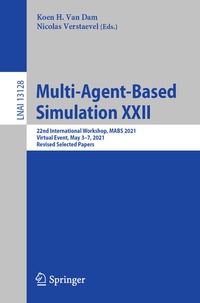
Multi-Agent-Based Simulation XXII
22nd International Workshop, MABS 2021, Virtual Event, May 3-7, 2021, Revised Selected Papers
Published on 15. January 2022
VIII, 195 pages
978-3-030-94548-0 (ISBN)
Description

This book constitutes the thoroughly refereed post-conference proceedings of the 21st International Workshop on Multi-Agent-Based Simulation, MABS 2021, held in May 2021 as part of AAMAS 2021. The conference was held virtually due to COVID 19 pandemic.
The 14 revised full papers included in this volume were carefully selected from 23 submissions. The workshop focused on finding efficient solutions to model complex social systems, in such areas as economics, management, organizational and social sciences in general. In all these areas, agent theories, metaphors, models, analysis, experimental designs, empirical studies, and methodological principles, all converge into simulation as a way of achieving explanations and predictions, exploration and testing of hypotheses, better designs and systems and providing decision-support in a wide range of applications.
The 14 revised full papers included in this volume were carefully selected from 23 submissions. The workshop focused on finding efficient solutions to model complex social systems, in such areas as economics, management, organizational and social sciences in general. In all these areas, agent theories, metaphors, models, analysis, experimental designs, empirical studies, and methodological principles, all converge into simulation as a way of achieving explanations and predictions, exploration and testing of hypotheses, better designs and systems and providing decision-support in a wide range of applications.
More details
Series
Edition
1st ed. 2022
Language
English
Place of publication
Cham
Switzerland
Publishing group
Springer International Publishing
Product notice
Reflowable
Illustrations
VIII, 195 p. 69 illus., 43 illus. in color.
ISBN-13
978-3-030-94548-0 (9783030945480)
DOI
10.1007/978-3-030-94548-0
Schweitzer Classification
Other editions
Additional editions
Koen H. van Dam | Nicolas Verstaevel
Multi-Agent-Based Simulation XXII
22nd International Workshop, MABS 2021, Virtual Event, May 3-7, 2021, Revised Selected Papers
Book
01/2022
Springer
€58.84
Shipment within 7-9 days
Content
- Intro
- Preface
- Organization
- Contents
- Social Simulation for Non-hackers
- 1 Introduction
- 2 The SCAMP Architecture
- 3 Group Definitions
- 4 Causal Event Graph
- 5 Geospatial Context
- 6 Hierarchical Goal Networks
- 7 Agent Changes
- 8 SCAMP's Data
- 9 Discussion and Next Steps
- References
- Using Causal Discovery to Design Agent-Based Models
- 1 Introduction
- 2 Related Work
- 3 Methodology
- 4 Case Study
- 5 Discussion and Conclusion
- References
- Multi-level Adaptation of Distributed Decision-Making Agents in Complex Task Environments
- 1 Introduction
- 2 Model
- 3 Results
- 4 Discussion
- 5 Conclusion
- References
- Fast Agent-Based Simulation Framework with Applications to Reinforcement Learning and the Study of Trading Latency Effects
- 1 Motivation
- 2 Related Work
- 3 Architecture
- 4 Example Case Study - Processing Delay in Market Dynamics
- 4.1 The Model
- 4.2 Findings
- 5 Example Use Case - Market-Based Coordination of Learning Agents
- 6 A Performance Comparison
- 7 Conclusions
- References
- On the Same Wavelengths: Emergence of Multiple Synchronies Among Multiple Agents
- 1 Introduction
- 2 Psychological Background
- 2.1 General Psychological Mechanisms Used to Design the Agent Models
- 2.2 Emerging Synchrony Among Individuals
- 3 The Two-Agent Model
- 3.1 General Approach of Agent Modeling
- 3.2 Conceptual Representations for the Agent Model
- 3.3 Numerical Representations for the Agent Model
- 4 Simulation Method for the Agents
- 5 Analysis of the Two-Agent Model: Main Simulation
- 6 Discussion
- References
- Multi-agent Simulation for AI Behaviour Discovery in Operations Research
- 1 Introduction
- 2 System Overview
- 3 Case Study: Aerial Manoeuvring Domain
- 4 Evaluation
- 4.1 Multi-agent-Based-Simulation Architecture Limitations
- 4.2 User Evaluation
- 4.3 Research Applications
- 5 Conclusions
- References
- Using Agent-Based Modelling to Understand Advantageous Behaviours Against COVID-19 Transmission in the Built Environment
- 1 Introduction
- 2 Model
- 2.1 Overview of the Model
- 2.2 Description of the Model Entities
- 2.3 Description of the Model Processes
- 2.4 Virus Propagation - Risk Prediction
- 2.5 Parameters
- 2.6 Outputs
- 3 Results
- 3.1 Stochasticity Sensitivity Analysis
- 3.2 Use Cases: University of Guadalajara (UdeG) and MIT Media Lab
- 3.3 Analysis of the Virus Transmission Without Intervention
- 3.4 Comparison of Different Combinations of Interventions
- 4 Conclusion and Perspective
- References
- Quantifying the Effects of Norms on COVID-19 Cases Using an Agent-Based Simulation
- 1 Introduction
- 2 Simulation Design
- 2.1 Data Sets Used in the Simulation
- 2.2 Agents Activities and Deliberations
- 2.3 Reasoning with Norms
- 2.4 Environment Design
- 3 Calibration
- 4 Quantifying the Effects of Normative Interventions
- 5 Conclusion
- References
- MAS Network: Surrogate Neural Network for Multi-agent Simulation
- 1 Introduction
- 2 Framework Definition
- 2.1 Multi-agent Simulation
- 2.2 Coarse-Graining as System Dynamics
- 2.3 MAS Network
- 3 Implementation
- 3.1 Neural Network Architecture
- 3.2 Loss Function and Optimization Procedure
- 3.3 Input and Output Representations
- 4 Experimental Setup
- 4.1 Simulation Model
- 4.2 Dataset Design
- 5 Results
- 6 Conclusion
- References
- Real-Time Inference of Urban Metrics Applying Machine Learning to an Agent-Based Model Coupling Mobility Mode and Housing Choice
- 1 Introduction
- 2 Background
- 2.1 Mobility Mode and Housing Choice ABM
- 2.2 Related Work
- 3 Architecture of the Suggested Methodology
- 3.1 Batch Experiments. Generation of What-If Scenarios
- 3.2 Data Ingestion and Arrangement
- 3.3 Design of the Surrogate Model
- 3.4 Real-Time ABM Description
- 4 Discussion and Conclusion
- References
- Changing Perspectives: Adaptable Interpretations of Norms for Agents
- 1 Introduction
- 2 Example
- 3 Adaptable Interpretations of Norms - Foundations
- 3.1 Perspectives
- 3.2 Perspectives, Values, and Goals
- 3.3 Perspectives and Social Affordances
- 4 Using Perspectives with Adaptable Interpretations of Norms
- 4.1 User Level
- 4.2 System Level
- 4.3 Agent Level
- 5 Preliminary Exploration
- 6 Conclusion
- References
- Exploration of Model Coupling Strategies in a Hybrid Agent-Based Traffic Simulation
- 1 Introduction
- 2 Related Work
- 3 Methodology
- 3.1 Traffic Models
- 3.2 Implementation and Coupling Strategy
- 4 Experiment and Results
- 4.1 Experiment Design
- 4.2 Results
- 5 Conclusion
- References
- The Recruitment Game: An Agent-Based Simulation
- 1 Introduction
- 2 The Model
- 2.1 Structure, Initial Settings, Parametrization
- 2.2 Recruitment Game
- 2.3 Parametrization and Model Initialization
- 3 Results
- 3.1 Global Sensitivity Analysis
- 3.2 Experimental Design
- 3.3 Experiment Results
- 3.4 Calibration and Identification Approach
- 4 Conclusions
- References
- Fishing Together?
- 1 Introduction
- 2 Models of Individual and Social Decision-Making and Behaviour
- 3 Empirical Exploration on Togetherness
- 3.1 Inspiration and Reflections on Togetherness of Thai Fishers Participating in Behavioural Experiments
- 4 Formalising Fishing Together
- 4.1 AgentEx+Collective|A Conceptual Model
- 5 Discussion and Conclusion
- References
- Author Index
