

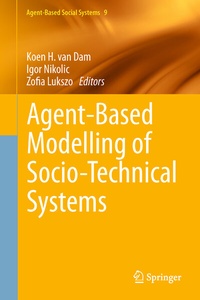
Agent-Based Modelling of Socio-Technical Systems
Description

Decision makers in large scale interconnected network systems require simulation models for decision support. The behaviour of these systems is determined by many actors, situated in a dynamic, multi-actor, multi-objective and multi-level environment. How can such systems be modelled and how can the socio-technical complexity be captured? Agent-based modelling is a proven approach to handle this challenge. This book provides a practical introduction to agent-based modelling of socio-technical systems, based on a methodology that has been developed at TU Delft and which has been deployed in a large number of case studies. The book consists of two parts: the first presents the background, theory and methodology as well as practical guidelines and procedures for building models. In the second part this theory is applied to a number of case studies, where for each model the development steps are presented extensively, preparing the reader for creating own models.
Reviews / Votes
From the reviews:
"Six case studies are presented using the methodology. This is ideal, especially for students to see the process applied to different models in a coherent manner. Graduate students would be able to begin designing a model after reading. . this is a very useful book for those developing (and teaching) agent-based modelling of socio-technical systems and is a step towards developing more useful models for decision-makers." (Nicole Ronald, Journal of Artificial Societies and Social Simulation, April, 2013)
More details
Other editions
Additional editions
Content
Foreword by Prof Nigel Gilbert.- Preface by the editors.- 1 Introduction; G.P.J. Dijkema, Z. Lukszo and M.P.C. Weijnen.
-
Part I Theory and practice.- 2 Theory; I. Nikolic and J. Kasmire
.-
3 Practice; I. Nikolic, K.H. van Dam and J. Kasmire
.-
Part II Case Studies.- 4 Introduction to the Case Studies; K.H. van Dam, I. Nikolic and Z. Lukszo
.-
5 Agent-Based Models of Supply Chains; B. Behdani, K.H. van Dam and Z. Lukszo
.-
6 An Agent-Based Model of Consumer Lighting; E.J.L. Chappin and M.R. Afman
.-
7 An Agent-based Model of CO2 Policies and Electricity Generation; E.J.L. Chappin and G.P.J. Dijkema
.-
8 An Agent-Based Model of a Mobile Phone Production, Consumption and Recycling Network; L.A. Bollinger, C.B. Davis and I. Nikolic
.-
9 Next Steps in Modelling Socio-Technical Systems: Towards Collaborative Modelling; A. Chmieliauskas, C.B. Davis and L.A. Bollinger
.-
List of Contributors.- Index.
