

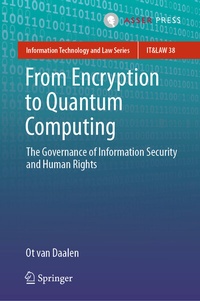
From Encryption to Quantum Computing
Description

This book examines the implications of information security which plays such an important role in modern digital infrastructure. Information security technologies restrict the (mis)use of this infrastructure, while also constantly being probed by researchers, intelligence agencies and criminals. One can see this cycle of making and breaking everywhere in the digital sphere. An important example of this cat-and-mouse game is the development of quantum computers, which may in the near future break some widely used encryption technologies.
This cycle also has implications for human rights: weakening encryption may affect privacy, for example. But the relationship between human rights and information security has not been investigated in-depth before. In this study, state obligations relating to information security are analysed under the European Convention for Human Rights and the EU Charter for Fundamental Rights, focusing on issues as human rights-compatible encryption policy, on how governments should deal with vulnerabilities in software, and whether governments can curtail the development and export of quantum computers.
This book analyses the human rights-compatibility of quantum computing governance and offers unique insights into the connection between human rights and information security that will be relevant for legal practitioners, policy-makers and academics involved in this field of research.
Ot van Daalen is Assistant Professor at the Institute for Information Law (IViR), Faculty of Law of the University of Amsterdam, the Netherlands.
More details
Other editions
Additional editions
Content
Chapter 1. Introduction.- Part I The Landscape.- Chapter 2. The Technological and Societal Landscape.- Chapter 3. The Governance Landscape.- Part II The Human Rights Framework.- Chapter 4 Human Rights in Context.- Chapter 5. The Right to Privacy and Data Protection.- Chapter 6. The Right to Communications Freedom.- Chapter 7 The Right to Science.- Part III Synthesis.- Chapter 8. Human Rights-Compatible Information Security Cycle Governance.- Chapter 9. Human Rights-Compatible Encryption Governance.- Chapter 10. Human Rights-Compatible Quantum Computing Governance.- Chapter 11. Conclusion and Summary.
