

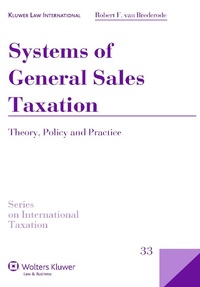
Systems of General Sales Taxation
Theory, Policy and Practice
Published on 7. August 2009
400 pages
978-90-411-5492-7 (ISBN)
Description

Sales taxes - including gross receipt taxes, retail sales taxes and value added taxes - are a key part of the fiscal revenue of many countries. Given an increasingly global economy - and the recent stresses to which it's been subjected - many issues come into play in connection with the legal, tax policy and economic implications presented by the taxation of international transactions.
This thoughtful work begins with the basics and approaches sales taxation from a number of different aspects. It provides in-depth economic analysis (for non-economists) of all the taxes covered, including tax shifting, tax incidence, the economic effect of reduced rates and exemptions, tax accumulation, regressivity, and the Laffer curve approach. In addition, it offers a tax policy approach in regard to specific economic sectors such as the treatment of small enterprises, financial services, and real property.
This highly useful reference employs a comparative focus as well, especially where US sales tax is contrasted to EU VAT (e.g., in regard of e-commerce and the treatment of capital goods). Last but not least, the work offers insightful legal analysis in such key areas as cross-border transactions and US constitutional restraints.
This thoughtful work begins with the basics and approaches sales taxation from a number of different aspects. It provides in-depth economic analysis (for non-economists) of all the taxes covered, including tax shifting, tax incidence, the economic effect of reduced rates and exemptions, tax accumulation, regressivity, and the Laffer curve approach. In addition, it offers a tax policy approach in regard to specific economic sectors such as the treatment of small enterprises, financial services, and real property.
This highly useful reference employs a comparative focus as well, especially where US sales tax is contrasted to EU VAT (e.g., in regard of e-commerce and the treatment of capital goods). Last but not least, the work offers insightful legal analysis in such key areas as cross-border transactions and US constitutional restraints.
More details
Other editions
Additional editions
Book
08/2009
Kluwer Law International
€240.50
Shipment within 10-20 days
Content
- Cover
- Half Title Page
- Editorial Board
- Title Page
- Copyright Page
- Dedication
- Table of Contents
- Preface and Acknowledgments
- List of Tables and Figures
- List of Abbreviations
- List of Cases
- Chapter 1 General Introduction
- Chapter 2 Short Overview of the History of General Sales Taxation
- Chapter 3 Systems of Sales Taxation: General Overview
- 3.1. SINGLE STAGE TAXES
- 3.1.1. MANUFACTURER TAX
- 3.1.2. WHOLESALER TAX
- 3.1.3. RETAIL TAX
- 3.2. ALL STAGE TAXES
- 3.2.1. GROSS RECEIPT TAXES
- 3.2.2. VALUE ADDED TAXES
- 3.2.2.1. Addition Method
- 3.2.2.2. Subtraction Method
- 3.2.2.3. Tax Credit Method
- 3.3. SUMMARY AND EVALUATION
- Chapter 4 Characterization of Consumption Taxes
- 4.1. DIRECT VERSUS INDIRECT TAX
- 4.2. GENERAL COVERAGE
- 4.3. CLASSIFICATION ON THE BASIS OF THE SCOPE OF THE TAX
- 4.3.1. CONSUMPTION TYPE
- 4.3.2. INCOME TYPE
- 4.3.3. PRODUCT TYPE
- 4.4. TAX INCIDENCE
- 4.4.1. WHO BEARS THE BURDEN OF A CONSUMPTION TAX?
- 4.4.2. REGRESSIVITY OF CONSUMPTION TAXES
- 4.4.2.1. Introduction
- 4.4.2.2. Terminology
- 4.4.2.2.1. Progressive Taxes
- 4.4.2.2.2. Proportional Taxes
- 4.4.2.2.3. Regressive Taxes
- 4.4.2.3. Philosophical Perspective
- 4.4.2.4. Regressivity in the Political Debate
- 4.4.2.5. The Argument for VAT Being Regressive
- 4.4.2.6. Preliminary Remarks
- 4.4.2.6.1. The Effect of Regressivity Is Relative
- 4.4.2.6.2. VAT Is Only One Tax in a Tax System
- 4.4.2.6.3. Countermeasures
- 4.4.2.7. Empirical Verification of VAT's Regressivity
- 4.4.2.7.1. Level of Expenditure Is Constant
- 4.4.2.7.2. Savings Remain Untaxed
- 4.4.2.7.3. Individual Income Levels Are Constant
- 4.4.2.8. The Very Poor and the Very Rich
- 4.4.2.9. Conclusions
- 4.5. NEUTRALITY
- 4.6. ECONOMIC EFFICIENCY
- Chapter 5 Gross Receipt Taxes
- 5.1. INTRODUCTION
- 5.2. OVERVIEW OF CURRENT GRTS IN THE UNITED STATES
- 5.3. ECONOMIC EVALUATION
- 5.3.1. BROAD BASE
- 5.3.2. LOW RATE
- 5.3.3. STABLE SOURCE OF REVENUE
- 5.3.4. TAX CASCADING
- 5.3.5. VERTICAL INTEGRATION
- 5.3.6. DISPARITIES IN EFFECTIVE TAX RATES
- 5.3.7. EXTERNAL NEUTRALITY
- 5.3.8. LACK OF TRANSPARENCY
- 5.3.9. ECONOMIC ASSESSMENT
- 5.4. US LEGAL ISSUES
- 5.4.1. NEXUS ISSUES
- 5.4.2. APPORTIONMENT ISSUES
- 5.4.3. PATH TO COLLISION
- 5.5. CONCLUSIONS
- Chapter 6 Retail Sales Taxes
- 6.1. GENERAL
- 6.2. RST IN THE UNITED STATES AT THE SUBNATIONAL LEVEL
- 6.2.1. INTRODUCTION
- 6.2.2. GENERAL DESCRIPTION AND CHARACTERIZATION
- 6.2.3. SCOPE OF THE TAX
- 6.2.4. RATES
- 6.2.5. DISTRIBUTIONAL EFFECTS
- 6.2.5.1. Tax Revenue
- 6.2.5.2. Cascading Effect
- 6.2.5.3. Regressivity
- 6.2.6. TAX ON SERVICES
- 6.2.7. INTERSTATE SERVICES
- 6.2.8. INTERSTATE TRADE IN GOODS
- 6.2.9. COMPLIANCE
- 6.2.10. COORDINATION OF STATE AND LOCAL SALES TAXES
- 6.2.11. MERITS AND DEMERITS
- 6.2.11.1. Revenue Productivity
- 6.2.11.2. Revenue Stability
- 6.2.11.3. Tax Efficiency
- 6.2.11.4. Operational Cost
- 6.2.11.5. Resource Allocation
- 6.2.11.6. Fairness of the Tax
- 6.2.11.7. Reduced Taxpayer Awareness
- 6.2.12. SELF-SUPPLY RULES
- 6.2.13. CONCLUSIONS
- 6.3. FEDERAL SALES TAX IN THE UNITED STATES
- 6.3.1. INTRODUCTION
- 6.3.2. OUTLINE OF THE PROPOSED NATIONAL RETAIL SALES TAX
- 6.3.2.1. General
- 6.3.2.2. Abolition of the IRS
- 6.3.2.3. Collection Costs Reimbursement
- 6.3.2.4. Low Income Prebate
- 6.3.3. ECONOMIC EFFECTS OF NRST
- 6.3.4. EFFECTS ON FEDERAL/STATE RELATIONSHIP
- 6.3.5. RATE FOR THE NRST
- 6.3.6. TAX AVOIDANCE AND EVASION EFFECTS
- 6.3.7. CONCLUSIONS
- Chapter 7 Subtraction VAT
- 7.1. GENERAL
- 7.2. THE JAPANESE CONSUMPTION TAX
- 7.3. SUBTRACTION VAT PROPOSALS IN THE UNITED STATES
- 7.4. THE MICHIGAN BUSINESS TAX
- Chapter 8 Credit Invoice Method VAT
- 8.1. INTRODUCTION
- 8.2. PROBLEM AREAS WITHIN THE CREDIT INVOICE METHOD VAT
- 8.2.1. RATES AND RATES VARIATION
- 8.2.1.1. Rationale for Rate Variation
- 8.2.1.2. Effect of Rate Variation
- 8.2.1.2.1. Classification Problems
- 8.2.1.2.2. Recouping Effect
- 8.2.1.2.3. Administrative and Compliance Complexities
- 8.2.1.2.4. Conclusions
- 8.2.1.3. Optimum Efficient Rate for VAT
- 8.2.2. AGRICULTURAL SECTOR
- 8.2.2.1. General Background
- 8.2.2.2. The EU Flat Rate Compensation for the Agricultural Sector
- 8.2.3. SMALL ENTERPRISES
- 8.2.4. EXEMPTIONS
- 8.2.4.1. Definition of Exemption under a VAT
- 8.2.4.2. Rationale for Exemptions
- 8.2.4.3. Economic Effect of Exemptions
- 8.2.4.3.1. Recouping Effect within the Distribution Chain
- 8.2.4.3.2. Reduced Effective Rate with Exemption at Retail Stage
- 8.2.4.3.3. Adverse Incentive of Self-production
- 8.2.4.3.3.1. Self-supply Rules in the EU
- 8.2.4.4. Classification Problems
- 8.2.5. VAT ADJUSTMENTS
- 8.2.5.1. Bad Debts
- 8.2.5.2. Treatment of Postsale Price Adjustments
- 8.2.5.3. Mixed Use
- 8.2.5.4. Change of Use
- 8.2.6. FINANCIAL SERVICES
- 8.2.6.1. Arguments for Exempting Financial Services
- 8.2.6.2. Arguments for Taxing Financial Services
- 8.2.6.3. Practical Problems with the Exemption Regime for Financial Services
- 8.2.6.3.1. General
- 8.2.6.3.2. Mixed Transactions
- 8.2.6.3.3. Change of Use
- 8.2.6.3.4. Sale of Used Business Assets
- 8.2.6.3.5. Sale of Repossessed Goods
- 8.2.6.3.6. Exported Services
- 8.2.6.3.7. Definition of Financial Services
- 8.2.6.3.8. Input Tax Allocation
- 8.2.6.4. Analysis of Value Added of Financial Services
- 8.2.6.5. Methods of Taxing Financial Services
- 8.2.6.5.1. Taxation under a Separate Regime
- 8.2.6.5.1.1. Addition Method
- 8.2.6.5.1.2. Subtraction Method
- 8.2.6.5.1.3. Cash Flow Method
- 8.2.6.5.2. Taxation within the Credit Invoice Method
- 8.2.6.5.2.1. Option for Taxation
- 8.2.6.5.2.2. Zero Rating
- 8.2.6.5.2.3. Modified Reverse Charge
- 8.2.6.5.2.4. Limited Credit to Financial Institutions
- 8.2.6.5.2.5. Proxy Credit on Financial Services Procurement
- 8.2.6.5.3. Evaluation and Conclusions
- 8.2.7. TREATMENT OF CAPITAL GOODS
- 8.2.7.1. Introduction and Scope
- 8.2.7.2. Moveable Tangible Property
- 8.2.7.2.1. Resale of Goods during Economic Life Cycle
- 8.2.7.2.1.1. Business-to-Business (B2B) and Business-to-Consumer (B2C) Sales
- 8.2.7.2.1.2. Consumer-to-Consumer (C2C) Sales (Casual Sales)
- 8.2.7.2.2. Treatment of Secondhand Goods (Sale to Dealer with No Trade-In)
- 8.2.7.2.2.1. VAT Treatment
- 8.2.7.2.2.2. Sales Tax Treatment
- 8.2.7.2.2.3. Conclusions
- 8.2.7.2.3. Treatment of Trade-Ins
- 8.2.7.2.3.1. VAT Treatment
- 8.2.7.2.3.2. Sales Tax Treatment
- 8.2.7.2.3.3. Conclusions
- 8.2.7.2.4. Pro Rata Temporis Credit for Capital Goods
- 8.2.7.3. Immoveable Tangible Property (Real Property)
- 8.2.7.3.1. Outline of the Theoretical Problems
- 8.2.7.3.2. The Current Treatment in the EU
- 8.2.7.3.3. A Practical Solution for Incorporating Immoveable Property in a VAT System
- 8.2.7.3.3.1. Sales of Commercial Property
- 8.2.7.3.3.2. Sales of Residential Property
- 8.2.7.3.3.3. Commercial Rentals
- 8.2.7.3.3.4. Residential Rentals
- 8.2.7.3.4. Conclusions
- 8.2.8. COMPOSITE SUPPLIES
- 8.2.9. PUBLIC SECTOR
- 8.2.9.1. Theory and Background
- 8.2.9.2. The EU Treatment of the Public Sector
- 8.2.9.3. Conclusions
- Chapter 9 Cross-Border Transactions
- 9.1. ORIGIN VERSUS DESTINATION PRINCIPLE
- 9.1.1. ORIGIN PRINCIPLE
- 9.1.2. DESTINATION PRINCIPLE
- 9.2. WTO RULES FOR BORDER TAX ADJUSTMENTS AND THEIR ECONOMIC EFFECTS
- 9.3. US TAX PROPOSALS TO MITIGATE CROSS-BORDER DISADVANTAGE
- 9.3.1. REPLACEMENT OF INCOME TAX BY A FEDERAL INDIRECT TAX
- 9.3.1.1. General
- 9.3.1.2. The Economic Effects of Substituting an Indirect Tax for a Corporate Income Tax
- 9.3.2. THE BORDER TAX EQUITY ACT
- 9.3.3. THE ALTERNATIVE: CHANGE THE CHARACTER OF THE CORPORATE INCOME TAX
- 9.3.4. FEASIBILITY OF THE VALUE-ADDED-BASED CORPORATE INCOME TAX
- 9.3.4.1. WTO Arguments against FSC and ETI
- 9.3.4.2. Evaluation of a Value-Added-Based Income Tax against WTO Rules
- 9.3.5. CONCLUSIONS
- 9.4. IMPORTATION AND EXPORTATION OF GOODS
- 9.4.1. IMPORTATION
- 9.4.2. EXPORTATION
- 9.5. TAX JURISDICTION RULES
- 9.5.1. PLACE OF SUPPLY OF GOODS UNDER EU-VAT
- 9.5.2. PLACE OF SUPPLY OF SERVICES UNDER EU-VAT
- 9.5.2.1. Current Rules
- 9.5.2.2. Future Rules (2010-2015)
- 9.6. DISTANCE (MAIL-ORDER) SALES AND E-COMMERCE
- 9.6.1. THE AMERICAN DEBATE
- 9.6.1.1. Introduction
- 9.6.1.2. Scope of the Debate
- 9.6.1.3. Legal Environment
- 9.6.1.4. Economic and Competitive Distortions
- 9.6.1.5. Complexity and Costs of Withholding Use Tax
- 9.6.1.6. The Role of Congress
- 9.6.1.7. Possible Solutions
- 9.6.1.8. Taxation of Internet Access and Other Online Services
- 9.6.1.9. International Aspects
- 9.6.1.10. Conclusions
- 9.6.2. EUROPEAN PRACTICE
- 9.7. THE CHALLENGE OF FRAUD SCHEMES
- 9.7.1. INTRODUCTION AND SUMMARY
- 9.7.2. DESCRIPTION OF CAROUSEL FRAUD
- 9.7.3. COUNTERMEASURES TO FRAUD
- 9.7.3.1. Civil Law Defense
- 9.7.3.2. Noneconomic Defense
- 9.7.3.3. Abuse of Law Doctrine
- 9.7.3.4. Joint and Several Liability
- 9.7.3.5. Alternative Solutions
- 9.7.4. CONCLUSIONS
- Chapter 10 Harmonization of Indirect Tax in Federal or Common Markets
- 10.1. INTRODUCTION
- 10.2. THE HARMONIZATION OF INDIRECT TAXES IN THE EU
- 10.2.1. THE OBJECTIVES OF THE EEC TREATY
- 10.2.2. RELATIONSHIP BETWEEN THE OBJECTIVES AND THE TAX PROVISIONS OF THE TREATY
- 10.2.3. THE NEED FOR HARMONIZATION AND THE CHOICE FOR VAT
- 10.2.4. OVERVIEW OF THE HISTORY OF SALES TAX HARMONIZATION IN THE EU
- 10.2.5. SCOPE AND PRESENT STATE OF THE HARMONIZATION
- 10.3. THE HARMONIZATION OF SALES AND USE TAXES IN THE UNITED STATES
- 10.3.1. REASONS FOR HARMONIZATION
- 10.3.2. LEGISLATIVE ASPECTS
- 10.3.3. OBJECTIVE AND METHODOLOGY OF THE STREAMLINING PROJECT
- 10.3.4. PARTICIPATING AND ASSOCIATE STATES
- 10.3.5. DECISION-MAKING PROCESS
- 10.3.6. SCOPE OF HARMONIZATION
- 10.3.6.1. Registration and Administration
- 10.3.6.2. State and Local Tax Base
- 10.3.6.3. Change of Rules and Regulations
- 10.3.6.4. Uniform Jurisdiction (Sourcing) Rules
- 10.3.6.5. Uniform Definitions
- 10.3.6.6. Uniform Tax Return Forms
- 10.3.7. CERTIFICATION AND COMPLIANCE MODELS
- 10.3.7.1. Certification
- 10.3.7.2. Compliance Models
- 10.3.8. FINANCIAL COMPENSATION FOR BUSINESSES
- 10.3.9. AMNESTY
- 10.3.10. CONSUMER PRIVACY PROTECTION
- 10.3.11. THE VOLUNTARY COMPLIANCE ASSUMPTION
- 10.3.12. POLITICAL FEASIBILITY
- 10.3.13. CONCLUSIONS
- Chapter 11 Revenue Allocation within Federal and Common Markets
- 11.1. INTRODUCTION
- 11.2. RST VERSUS VAT
- 11.3. COOPERATION MODELS
- 11.3.1. SEPARATE FEDERAL AND SUBNATIONAL TAXES
- 11.3.2. FEDERAL SURCHARGE
- 11.3.3. STATE SURCHARGE
- 11.4. AGGREGATE LEVEL OF REVENUE SHARING
- 11.4.1. EU CLEARING HOUSE SYSTEM
- 11.4.2. VIABLE INTEGRATED VAT
- 11.4.3. COMPENSATING VAT
- 11.4.4. DUAL VAT SYSTEM
- 11.4.5. DIGITAL VAT
- 11.4.6. COMBINED FEDERAL AND SUBNATIONAL SALES TAX
- 11.4.6.1. Brief Description of the Combined Tax System
- 11.4.6.2. Calculation of the Single National Tax Rate
- 11.4.6.3. Macroeconomic Method of Revenue Allocation
- 11.4.6.4. Final Remarks and Conclusions
- 11.5 CONCLUSIONS
- Chapter 12 Tax Policy Lessons
- Bibliography
- Index
- Back Cover
