

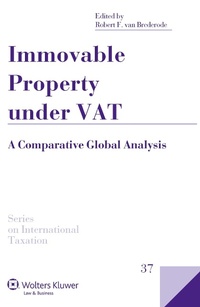
Immovable Property under VAT
A Comparative Global Analysis
Published on 12. May 2011
328 pages
978-90-411-3949-8 (ISBN)
Description

The ideal value-added tax (VAT) would carry an economic efficiency ratio of 100 as, in theory, VAT should not be susceptible to exemptions and rate variations. However, practical reality tells a different story, and it will come as no surprise to learn that the VAT systems of almost all countries remain far from the benchmark, and that this is particularly the case when VAT is applied to real estate. This book describes and analyses VAT treatment of real estate transactions in six representative countries: Australia, Canada, Germany, Japan, Mexico, and the United Kingdom. As in any jurisdiction, the VAT schemes covered must accommodate complex factual matrices that demand consistent, fair, and equal treatment. Among these VAT determinants the authors, each an expert in the national tax law of one of the six countries, address the following: types of real estate sales; long versus short term leases; commercial versus residential use; newly constructed versus existing property; status of the parties involved as taxable or non-taxable for VAT; taxable and tax-free supplies; special rules for charities, mooring facilities, aircraft, sports facilities, etc.; subdivision of apartments into title units; commercial residential premises; construction work; cross-border supply of construction work and services; and transfer of a 'going concern'. The discussions also include the practical areas of accounting for VAT, administrative compliance, personal tax liability, and VAT refund and overpayment certification processes, as well as thorough consideration of relevant case law and examination of frequently litigated matters. Each author has designed his or her chapter to ensure that the technical nuances of each system are explained. An introductory chapter outlines economic theory and preferred VAT treatment of real estate transactions, and compares the variety of solutions applied in the six countries covered. Although a number of legal works exist on real estate under VAT in single jurisdictions, this is the first book to combine a multi-jurisdictional approach with attention to relevant economic theory, allowing for a very useful assessment of best practices. For this reason it is sure to be welcomed by practitioners and academics not only as an overview of the problem areas encountered when designing VAT policy, but also as a reference in applying VAT to real estate transactions.
More details
Other editions
Additional editions
Book
05/2011
1st Edition
Kluwer Law International
€248.09
Shipment within 10-20 days
Content
- Intro
- Title Page
- Copyright
- List of Authors
- Summary of Contents
- Table of Contents
- List of Tables
- List of Abbreviations
- Preface and Acknowledgements
- Chapter 1 Theory and Practice of VAT Treatment of Real Estate
- 1.1 Introduction
- 1.2 The Current Treatment in the EU
- 1.3 Problems of Scope and Definition
- 1.4 Sale and Rental of Real Estate
- 1.4.1 Introduction
- 1.4.2 Sales of Commercial Property
- 1.4.3 Sales of Residential Property
- 1.4.4 Commercial Rentals
- 1.4.5 Residential Rentals
- 1.5 Intermediate Sales and Tax Accumulation
- 1.5.1 General
- 1.5.2 Intermediary Sales of Real Estate between Consumers and Taxable Persons
- 1.6 Mixed Use and Change of Use
- 1.7 Treatment of Small Traders
- 1.8 Self-construction
- 1.9 Budgetary Relevance of Taxing Real Estate
- 1.10 Conclusions
- Chapter 2 Australia
- 2.1 Introduction
- 2.1.1 Enterprise
- 2.1.2 Entities
- 2.1.3 Supplies
- 2.1.4 Acquisitions
- 2.2 Supplies
- 2.2.1 Taxable Supplies
- 2.2.1.1 Consideration
- 2.2.1.2 In the Course or Furtherance of an Enterprise
- 2.2.1.3 Supply Connected with Australia
- 2.2.1.4 Registering for GST
- 2.2.2 GST-Free Supplies
- 2.2.2.1 Sales of Land and Buildings As a Going Concern
- 2.2.2.2 Sales of Farm Land that Will Be Used for Farming
- 2.2.2.3 Certain Sales of Farm Land to an Associate
- 2.2.2.4 Supplies of Certain Types of Accommodation by Charities
- 2.2.2.4.1 Supplies of Accommodation for Nominal Consideration
- 2.2.2.4.2 Supplies of Retirement Village Accommodation
- 2.2.3 Input Taxed Supplies
- 2.2.3.1 Lease of Residential Premises
- 2.2.3.2 Residential Premises Used Partly for Non-residential Purposes
- 2.2.3.3 Sale of Residential Premises
- 2.2.3.4 Residential Premises Used Partly for Non-residential Purposes
- 2.2.3.5 Sale of New Residential Premises
- 2.2.4 Out-of-Scope Supplies
- 2.3 Acquisitions
- 2.3.1 Creditable Acquisitions
- 2.3.1.1 Creditable Purpose
- 2.3.1.2 Requirement of a Taxable Supply
- 2.3.1.3 Requirement of Consideration
- 2.3.1.4 The Recipient Must Be Registered
- 2.3.1.5 Partly Creditable Acquisitions
- 2.3.1.6 Change of Use and Adjustments
- 2.3.2 Non-creditable Acquisitions
- 2.3.3 Reduced Credit Acquisitions
- 2.4 Accounting for GST
- 2.4.1 Cash Based Accounting for GST
- 2.4.2 Accruals Based Accounting for GST
- 2.4.3 Attributing Input Tax Credits under the Accruals Basis
- 2.4.4 Tax Periods
- 2.4.5 Invoices and Tax Invoices
- 2.5 Types of Real Property
- 2.5.1 Fee Simple
- 2.5.2 Leasehold Interests
- 2.5.3 Life Interests
- 2.5.4 Reversion
- 2.5.5 Remainder
- 2.5.6 Equity of Redemption
- 2.5.7 Easements
- 2.5.8 Profits à Prendre
- 2.5.9 Residential Premises
- 2.5.10 New Residential Premises
- 2.5.10.1 Premises Not Previously Sold As Residential Premises
- 2.5.10.1.1 Specific Issues Concerning New Residential Premises
- 2.5.10.1.1.1 Subdivisions
- 2.5.10.1.1.2 Building Relocations
- 2.5.10.1.1.3 Residential Premises Previously Sold as Commercial Property
- 2.5.10.1.1.4 Subdivision of Apartments into Strata Title Units
- 2.5.10.1.1.5 Tenants in Common
- 2.5.10.2 Premises Created through Substantial Renovations
- 2.5.10.3 Premises Built to Replace Demolished Premises on the Same Land
- 2.5.10.4 Sales of Rented Housing and the Five-Year Rule
- 2.5.11 Commercial Residential Premises
- 2.5.11.1 Hotel, Motel, Inn, Hostel or Boarding House
- 2.5.11.2 Boarding Facilities in Connection with a School
- 2.5.11.3 Ships Mainly Let Out on Hire
- 2.5.11.4 Ships Mainly Used for Entertainment or Transport
- 2.5.11.5 Caravan Parks and Camping Grounds
- 2.5.11.6 Anything Similar to Residential Premises
- 2.5.11.7 The Long Stay Rule
- 2.5.11.7.1 Meaning of 'Commercial Accommodation'
- 2.5.11.7.2 Meaning of 'Provided to An Individual'
- 2.5.11.7.3 Meaning of 'Long-term Accommodation'
- 2.5.11.7.4 Long-term Accommodation in Caravan Parks and Camping Grounds
- 2.5.11.7.5 Predominantly for Long-term Accommodation
- 2.5.11.7.6 The 50% Concession
- 2.5.11.7.7 The Input Taxed Concession
- 2.5.11.8 Special Cases
- 2.5.11.8.1 Floating Homes and Ships
- 2.5.11.8.2 Demountable Housing
- 2.5.11.8.3 Vehicles
- 2.5.11.8.4 Strata and Other Separately Titled Premises
- 2.6 The Special Rules
- 2.6.1 GST Groups
- 2.6.1.1 Eligibility to Form a GST Group
- 2.6.1.1.1 General Requirements
- 2.6.1.1.2 Specific Requirements
- 2.6.2 GST Joint Ventures
- 2.6.2.1 Eligibility to Form a GST Joint Venture
- 2.6.2.1.1 Approved Purposes
- 2.6.2.1.2 The Difference between a Joint Venture and a Partnership
- 2.6.3 Supplies between Associates
- 2.6.4 Anti-avoidance Provisions
- 2.6.5 Security Deposits
- 2.6.6 The Margin Scheme
- 2.6.6.1 How It Works
- 2.6.6.2 Property Eligible for the Margin Scheme
- 2.6.6.3 Property Not Eligible for the Margin Scheme
- 2.6.6.3.1 Property Acquired as a Taxable Supply
- 2.6.6.3.2 Inherited Property
- 2.6.6.3.3 Agreement in Writing
- 2.6.6.3.4 GST Groups
- 2.6.6.3.5 GST Joint Ventures
- 2.6.6.3.6 Certain GST-free Supplies
- 2.6.6.3.7 Acquisitions for No Consideration
- Chapter 3 Canada
- 3.1 Introduction
- 3.2 Federal VAT: GST/HST
- 3.2.1 Principles and Policy Design
- 3.2.1.1 The GST/HST System in General
- 3.2.1.2 Treatment of Real Property under the GST/HST System
- 3.2.2 Frequently Litigated Legal Issues
- 3.2.3 GST/HST Administration and Compliance
- 3.2.3.1 Approach of the GST/HST
- 3.2.3.2 GST/HST Rules, Procedures, and Forms
- 3.3 An Independent Subnational VAT: Québec Sales Tax (QST)
- 3.3.1 Principles and Policy
- 3.3.1.1 The QST System
- 3.3.1.2 Treatment of Immovable Property under the QST System
- 3.3.2 Frequently Litigated Legal Issues
- 3.3.3 QST Administration and Compliance
- 3.3.3.1 Harmonization with GST/HST and Approach
- 3.3.3.2 QST Rules, Procedures, and Forms
- 3.4 Other Taxes on Real and Immovable Property in Canada
- 3.5 Conclusion
- Chapter 4 Germany
- 4.1 Introduction
- 4.1.1 German VAT and EU Law Influence
- 4.1.2 Basic Structural Features of VAT Liability
- 4.2 VAT Classification of Transactions Connected to Real Estate
- 4.2.1 Transfer of Title in Developed or Undeveloped Land
- 4.2.2 Construction Work
- 4.2.3 Preparatory and Ancillary Services for the Sale, Development or Use of Real Estate
- 4.2.4 Real Estate Development as Composite Transaction
- 4.2.5 Leasing, Letting, and Granting of Other Rights to Use Immovable Property
- 4.2.6 Sale and Lease Back
- 4.3 Taxable Transactions
- 4.3.1 Supplies Made by a Taxable Person Acting as Such
- 4.3.2 Supply for Consideration
- 4.3.3 Supply within German Territory
- 4.3.3.1 Supply of Goods
- 4.3.3.2 Supply of Services Directly Connected with Immovable Property
- 4.3.3.3 Supply of Other Services
- 4.3.4 Exception for the Transfer of Business
- 4.4 Exemptions
- 4.4.1 Transfer of Title in Real Estate
- 4.4.2 Leasing, Letting and Similar Activities
- 4.4.2.1 Core Activities
- 4.4.2.2 Ancillary Services
- 4.4.3 Waiver of the Exemption
- 4.4.3.1 Prerequisites
- 4.4.3.2 Exercise
- 4.5 Taxable Amount
- 4.6 Applicable Tax Rate
- 4.7 Personal Tax Liability
- 4.7.1 Default Rule: Tax Liability of the Taxable Person
- 4.7.2 Reverse Charge: Tax Liability of the Customer
- 4.7.2.1 Cross-Border Supply of Construction Work
- 4.7.2.2 Cross-Border Supply of Services
- 4.7.2.3 Domestic Supply of Construction Work and Similar Services
- 4.7.2.4 Transfer of Real Estate
- 4.8 Input VAT Deduction or Refund
- 4.8.1 General Observations
- 4.8.2 Discretionary Business Integration of Mixed-Used Goods
- 4.8.2.1 Case Law and National Qualifications
- 4.8.2.2 Exercise
- 4.8.2.3 Future Legislative Amendments
- 4.8.3 Proportional Deduction
- 4.8.4 Adjustment of Deductions
- Chapter 5 Japan
- 5.1 Overview of the Current System
- 5.1.1 Japan's Consumption Tax
- 5.1.2 Treatment of Immovable Property
- 5.1.2.1 Type of Property and Transaction: General Rules
- 5.1.2.2 Distinction between Exempt and Taxable Transactions
- 5.1.3 Transactions of Land with Buildings or Other Facilities
- 5.2 Policy Issues in the Current System
- 5.2.1 Limiting Tax Savings by Owners of Apartment Houses
- 5.2.1.1 Background of the Problem
- 5.2.1.2 Counter Measures Introduced by FY 2010 Tax Reform
- 5.2.2 Possible Effects of Tax Rate Increases on Housing Construction
- 5.3 Court Cases on Immovable Property Transactions
- 5.3.1 Case on Taxable Transactions
- 5.3.2 Case on Input Tax Credit
- 5.4 Concluding Comments
- Chapter 6 Mexico
- 6.1 Introduction
- 6.2 Background
- 6.2.1 When and Why VAT Was Introduced in Mexico
- 6.2.2 Value Added Tax Overview
- 6.2.3 Taxable Transactions
- 6.2.4 Tax Rates
- 6.2.5 Types of Taxable Transactions
- 6.2.5.1 Sale of Goods (Alienation)
- 6.2.5.2 Services
- 6.2.5.3 Leasing of Goods
- 6.2.5.4 Imports
- 6.2.5.5 Exports
- 6.2.6 Tax Payments
- 6.2.7 Creditable VAT
- 6.2.8 Taxpayers Subject to VAT Withholding
- 6.2.9 VAT Refunds and Overpayment Certification Process
- 6.2.10 Tax Obligations
- 6.3 VAT on Real Estate Investments
- 6.3.1 Sale of Real Estate in General
- 6.3.2 Land and Residential Buildings
- 6.3.3 Sale of Commercial Property
- 6.3.4 Sale of Certificates
- 6.3.5 Calculation of VAT on the Sale of Commercial Property
- 6.3.6 Sales of Real Estate Registered in a Public Instrument
- 6.3.7 Lease or Usufruct of Real Estate
- 6.3.8 Lease of Residential Construction
- 6.3.9 Lease or Usufruct of Real Property for Agriculture
- 6.3.10 Lease of Commercial Property
- 6.3.11 Recovery of VAT by a Real Estate Leasing Company
- 6.3.12 Development of Real Estate
- 6.3.13 Financing of Real Property
- 6.4 Other Taxes on Mexican Real Estate
- 6.4.1 Real Estate Transfer Tax
- 6.4.2 Real Estate Property Tax
- 6.5 Summary and Conclusions
- Chapter 7 United Kingdom
- 7.1 Introduction and Territorial Scope
- 7.1.1 Overview
- 7.1.2 Legislation and Case Law
- 7.1.3 Policy Context
- 7.1.4 Further Sources of Information
- 7.2 Property Transactions: Exemption
- 7.2.1 The Directive
- 7.2.2 UK Law
- 7.2.3 Meaning of Immovable Property
- 7.2.4 Types of Transaction
- 7.2.5 Leasing or Letting
- 7.2.6 Further Payments
- 7.2.7 Service Charges
- 7.2.8 Other Exemptions
- 7.3 Property Transactions: Exceptions to Exemption
- 7.3.1 Overview
- 7.3.2 New Buildings
- 7.3.3 Hotel and Similar Accommodation
- 7.3.4 Holiday Accommodation
- 7.3.5 Camping, Caravans and Houseboats
- 7.3.6 Parking of Vehicles
- 7.3.7 Mooring Facilities, Aircraft
- 7.3.8 Sports Facilities
- 7.3.9 Other Exceptions
- 7.4 Property Transactions: Option to Tax
- 7.4.1 Overview
- 7.4.2 Exceptions
- 7.4.3 Recovering Input Tax
- 7.4.4 Duration and Revocation
- 7.4.5 Potential Disadvantages
- 7.4.6 Anti-avoidance Rules
- 7.4.7 'Development Financiers'
- 7.5 Property Transactions: Transfer of a Going Concern (TOGC)
- 7.5.1 General Conditions
- 7.5.2 Business Assets Transferred as Part of a Going Concern
- 7.5.3 Same Kind of Business
- 7.5.4 Taxable Person
- 7.5.5 Option to Tax
- 7.5.6 Consequences
- 7.6 Property Transactions: Zero-Rating
- 7.6.1 Overview
- 7.6.2 Person Constructing A Dwelling
- 7.6.2.1 'Designed as a Dwelling'
- 7.6.2.2 'Person Constructing'
- 7.6.2.3 First Grant of a Major Interest
- 7.6.2.4 Extent of Zero-Rating
- 7.6.2.5 Input Tax Recovery
- 7.6.3 Person Constructing an RRP/RCP Building
- 7.6.3.1 Intended Use
- 7.6.3.2 Extensions, Annexes
- 7.6.4 Person Converting for Residential Use
- 7.6.4.1 Previous Use
- 7.6.4.2 'Person Converting'
- 7.6.5 Person Substantially Reconstructing a Protected Building
- 7.6.5.1 'Protected Building'
- 7.6.5.2 'Person Substantially Reconstructing'
- 7.7 Property Transactions: Supply Issues
- 7.7.1 Transactions for No Consideration
- 7.7.2 Transactions at Undervalue
- 7.7.3 Private Use
- 7.7.4 Lease Variations
- 7.7.5 Apportionment of Rent
- 7.7.6 Reverse Consideration on Disposals
- 7.7.7 Tenant Inducements
- 7.7.8 Arrangements with Local Authorities
- 7.8 Property Transactions: Time of Supply
- 7.8.1 Disposals
- 7.8.2 Leases
- 7.9 Taxable Person
- 7.9.1 VAT Groups
- 7.9.2 Partnerships
- 7.9.3 Limited Partnerships
- 7.9.4 Trusts
- 7.9.5 Joint Ventures
- 7.10 Building Work
- 7.10.1 Overview
- 7.10.2 Zero-rating
- 7.10.2.1 Construction
- 7.10.2.2 Protected Buildings
- 7.10.2.3 Conversions for Housing Associations
- 7.10.2.4 People with Disabilities
- 7.10.3 Reduced Rate
- 7.10.3.1 Residential Conversions
- 7.10.3.2 Empty Residential Properties
- 7.10.3.3 Energy Saving Materials
- 7.10.3.4 Grant-funded Heating and Security
- 7.10.3.5 Mobility Aids
- 7.10.3.6 Home Improvements in the Isle of Man
- 7.10.4 Refund Schemes
- 7.10.5 Time of Supply
- 7.10.6 Self-supply
- 7.11 Partial Exemption
- 7.12 Capital Goods Scheme (CGS)
- 7.13 Avoidance and 'Abuse'
- Glossary
- Bibliography
- Table of Cases
- Index
