

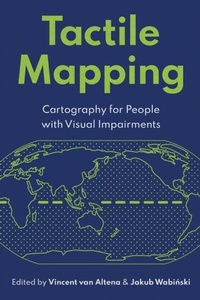
Tactile Mapping
Description

Unaware of the nuances of a landscape, changes in elevation, or the presence of nearby bodies of water, people with visual impairments often need maps to tell them more. The lack of a geographic overview not only hinders exploration of unfamiliar neighborhoods but can also impede a geospatial understanding of local, regional, and international phenomena. Tactile Mapping: Cartography for People with Visual Impairments¿aims to bring together the research on cartography, mapmakers, and tactile map users by exploring the subject from a multidisciplinary perspective.
A collaboration by skilled professionals, domain experts, and people with visual impairments,¿Tactile Mapping¿offers fresh insights from three perspectives: user experience, scientific research, and practical implementation. Through this collection, cartographers and other geographic practitioners can delve into the foundations and methods of presenting geographic information for greater accessibility.
Dr. Vincent van Altena, Senior Researcher at Kadaster (the Netherlands), is a geospatial expert with a background in theology and GIS. He leads the Dutch initiative on tactile mapping and is co-chair of the International Cartographic Association (ICA) Working Group on Inclusive Cartography. In his free time, Vincent enjoys music and cooking.
Dr. Jakub Wabinski, Assistant Professor at the Military University of Technology in Warsaw, Poland, is a co-chair of the ICA Working Group on Inclusive Cartography. Jakub, whose research focuses on tactile map design, has a background in geospatial engineering and a passion for novel geovisualization methods. In his free time, Jakub enjoys board games and exploring the outdoors.
All prices
More details
Other editions
Additional editions
Content
FOREWORD (Jack Dangermond)
FOREWORD (Marek Kalbarczyk)
PART 1: INTRODUCTION
Living without sight (Ellen Zieleman)
Chapter 1: From visual to tactile: Societal attitudes and accessible information (Vincent van Altena)
PART 2: MAPS AND PERCEPTION
Defying darkness (Ran Nitka)
Chapter 2: The relevance of maps in understanding our world (Georg Gartner)
Chapter 3: Understanding through touch (Astrid Kappers)
The development of tactile mapping in Norway (Carl William Lund and Henrik Gulliksen Schüller)
Dreams become a goal (Ashna Abdulrahman Kareem Zada)
PART 3: DESIGNING TACTILE MAPS
A journey beyond knowledge (Petr Novák)
Chapter 4: Map symbol design: Visual and haptic variables (Amy L. Griffin)
Chapter 5: Map design and cognition (Jakub Wabinski and Simon Ungar)
Chapter 6: Generalization for tactile maps (Guillaume Touya)
Tactile maps of historic gardens (Jakub Wabinski)
Making the invisible visible (Shirly Goldner)
PART 4: USERS AND EDUCATION
Completely lost without maps (Leydiane Cristina Santana)
Chapter 7: User-centered and inclusive cartographic design (Robert Roth, Merve Keskin, and Zdenek Stachon)
Chapter 8: Learning geography when you're blind (Carla Cristina Reinaldo Gimenes de Sena and Waldirene Ribeiro do Carmo)
Chapter 9: Training in orientation and mobility (Petr Cervenka)
A collaborative approach to tactile mapping in the Netherlands (Jolijn Jansen)
Tactile world thematic map (Young-Hoon Kim)
PART 5: RELIABLE OUTPUT
We drop things at the same rate (Dorothy Atieno Lensa)
Chapter 10: Accessible media (Radek Barvír, Alena Vondráková, and Jan Brus)
Chapter 11: Methodical reflections (Albina Moscicka)
3D printed cartography in East Africa (Samuel Foulkes and Quentin Roa)
Optimized route planning for blind pedestrians (Sagi Dalyot and Achituv Cohen)
Maps aren't just a fun gimmick (Parham Doustdar)
CONCLUSION (Vincent van Altena and Jakub Wabinski)
I finally belong (Ellen Zieleman)
ACKNOWLEDGMENTS
