

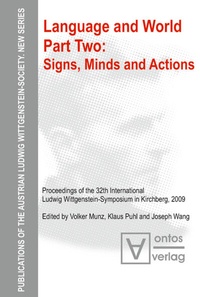
Signs, Minds and Actions
1st Edition
Published on 2. May 2013
336 pages
978-3-11-033057-1 (ISBN)
Description

This second of two volumes brings together invited papers of the 32nd International Wittgenstein Symposium (Kirchberg/W. (Austria), 2009). The collection not only contains articles related to some of Wittgenstein's central arguments but also holds contributions that deal with the role and function of signs, as well as with the relations between language and action, consciousness and metaphysics. An interdisciplinary workshop was dedicated to "Wittgenstein and Literature", an area of study which has been prominent in the philosophical discourse of the last decade. Contributors to this volume are Anat Biletzki, Michael Dummett, Laurence Goldstein, Peter Janich, Brian McGuinness, Marjorie Perloff, David Schalkwyk, Joachim Schulte, Pirmin Stekeler-Weithofer, David Stern, Eike von Savigny among others.
More details
Other editions
Additional editions
Volker Munz | Klaus Puhl | Joseph Wang
Signs, Minds and Actions
Book
07/2010
1st Edition
De Gruyter
€149.95
Shipment within 7-9 days

Volker Munz | Klaus Puhl | Joseph Wang
Munz, Volker; Puhl, Klaus; Wang, Joseph: Language and World / Signs, Minds and Actions
Book
01/2010
De Gruyter
€119.95
Article exhausted; check different version
Content
1 - Preface [Seite 5]
2 - Theories of the Linguistic Sign [Seite 11]
2.1 - The Coherence Theory of Truth: Russell's Worst Invention? Stewart Candlish and Nic Damnjanovic, Perth [Seite 13]
2.2 - Names, Nonsubstitutivity and the Tanney Puzzle Laurence Goldstein, Kent [Seite 23]
2.3 - Is there a Language 'Behind' Speaking? How to Look at 20th Century Language Theory in an Alternative Way Sybille Krämer, Berlin [Seite 39]
3 - Language and Action [Seite 51]
3.1 - Sprechen als vernünftiges Handeln: Grundlage einer rationalen Hermeneutik Peter Janich, Marburg [Seite 53]
3.2 - On the Pragmatics of Unanswerable Questions Peter Kügler, Innsbruck [Seite 63]
3.3 - Zur Performativität des Narrativen: Vorüberlegungen zu einer performativen Narratologie Alexandra Strohmaier, Graz [Seite 77]
4 - Language and Consciousness [Seite 95]
4.1 - Sense-data and Senses* Michael Dummett, Oxford [Seite 97]
4.2 - Showing and Self-Presentation of Experiences - Some Philosophical Cases Johann Christian Marek, Graz [Seite 103]
4.3 - Sind Eindrücke Informationsträger? Was wir aus PU §§354-356 lernen können. Eike von Savigny, Bielefeld [Seite 113]
4.4 - The Harmony Chapter Joachim Schulte, Zürich [Seite 123]
4.5 - Wittgenstein on the Inverted Spectrum David Stern, Iowa City [Seite 135]
5 - Language and Metaphysics [Seite 145]
5.1 - The 'Language and World' of Religion* Anat Biletzki, Tel Aviv [Seite 147]
5.2 - Realismus, Ontologie und Sprachabhängigkeit Volker Gadenne, Linz [Seite 157]
5.3 - Und Gott war das Wort: Wittgensteins niedrige Absichten Esther Ramharter, Wien [Seite 169]
5.4 - Objective Interpretation and the Metaphysics of Meaning Maria E. Reicher, Aachen [Seite 181]
5.5 - Generisches Wissen in kategorialen Inferenzstrukturen: Zur Metaphysik des Begrifflichen. Pirmin Stekeler-Weithofer, Leipzig [Seite 191]
6 - Reality and Construction [Seite 217]
6.1 - Texts Do Not Reflect Outer Reality. What Do They Do Then? Krzysztof Abriszewski, Torun [Seite 219]
6.2 - Conceptualizing Technoscience in a Reasonable, Constructivist Way Ewa Binczyk, Torun [Seite 227]
6.3 - How the Category of Embodiment Transforms the Problems of Philosophy of the Language: The Case of Understanding Aleksandra Derra, Torun [Seite 235]
7 - Wittgenstein and the Literary [Seite 243]
7.1 - Das erlösende Wort James C. Klagge, Blacksburg [Seite 245]
7.2 - Wittgenstein and Literature Brian McGuinness, Siena [Seite 257]
7.3 - Writing Philosophy as Poetry: Wittgenstein's Literary Syntax Marjorie Perloff, Stanford [Seite 277]
7.4 - Ludwig Wittgenstein über Wilhelm Busch - "He has the REAL philosophical urge." Josef G. F. Rothhaupt, München [Seite 297]
7.5 - Wittgenstein and Sebald: The Place of Home and the Grammar of Memory David Schalkwyk, Cape Town [Seite 317]
2 - Theories of the Linguistic Sign [Seite 11]
2.1 - The Coherence Theory of Truth: Russell's Worst Invention? Stewart Candlish and Nic Damnjanovic, Perth [Seite 13]
2.2 - Names, Nonsubstitutivity and the Tanney Puzzle Laurence Goldstein, Kent [Seite 23]
2.3 - Is there a Language 'Behind' Speaking? How to Look at 20th Century Language Theory in an Alternative Way Sybille Krämer, Berlin [Seite 39]
3 - Language and Action [Seite 51]
3.1 - Sprechen als vernünftiges Handeln: Grundlage einer rationalen Hermeneutik Peter Janich, Marburg [Seite 53]
3.2 - On the Pragmatics of Unanswerable Questions Peter Kügler, Innsbruck [Seite 63]
3.3 - Zur Performativität des Narrativen: Vorüberlegungen zu einer performativen Narratologie Alexandra Strohmaier, Graz [Seite 77]
4 - Language and Consciousness [Seite 95]
4.1 - Sense-data and Senses* Michael Dummett, Oxford [Seite 97]
4.2 - Showing and Self-Presentation of Experiences - Some Philosophical Cases Johann Christian Marek, Graz [Seite 103]
4.3 - Sind Eindrücke Informationsträger? Was wir aus PU §§354-356 lernen können. Eike von Savigny, Bielefeld [Seite 113]
4.4 - The Harmony Chapter Joachim Schulte, Zürich [Seite 123]
4.5 - Wittgenstein on the Inverted Spectrum David Stern, Iowa City [Seite 135]
5 - Language and Metaphysics [Seite 145]
5.1 - The 'Language and World' of Religion* Anat Biletzki, Tel Aviv [Seite 147]
5.2 - Realismus, Ontologie und Sprachabhängigkeit Volker Gadenne, Linz [Seite 157]
5.3 - Und Gott war das Wort: Wittgensteins niedrige Absichten Esther Ramharter, Wien [Seite 169]
5.4 - Objective Interpretation and the Metaphysics of Meaning Maria E. Reicher, Aachen [Seite 181]
5.5 - Generisches Wissen in kategorialen Inferenzstrukturen: Zur Metaphysik des Begrifflichen. Pirmin Stekeler-Weithofer, Leipzig [Seite 191]
6 - Reality and Construction [Seite 217]
6.1 - Texts Do Not Reflect Outer Reality. What Do They Do Then? Krzysztof Abriszewski, Torun [Seite 219]
6.2 - Conceptualizing Technoscience in a Reasonable, Constructivist Way Ewa Binczyk, Torun [Seite 227]
6.3 - How the Category of Embodiment Transforms the Problems of Philosophy of the Language: The Case of Understanding Aleksandra Derra, Torun [Seite 235]
7 - Wittgenstein and the Literary [Seite 243]
7.1 - Das erlösende Wort James C. Klagge, Blacksburg [Seite 245]
7.2 - Wittgenstein and Literature Brian McGuinness, Siena [Seite 257]
7.3 - Writing Philosophy as Poetry: Wittgenstein's Literary Syntax Marjorie Perloff, Stanford [Seite 277]
7.4 - Ludwig Wittgenstein über Wilhelm Busch - "He has the REAL philosophical urge." Josef G. F. Rothhaupt, München [Seite 297]
7.5 - Wittgenstein and Sebald: The Place of Home and the Grammar of Memory David Schalkwyk, Cape Town [Seite 317]
