

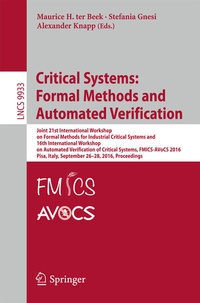
Critical Systems: Formal Methods and Automated Verification
Joint 21st International Workshop on Formal Methods for Industrial Critical Systems and 16th International Workshop on Automated Verification of Critical Systems, FMICS-AVoCS 2016, Pisa, Italy, September 26-28, 2016, Proceedings
Published on 12. September 2016
XVI, 247 pages
978-3-319-45943-1 (ISBN)
Description

This book constitutes the refereed proceedings of the Joint 21st International Workshop on Formal Methods for Industrial Critical Systems and the 16th International Workshop on Automated Verification of Critical Systems, FMICS-AVoCS 2016, held in Pisa, Italy, in September 2016.The 11 full papers and 4 short papers presented together with one invited talk were carefully reviewed and selected from 24 submissions. They are organized in the following sections: automated verification techniques; model-based system analysis; and applications and case studies.
More details
Other editions
Additional editions
Maurice H. ter Beek | Stefania Gnesi | Alexander Knapp
Critical Systems: Formal Methods and Automated Verification
Joint 21st International Workshop on Formal Methods for Industrial Critical Systems and 16th International Workshop on Automated Verification of Critical Systems, FMICS-AVoCS 2016, Pisa, Italy, September 26-28, 2016, Proceedings
Book
09/2016
Springer
€53.49
Shipment within 10-15 days
Content
- Intro
- Preface
- Organization
- Abstracts of the Invited Talks
- Lessons Learned in a Journey Toward Correct-by-Construction Model-Based Development
- Model-based Testing Strategies and Their (In)dependence on Syntactic Model Representations
- Random Testing of Formal Properties for Industrial Critical Systems
- Contents
- Invited Talk
- Model-Based Testing Strategies and Their (In)dependence on Syntactic Model Representations
- 1 Introduction
- 2 Problem Description
- 3 A Model-Independent Method for Input Equivalence Class Partition Testing
- 4 Model-Based Transformation-Invariant Calculation of Input Equivalence Classes
- 5 Conclusion
- References
- Automated Verification Techniques
- Abstract Interpretation of MATLAB Code with Interval Sets
- 1 Introduction
- 1.1 Contribution
- 2 Related Work
- 3 Abstract Interpretation of MATLAB
- 3.1 Syntax and Concrete Semantics
- 3.2 Abstract Semantics
- 3.3 Abstract Interpretation
- 4 Evaluation
- 5 Conclusion
- References
- Workflow Nets Verification: SMT or CLP?
- 1 Introduction
- 2 Preliminaries
- 2.1 Workflow Nets
- 2.2 Modal Specifications
- 2.3 Modal Specifications Verification Method
- 3 Experimental Protocol
- 4 Results and Feedback from Experiments
- 4.1 Observation from State-Machine Workflow Nets Verification
- 4.2 Observation from Marked-Graph Workflow Nets Verification
- 4.3 Observation from Free-Choice Workflow Nets Verification
- 4.4 Observation from Ordinary Workflow Nets Verification
- 4.5 Lessons Learned from Experience
- 5 Related Work and Conclusion
- References
- One Step Towards Automatic Inference of Formal Specifications Using Automated VeriFast
- 1 Introduction
- 2 Architecture
- 3 An Inner Look at Automated VeriFast
- 3.1 Auto-generating Predicates
- 3.2 Auto-fixing
- 4 Automated VeriFast by Examples
- 4.1 Stack Example
- 4.2 Bank Example
- 5 Related Work
- 6 Conclusions and Future Work
- References
- Analyzing Unsatisfiability in Bounded Model Checking Using Max-SMT and Dual Slicing
- 1 Introduction
- 2 Background and Motivating Example
- 2.1 Bounded Model Checking for Embedded Control Software
- 2.2 Example Model with a Counter
- 2.3 Motivation
- 3 Initial Condition Analysis Using Maximum Satisfiability
- 3.1 Max-SMT
- 3.2 Analyzing Initial Conditions with a Partial Max-SMT Solver
- 3.3 Example of Analyzing Initial Conditions
- 3.4 Limitations
- 4 Causal Path Analysis Using Dual Slicing
- 4.1 Dual Slicing
- 4.2 Causal Path Analysis
- 4.3 How to Compare Execution Logs
- 4.4 Example of Analyzing the Causal Path
- 5 Case Study
- 5.1 Outline of the Model and Problem Setting
- 5.2 Results
- 6 Related Work
- 7 Conclusion and Future Work
- References
- Towards the Automated Verification of Weibull Distributions for System Failure Rates
- 1 Introduction
- 2 Multi-state Failure Mode in Satellite Subsystems
- 3 Preliminaries
- 3.1 Continuous-Time Markov Chains
- 3.2 The PRISM Model Checker
- 3.3 Continuous Stochastic Logic
- 4 Approximation of Weibull Failure Models
- 4.1 Weibull Distributions
- 4.2 Increasing Failure Rates (IFR)
- 4.3 Decreasing Failure Rates (DFR)
- 5 Encoding the Weibull Models with CTMCs in PRISM
- 5.1 Encoding the Weibull Distribution with IFR
- 5.2 Encoding the Weibull Distribution with DFR
- 6 Conclusion and Future Work
- References
- Fault-Aware Modeling and Specification for Efficient Formal Safety Analysis
- 1 Introduction
- 2 Model-Based Safety Analysis
- 2.1 Fault Terminology
- 2.2 State-Based Fault Modeling
- 3 Fault-Aware Modeling and Specification
- 3.1 Fault-Aware Kripke Structures
- 3.2 Fault-Aware Linear Temporal Logic
- 3.3 Fault Injection
- 4 Deductive Cause Consequence Analysis
- 4.1 Conceptual Improvement: Safe Fault Sets
- 4.2 Efficiency Improvement: Fault Removal
- 5 Tool Support and Evaluation
- 5.1 The S# Modeling and Analysis Framework for Safety-Critical Systems
- 5.2 Evaluated Case Studies
- 5.3 Evaluation Results
- 6 Conclusion and Future Work
- References
- Model-Based System Analysis
- Block Library Driven Translation Validation for Dataflow Models in Safety Critical Systems
- 1 Introduction
- 2 Formal Specification of Blocks in Dataflow Languages
- 2.1 Example of Block Specification: IntegerDelay
- 2.2 Specifying a Block Family
- 2.3 Verification and Validation of Block Specifications
- 2.4 Handling Loop Constructs
- 3 Verification of the Correctness of Generated Code
- 3.1 Semantic Annotation of the Generated Code
- 3.2 Verification Using the Frama-C Toolset
- 4 Translation Validation of IntegerDelay
- 5 Related Work
- 6 Conclusion and Future Work
- References
- A Model-Based Framework for the Specification and Analysis of Hierarchical Scheduling Systems
- 1 Introduction
- 2 Background
- 3 Formal Model-Based Compositional Framework for Hierarchical Scheduling Systems
- 3.1 Automata-Based Models for a Scheduling Unit
- 3.2 Formal Analysis of Hierarchical Scheduling Systems
- References
- Utilising K Semantics for Collusion Detection in Android Applications
- 1 Introduction
- 1.1 Related Work
- 2 A Collusion Definition on the Android Level
- 3 The K Framework
- 4 Concrete Android Semantics
- 5 Abstract Android Semantics
- 6 Model Checking for Collusion
- 7 Concluding Remarks and Future Work
- References
- Unified Simulation, Visualization, and Formal Analysis of Safety-Critical Systems with
- 1 Introduction
- 2 Case Study: Height Control System
- 3 Modeling Safety-Critical Systems with
- 3.1 Model of Computation
- 3.2 The Modeling Language
- 3.3 Fault Modeling
- 4 Analyzing Safety-Critical Systems with
- 4.1 Execution Semantics of Models
- 4.2 Model Checking Models
- 4.3 Simulating Models
- 4.4 Evaluation of Model Checking Efficiency
- 4.5 Safety Analysis of the Height Control Case Study
- 5 Conclusion and Future Work
- References
- Applications and Case Studies
- Formal Verification of a Rover Anti-collision System
- 1 Introduction
- 2 The S3 Toolset
- 3 Specification and Design of the ARP Use Case
- 3.1 The Context of Use Case
- 3.2 System-Level Safety and Functional Requirements
- 3.3 System Design Choice
- 3.4 High-Level Software Requirements and Software Design
- 4 Property Verification
- 4.1 The Workflow of Property Verification
- 4.2 K-Inductive Proof of Safety Property
- 4.3 BMC and Test Case Generation
- 4.4 Safety Property and Map Data Validation
- 4.5 Property Verification Results
- 5 Equivalence Proof Between Design and Generated Code
- 6 Lessons Learned
- 6.1 Proof of Generated Code
- 6.2 Proof-Driven Design Guidance
- 7 Conclusion and Perspective
- References
- Verification of AUTOSAR Software Architectures with Timed Automata
- 1 Introduction
- 2 Background
- 2.1 Introduction to AUTOSAR
- 2.2 Timed Automata
- 3 Transformation of AUTOSAR Models
- 3.1 Transformation
- 4 AUTOSAR Timing Extensions
- 4.1 Timing Events
- 5 Implementation and Evaluation
- 6 Conclusion
- References
- Verification by Way of Refinement: A Case Study in the Use of Coq and TLA in the Design of a Safety Critical System
- 1 Introduction
- 2 Application: Arbitrary Waveform Generator (AWG)
- 3 Expressing the AWG in TLA+
- 3.1 Limitations of the TLA+ Framework
- 4 Expressing the AWG in TLACoq
- 5 Implementing TLACoq
- 6 Conclusions
- References
- Application of Coloured Petri Nets in Modelling and Simulating a Railway Signalling System
- 1 Introduction
- 2 Introduction to the Railway Signalling Principle and Desired Properties
- 2.1 Railway Signalling Principle
- 2.2 Desired Properties
- 3 The Coloured Petri Net Model
- 3.1 Global Declarations and Route's State
- 3.2 Setting Routes
- 3.3 Clearing Signals
- 3.4 Approach Locked and Back Locked
- 3.5 Releasing Route
- 4 Lessons Learnt and Perspective
- 5 Conclusion and Suggested Work
- References
- Formal Techniques for a Data-Driven Certification of Advanced Railway Signalling Systems
- 1 Introduction
- 2 Innovation in Signalling Systems
- 2.1 ``Communication Based'' Distancing Systems
- 2.2 Highly Innovative Distancing Concepts
- 2.3 Distributed Interlocking Systems
- 2.4 Safety Paradigm Shift
- 3 Integrity and Consistency of Vital Information
- 4 Demonstrating Safety
- 4.1 Data-Driven Safety Design Techniques
- 4.2 Software Faults
- 5 Quantitative Dependability Assessment
- 6 Conclusions
- References
- Author Index
