

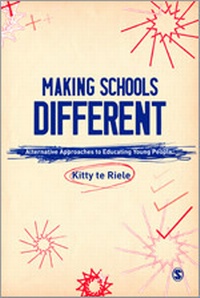
Making Schools Different
Alternative Approaches to Educating Young People
1st Edition
Published on 18. September 2009
176 pages
978-1-84920-445-3 (ISBN)
Description

With a foreword by Professor Stephen Ball
What can we do with students who don't succeed in the typical classroom, and what are the alternatives to full-time schooling?
With contributions from leading academics from Canada, America, the UK, The Netherlands and Australia, this internationally-minded book helps the reader to reflect on the ways young people are taught, and presents possible alternative approaches. Global social and economic changes and technological developments are driving the need for change within education, so that we can better cater for a diversity of young people. This book offers a forward-looking overview of where we are now, and where we might want to go in the future.
It includes chapters on:
- educational innovations;
- learning identities;
- learning spaces;
- e-learning and remote students;
- alternatives in education.
This book will open your mind to the changing experience of schooling, and highlights new and different ways to help those whose needs simply don't fit into the usual mould.
Suitable for all those on all undergraduate and postgraduate Education courses, and for those on Education Studies and Childhood and Youth courses, this book is an engaging, thought-provoking read.
Kitty te Riele is a Senior Lecturer in Education in the Faculty of Arts and Social Sciences, University of Technology, Sydney
What can we do with students who don't succeed in the typical classroom, and what are the alternatives to full-time schooling?
With contributions from leading academics from Canada, America, the UK, The Netherlands and Australia, this internationally-minded book helps the reader to reflect on the ways young people are taught, and presents possible alternative approaches. Global social and economic changes and technological developments are driving the need for change within education, so that we can better cater for a diversity of young people. This book offers a forward-looking overview of where we are now, and where we might want to go in the future.
It includes chapters on:
- educational innovations;
- learning identities;
- learning spaces;
- e-learning and remote students;
- alternatives in education.
This book will open your mind to the changing experience of schooling, and highlights new and different ways to help those whose needs simply don't fit into the usual mould.
Suitable for all those on all undergraduate and postgraduate Education courses, and for those on Education Studies and Childhood and Youth courses, this book is an engaging, thought-provoking read.
Kitty te Riele is a Senior Lecturer in Education in the Faculty of Arts and Social Sciences, University of Technology, Sydney
Reviews / Votes
'In editing this collection of alternative approaches to education for estranged young people, te Riele has shone a strong light on the inability of society to adequately respond to the learning needs of all citizens, regardless of background. She has included chapters on e-learning technologies, vocational education, the concept of learning identities, the education of Indigenous students and in her own chapter, what she calls the 'pedagogy of hope'. She discusses a positive culture of learning, focusing on possibility, establishing a community of hope and critical relfection. She observes the view of Rorty that 'a philosophy of hope ultimately aims to create a fairer and more democratic society;...The fact that such challenges are not new indicates their complexity and location within a web of socio-economic and cultural factors that make progress towards democratic schooling extremely difficult around the world. If we accept that all humans have a deep interest in the knowledge and learning and that working families have an intimate understanding of the issues they face every day, then the current nature of the curriculum must be brought into question. Rather than fitting all young people to a pre-determined world view, it may be that the field of school knowledge and practice must relate and connect more closely with the dispositions and habitus of all young people' -Journal of Education Policy
'This edited text by te Riele begins with an interesting but familiar premise: we are forced to attend school for many years and, during this time, many of us get to the point that we just want to leave and get on with our lives. This sets the context for the remaining chapters of the book - which focus on issues regarding non-participation in, and disengagement from, compulsory education...One of the striking features of the text is that the case studies and other examples clearly illustrate how the concepts discussed throughout the book can be applied in a realistic setting...This will ensure that the appeals to a range of audiences including both educational practitioners and those studying a range of undergraduate and postgraduate courses focusing on education and children's experiences at school' -
British Journal of Educational Technology
'The short chapters make for an easy read. Other useful features of the book include suggested further readings, web pages and discussion questions at the end of each chapter. These can be used to help students think about alternative approaches to schooling. I will recommend this booik to teacher educators, teachers, youth workers and policy makers' -
The Psychology of Education
All prices
More details
Edition
First Edition
Language
English
Place of publication
London
United Kingdom
Target group
College/higher education
Professional and scholarly
ISBN-13
978-1-84920-445-3 (9781849204453)
Copyright in bibliographic data and cover images is held by Nielsen Book Services Limited or by the publishers or by their respective licensors: all rights reserved.
Schweitzer Classification
Other editions
Additional editions
Book
09/2009
1st Edition
SAGE Publications Ltd
€94.70
Shipment within 15-20 days
Book
09/2009
1st Edition
SAGE Publications Ltd
€224.33
Shipment within 15-20 days
Person
Kitty te Riele is Principal Research Fellow in the Victoria Institute for Education, Diversity and Lifelong Learning, at Victoria University in Australia. She researches educational policy and practice for disadvantaged young people, with a particular focus on alternative education initiatives. Her research has involved students, teachers and community members as participants. Kitty has supervised doctoral research students from both Australia and Hong Kong on research projects in primary, secondary and tertiary education. She has taught professional ethics for pre-service teachers and has experience as an active member of faculty and university human research ethics committees. Her most recent book Negotiating Ethical Dilemmas in Youth Research (Routledge, 2013) is co-edited with Rachel Brooks. They have also guest-edited two special issues (for Young and Youth Studies Australia) focused on research ethics.
Content
Educational Innovation for Young People - Kitty te Riele
Alternative Schooling in the USA - Laudan Aron
The Need for Dialogue in Vocational Education - Frans Meijers
New Adulthood, Youth and Identity - Meg Maguire
Learning Identities for Living - Helen Stokes and Johanna Wyn
Doing Identity Differently in Practice - Kitty te Riele (Case Study 6.1) and Frans Meijers (Case Study 6.2)
Embedding the Ethic of Care in School Policies and Practices - Kumari Beck and Wanda Cassidy
Pedagogy of Hope - Kitty te Riele
Engaging Disaffected Young People - Linda Milbourne
Doing Pedagogy Differently in Practice - Jann Eason (Case Study 10.1) and Linda Milbourne (Case Study 10.2)
Learning Spaces in Educational Partnerships - Terri Seddon and Kathleen Ferguson
E-Learning Technologies and Remote Students - Stephen Crump
Part-time Schooling - Marie Brennan, Eleanor Ramsay, Alison Mackinnon and Katherine Hodgetts
Doing Place and Time Differently in Practice - Kathleen Ferguson and Terri Seddon (Case Study 14.1), Kylie Twyford and Stephen Crump (Case Study 14.2) and Katherine Hodgetts (Case Study 14.3)
Learning from Indigenous Education - Wanda Cassidy and Ann Chinnery
Alternative Schooling in the USA - Laudan Aron
The Need for Dialogue in Vocational Education - Frans Meijers
New Adulthood, Youth and Identity - Meg Maguire
Learning Identities for Living - Helen Stokes and Johanna Wyn
Doing Identity Differently in Practice - Kitty te Riele (Case Study 6.1) and Frans Meijers (Case Study 6.2)
Embedding the Ethic of Care in School Policies and Practices - Kumari Beck and Wanda Cassidy
Pedagogy of Hope - Kitty te Riele
Engaging Disaffected Young People - Linda Milbourne
Doing Pedagogy Differently in Practice - Jann Eason (Case Study 10.1) and Linda Milbourne (Case Study 10.2)
Learning Spaces in Educational Partnerships - Terri Seddon and Kathleen Ferguson
E-Learning Technologies and Remote Students - Stephen Crump
Part-time Schooling - Marie Brennan, Eleanor Ramsay, Alison Mackinnon and Katherine Hodgetts
Doing Place and Time Differently in Practice - Kathleen Ferguson and Terri Seddon (Case Study 14.1), Kylie Twyford and Stephen Crump (Case Study 14.2) and Katherine Hodgetts (Case Study 14.3)
Learning from Indigenous Education - Wanda Cassidy and Ann Chinnery
