

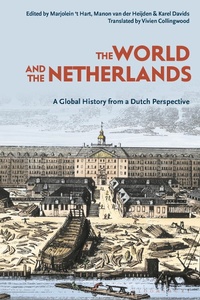
The World and The Netherlands
A Global History from a Dutch Perspective
1st Edition
Published on 26. January 2023
384 pages
978-1-350-19195-2 (ISBN)
Description

This is the first book to examine the history of the country in a way that connects global processes to local developments. Taking account of social, political and economic dynamics over the last thousand years, the book addresses key questions that get to the heart of the Netherlands' role in the world, both historically and in more recent times:
· Why did the 'West' become such a significant actor in the world, and what part did the Netherlands play?
· What were the driving forces in state-formation, and in what respects and why did the Netherlands take a different path to most of Europe?
· How did globalisation impact economic structures and socio-cultural life, and how did the Netherlands react to these new challenges?
· How did this very Christian and bourgeois nation develop into a flagship for liberal tolerance?
The book carefully balances a wider investigation of these issues with close inspections of how ordinary people experienced the changes they prompted. It also provide a convincing, judicious assessment of the ebbs and flows of this small country's global influence over time: prominent as a Golden Age economic powerhouse, colonial power, and bastion of political freedom in some eras, and yet impotent on the world stage at others. Supplemented with 35 images, 10 maps, a wealth of text boxes, charts and tables, as well as a companion website, this book is the definitive history of the Netherlands in a global context.
· Why did the 'West' become such a significant actor in the world, and what part did the Netherlands play?
· What were the driving forces in state-formation, and in what respects and why did the Netherlands take a different path to most of Europe?
· How did globalisation impact economic structures and socio-cultural life, and how did the Netherlands react to these new challenges?
· How did this very Christian and bourgeois nation develop into a flagship for liberal tolerance?
The book carefully balances a wider investigation of these issues with close inspections of how ordinary people experienced the changes they prompted. It also provide a convincing, judicious assessment of the ebbs and flows of this small country's global influence over time: prominent as a Golden Age economic powerhouse, colonial power, and bastion of political freedom in some eras, and yet impotent on the world stage at others. Supplemented with 35 images, 10 maps, a wealth of text boxes, charts and tables, as well as a companion website, this book is the definitive history of the Netherlands in a global context.
More details
Edition
1. Auflage
Language
English
Place of publication
London
United Kingdom
Publishing group
Bloomsbury Publishing PLC
Target group
College/higher education
Illustrations
12 bw illus
ISBN-13
978-1-350-19195-2 (9781350191952)
Copyright in bibliographic data and cover images is held by Nielsen Book Services Limited or by the publishers or by their respective licensors: all rights reserved.
Schweitzer Classification
Other editions
Additional editions
Marjolein 't Hart | Manon van der Heijden | Karel Davids
The World and The Netherlands
A Global History from a Dutch Perspective
Book
02/2023
Bloomsbury Academic
€31.50
Shipment within 15-20 days
Persons
Marjolein 't Hart is Professor Emeritus of the History of State Formation in a Global Context at the Vrije Universiteit Amsterdam and research fellow at Huygens Institute, both the Netherlands. She is the author of The Dutch Wars of Independence (2014).
Manon van der Heijden is Professor of Urban History at Leiden University, the Netherlands. She is the author of Women and Crime in Early Modern Holland (2016).
Karel Davids is Professor Emeritus of Economic and Social History at the Vrije Universiteit Amsterdam, the Netherlands. He is the author of Global Ocean of Knowledge, 1660-1860 (Bloomsbury, 2020), Religion, Technology and the Great and Little Divergences (2013) and The Rise and Decline of Dutch Technological Leadership (2008).
Lex Heerma van Voss is Research Fellow at the International Institute of Social History in Amsterdam, and Professor Emeritus of the History of Social Security at Utrecht University, both the Netherlands.
Leo Lucassen is Director of the International Institute of Social History in Amsterdam and Professor of Global Labour and Migration History at Leiden University, both the Netherlands.
Jeroen Touwen is Associate Professor of Economic and Social History at Leiden University, the Netherlands.
Manon van der Heijden is Professor of Urban History at Leiden University, the Netherlands. She is the author of Women and Crime in Early Modern Holland (2016).
Karel Davids is Professor Emeritus of Economic and Social History at the Vrije Universiteit Amsterdam, the Netherlands. He is the author of Global Ocean of Knowledge, 1660-1860 (Bloomsbury, 2020), Religion, Technology and the Great and Little Divergences (2013) and The Rise and Decline of Dutch Technological Leadership (2008).
Lex Heerma van Voss is Research Fellow at the International Institute of Social History in Amsterdam, and Professor Emeritus of the History of Social Security at Utrecht University, both the Netherlands.
Leo Lucassen is Director of the International Institute of Social History in Amsterdam and Professor of Global Labour and Migration History at Leiden University, both the Netherlands.
Jeroen Touwen is Associate Professor of Economic and Social History at Leiden University, the Netherlands.
Editor
Huygens Institute for the History of the Netherlands in The Hague, Netherlands and VU University Amsterdam, Netherlands
Leiden University, Netherlands
Vrije Universiteit Amsterdam, Netherlands
International Institute of Social History in Amsterdam, the Netherlands
Leiden University, the Netherlands
Translation
Content
List of Illustrations
List of Maps and Figures
Foreword
Introduction
Part I - Before the Great Divergence (c. 1000 - c. 1800)
1. Introduction
2. Growth and the Run-Up to the Great Divergence
3. The Struggle for Power: Socio-Political Developments
4. Community and the Individual: Socio-Cultural Developments
5. Conclusions
Part II - After the Great Divergence (c. 1800 - present day)
6. Introduction
7. Expansion, Stagnation and Globalisation: Economic Developments
8. State Formation, Democratisation and Social Care: Socio-Political Developments
9. New Opportunities, New Values and Norms: Socio-Cultural Developments
10. Conclusions
Recommended Reading
Index
List of Maps and Figures
Foreword
Introduction
Part I - Before the Great Divergence (c. 1000 - c. 1800)
1. Introduction
2. Growth and the Run-Up to the Great Divergence
3. The Struggle for Power: Socio-Political Developments
4. Community and the Individual: Socio-Cultural Developments
5. Conclusions
Part II - After the Great Divergence (c. 1800 - present day)
6. Introduction
7. Expansion, Stagnation and Globalisation: Economic Developments
8. State Formation, Democratisation and Social Care: Socio-Political Developments
9. New Opportunities, New Values and Norms: Socio-Cultural Developments
10. Conclusions
Recommended Reading
Index
