

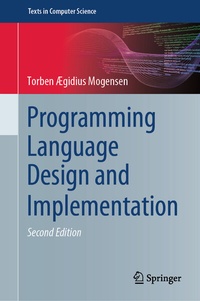
Programming Language Design and Implementation
Description

This concise textbook is intended as a guide for programming-language designers and users to better help them understand consequences of design decisions.
The text aims to provide readers with an overview of the design space for programming languages and how design choices affect implementation. It is not a classical compilers book, as it assumes the reader is familiar with basic compiler implementation techniques; nor is it a traditional comparative programming languages book, because it does not go into depth about any particular language, instead taking examples from a wide variety of programming languages to illustrate design concepts. Readers are assumed to already have done at least a bit of programming in functional, imperative, and object-oriented languages.
Topics and features:
- Provides topic-by-topic coverage of syntax, types, scopes, memory management and more
- (NEW) Integrates coverage on the history of programming languages, types, modules, domain-specific languages, and quantum computation
- Includes many technical exercises and discussion exercises
- (NEW) Contains significant expansions to many chapters and sections
- Inspires readers to think about language design choices, how these interact, and how they can be implemented
- Covers advanced topics such as formal semantics and limits of computation
Suitable for advanced undergraduates and beginning graduates, this highly practical and useful textbook/guide will also offer programming language professionals a superb reference and learning toolkit.
Torben Ægidius Mogensen is Associate Professor at the Dept. of Computer Science at the University of Copenhagen, Denmark.
More details
Other editions
Additional editions
Previous edition
Person
Torben Mogensen has taught programming language design, implementation, and transformation at the University of Copenhagen for over three decades. He is the author of the successful Springer textbook, Introduction to Compiler Design.
Content
1. A Brief History of Programming Languages.- 2. Implementation Strategies.- 3. Syntax.- 4. Memory Management.- 5. Scopes, Functions, and Parameter Passing.- 6. Control Structures.- 7. Types.- 8. Language Paradigms.- 9. Modularisation.- 10. Domain-Speci?c Programming Languages.- 11. Specifying the Semantics of a Programming Language.- 12. Exploring the Limits.
