
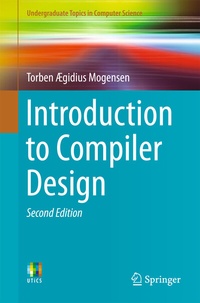
Introduction to Compiler Design
Description
Alles über E-Books | Antworten auf Fragen rund um E-Books, Kopierschutz und Dateiformate finden Sie in unserem Info- & Hilfebereich.
The second edition of this textbook has been fully revised and adds material about loop optimisation, function call optimisation and dataflow analysis. It presents techniques for making realistic compilers for simple programming languages, using techniques that are close to those used in "real" compilers, albeit in places slightly simplified for presentation purposes. All phases required for translating a high-level language to symbolic machine language are covered, including lexing, parsing, type checking, intermediate-code generation, machine-code generation, register allocation and optimisation, interpretation is covered briefly.
Aiming to be neutral with respect to implementation languages, algorithms are presented in pseudo-code rather than in any specific programming language, but suggestions are in many cases given for how these can be realised in different language flavours.
More details
Other editions
New editions
Additional editions

Person
Content
System requirements
File format: PDF
Copy protection: Watermark-DRM (Digital Rights Management)
System requirements:
- Computer (Windows; MacOS X; Linux): Use the free software Adobe Reader, Adobe Digital Editions, or any other PDF viewer of your choice (see eBook Help).
- Tablet/Smartphone (Android; iOS): Install the free app Adobe Digital Editions or another reading app for eBooks, e.g., PocketBook (see eBook Help).
- E-reader: Bookeen, Kobo, Pocketbook, Sony, Tolino and many more (only limited: Kindle).
The file format PDF always displays a book page identically on any hardware. This makes PDF suitable for complex layouts such as those used in textbooks and reference books (images, tables, columns, footnotes). Unfortunately, on the small screens of e-readers or smartphones, PDFs are rather annoying, requiring too much scrolling.
This eBook uses Watermark-DRM, a „soft” copy protection. This means that there are no technical restrictions to prevent illegal distribution. However, there is a personalised watermark embedded in the eBook that can be used to identify the purchaser of the eBook in the event of misuse and to provide evidence for legal purposes.
For more information, see our eBook Help page.