

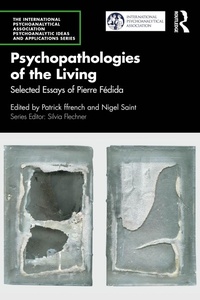
Psychopathologies of the Living
Selected Essays of Pierre Fedida
1st Edition
Published on 17. September 2025
214 pages
978-1-040-41093-6 (ISBN)
Description

Psychopathologies of the Living makes the work of the French psychoanalyst Pierre Fedida (1934-2002) available in English for the first time.
Patrick ffrench and Nigel Saint present key essays selected from Fedida's extensive oeuvre. The book directs attention to two salient dimensions of Fedida's writing: his attention to the pathologies of the body, considered as both a psychic and somatic entity, and his insistence on the relevance of psychoanalytic thought to the sciences of life. The chapters included in this collection detail Fedida's creative use of aesthetic sources in his psychoanalytic work, his distinctive and creative manipulation and revision of central psychoanalytic concepts and his precise attention to the texts of Freud, Ferenczi and Winnicott, among others. This selection of Fedida's essays also shows his avoidance of thematisation or explicit theorisation; for Fedida the theory of psychoanalysis must arise out of the specific interplay of language and the 'space of the session'.
Psychopathologies of the Living will be of great interest to psychoanalysts in practice and in training and to academics and scholars of philosophy, aesthetics and literary studies.
Patrick ffrench and Nigel Saint present key essays selected from Fedida's extensive oeuvre. The book directs attention to two salient dimensions of Fedida's writing: his attention to the pathologies of the body, considered as both a psychic and somatic entity, and his insistence on the relevance of psychoanalytic thought to the sciences of life. The chapters included in this collection detail Fedida's creative use of aesthetic sources in his psychoanalytic work, his distinctive and creative manipulation and revision of central psychoanalytic concepts and his precise attention to the texts of Freud, Ferenczi and Winnicott, among others. This selection of Fedida's essays also shows his avoidance of thematisation or explicit theorisation; for Fedida the theory of psychoanalysis must arise out of the specific interplay of language and the 'space of the session'.
Psychopathologies of the Living will be of great interest to psychoanalysts in practice and in training and to academics and scholars of philosophy, aesthetics and literary studies.
Reviews / Votes
"Among French theorists of psychoanalysis Pierre Fedida (1934-2002) is less well-known to Anglophone readers than Lacan, Anzieu, Kristeva, Laplanche or Green, but this book aims to set that right. Eight new translations are presented, as is an extensive introduction to his work. He was a close and scrupulous reader of Freud's work, relating it to the existential psychology of Binswanger." - Naomi Segal, Professor Emerita, Institute of Languages, Cultures & Societies, University of London"I had the good fortune to know Pierre Fedida personally, and I know and admire his work. I warmly support Patrick Ffrench and Nigel Saint's publication of a selection of his work in translation. This will make an essential contribution to a better understanding of modern psychoanalysis in its capacity to renew, deepen and enrich Freudian thought." - Julia Kristeva, University of Paris
More details
Series
Edition
1. Auflage
Language
English
Place of publication
London
United Kingdom
Publishing group
Taylor & Francis Ltd
Target group
College/higher education
Professional and scholarly
File size
5,05 MB
ISBN-13
978-1-040-41093-6 (9781040410936)
Copyright in bibliographic data and cover images is held by Nielsen Book Services Limited or by the publishers or by their respective licensors: all rights reserved.
Schweitzer Classification
Other editions
Additional editions
Book
09/2025
1st Edition
Routledge
€206.20
Shipment within 10-20 days
Book
09/2025
1st Edition
Routledge
€55.30
Shipment within 10-20 days
Persons
Editors and Translators:
Patrick ffrench is Professor of French at King's College London where he teaches 20th-century French literature, philosophy and cinema, critical theory and psychoanalysis.
Nigel Saint is Associate Professor of French at the University of Leeds where he teaches literature, culture and critical theory, and works on contemporary artists and art theory.
Translators:
Timothy Mathews is a critic and creative writer. His most recent translations are Guillaume Apollinaire, Seated Woman (2022), and selected pages from Roland Barthes, Fragments d'un discours amoureux (2023). timothymathews.com.
Anne-Marie Smith-Di Biasio teaches Modernist Studies and Literary translation at the Catholic University of Paris and is Associate Professor in Liberal Arts at Paris College of Art. Her most recent monograph is Le Palimpseste memoriel. Entendre la memoire au fil des modernismes (SUP 2024).
Patrick ffrench is Professor of French at King's College London where he teaches 20th-century French literature, philosophy and cinema, critical theory and psychoanalysis.
Nigel Saint is Associate Professor of French at the University of Leeds where he teaches literature, culture and critical theory, and works on contemporary artists and art theory.
Translators:
Timothy Mathews is a critic and creative writer. His most recent translations are Guillaume Apollinaire, Seated Woman (2022), and selected pages from Roland Barthes, Fragments d'un discours amoureux (2023). timothymathews.com.
Anne-Marie Smith-Di Biasio teaches Modernist Studies and Literary translation at the Catholic University of Paris and is Associate Professor in Liberal Arts at Paris College of Art. Her most recent monograph is Le Palimpseste memoriel. Entendre la memoire au fil des modernismes (SUP 2024).
Content
Acknowledgments
Series Editor's Foreword
Introduction
Patrick ffrench and Nigel Saint
Chapter One: 'The Site of the Stranger'
Translated by Patrick ffrench and Nigel Saint
Chapter Two: 'The Interlocutor'
Translated by Patrick ffrench and Nigel Saint
Chapter Three: 'Regression'
Translated by Patrick ffrench and Nigel Saint
Chapter Four: 'Where Does the Human Body Begin?'
Translated by Patrick ffrench and Nigel Saint
Chapter Five: 'On the Primitive'
Translated by Timothy Mathews
Chapter Six: 'The Dream's Hypochondria'
Translated by Patrick ffrench and Nigel Saint
Chapter Seven: 'Day's Residues, Life's Residues'
Translated by Anne-Marie Smith-Di Basio
Chapter Eight: 'The Indistinct Breath of the Image'
Translated by Patrick ffrench and Nigel Saint
Bibliography
Series Editor's Foreword
Introduction
Patrick ffrench and Nigel Saint
Chapter One: 'The Site of the Stranger'
Translated by Patrick ffrench and Nigel Saint
Chapter Two: 'The Interlocutor'
Translated by Patrick ffrench and Nigel Saint
Chapter Three: 'Regression'
Translated by Patrick ffrench and Nigel Saint
Chapter Four: 'Where Does the Human Body Begin?'
Translated by Patrick ffrench and Nigel Saint
Chapter Five: 'On the Primitive'
Translated by Timothy Mathews
Chapter Six: 'The Dream's Hypochondria'
Translated by Patrick ffrench and Nigel Saint
Chapter Seven: 'Day's Residues, Life's Residues'
Translated by Anne-Marie Smith-Di Basio
Chapter Eight: 'The Indistinct Breath of the Image'
Translated by Patrick ffrench and Nigel Saint
Bibliography
