

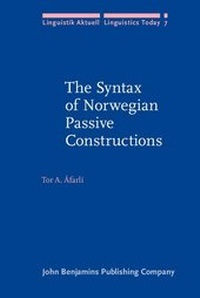
The Syntax of Norwegian Passive Constructions
1st Edition
Published on 6. November 1992
XII, 177 pages
978-90-272-8244-6 (ISBN)
Description

This book provides an analysis of the passive phenomenon in general and of Norwegian passive constructions in particular. Related topics such as English passive constructions and Norwegian ergative constructions are also examined. The analysis is carried out within a Government and Binding framework. Chapter 1 contains a very brief introduction to GB syntax and a description of the passive phenomenon and its manifestation in Norwegian. The "orthodox analysis" of the passive as proposed in Chomsky's Lectures on Government and Binding is contrasted with the "new analysis", which claims that "the passive morpheme" is an argument of the verb. The book sets out to show that a version of this "new analysis" successfully explains the basic properties of Norwegian passives. Chapters 2 and 3 examine properties of Norwegian passives, notably properties related to Theta-role assignment and Case assignment. Chapter 4 compares the Norwegian with the English passive and proposes a unified analysis of the two. Chapter 5 discusses various cases of passivization failure in Norwegian, while Chapter 6 focuses on the scope of movement in passive and ergative constructions in Norwegian and proposes a syntactic level "beneath" D-structure.
More details
Other editions
Additional editions
Tor A. Afarli
The Syntax of Norwegian Passive Constructions
Book
11/1992
John Benjamins Publishing Co
€104.94
Shipment within 10-15 days
Person
Content
- Intro
- CONTENTS
- Preface
- Chapter 1: Introduction
- 1.1 Introduction to GB-syntax
- 1.1.1 Basics
- 1.1.2 Some Specific Questions
- 1.2 Introduction to Passive
- 1.2.1 The Active/Passive Alternation
- 1.2.2 Brief Description of Norwegian Passives
- 1.2.2.1 The Periphrastic Passive
- 1.2.2.2 The S-passive
- 1.2.2.3 The Isomorphism between the two Passive Types
- 1.2.3 Approaches to Passive in GB-syntax
- 1.2.3.1 The Orthodox Analysis
- 1.2.3.2 The New Analysis
- 1.3 Conclusion
- Notes
- Chapter 2: Theta-role Assignment in Passives
- 2.1 The Passive Morpheme (PASS)
- 2.1.1 PASS as an Argument of the Verb
- 2.1.2 PASS and Overt Passive Morphology
- 2.1.3 PASS and the External Role
- 2.1.3.1 Previous Analyses within the New Approach
- 2.1.3.2 Conditions on Word-internal Theta-role Assignment
- 2.2 The Agent Phrase
- 2.3 Conclusion
- Notes
- Chapter 3: Case Assignment in Passives
- 3.1 Case in the LGB Analysis of Passives
- 3.2 The Notion of Case Transmission and Impersonal Passives
- 3.3 The Assumption that Passive Verbs May Assign Case
- 3.3.1 The Source of Postverbal Case Assignment in Passives
- 3.3.2 Consequences of the Assumption that Passive Verbs Assign Case
- 3.3.2.1 PASS, Case and Visibility
- 3.3.2.2 Case Conflict?
- 3.3.2.3 Burzio's Generalization
- 3.4 The Definiteness Effect
- 3.5 Conclusion
- Notes
- Chapter 4: A Comparative Analysis: Norwegian and English Passives
- 4.1 Explanation Related to Theta Properties
- 4.2 Explanation Related to Case Properties
- 4.2.1 PASS and Case
- 4.2.2 Passive from Transitive Verbs
- 4.2.3 Passive from Intransitive Verbs
- 4.2.4 Passive from Ditransitive Verbs
- 4.2.5 Pseudopassives
- 4.3 Ergative Constructions in Norwegian and English
- 4.4 A Note on Agreement in Norwegian and English
- 4.5 Conclusion
- Notes
- Chapter 5: Passivization and Ergative Verbs
- 5.1 Ergative Verbs
- 5.1.1 Types of Ergative Verb
- 5.1.2 Passivization Failure with Ergative Verbs
- 5.2 Concealed Ergative Verbs
- 5.2.1 Auxiliary Verbs
- 5.2.2 Copular Verbs
- 5.3 Possible Problems
- 5.3.1 A Note on Psych-verbs
- 5.3.2 Are There Unergative Verbs that Resist Passivization?
- 5.4 Conclusion
- Notes
- Chapter 6: Organization of Grammar and Ergative and Passive Constructions
- 6.1 The Scope of Movement in Ergative and Passive Constructions
- 6.2 On the Relation between Lexicon and Syntax
- 6.2.1 Argument Structure and Theta-role Assignment
- 6.2.2 Projection from Lexicon to Syntax
- 6.2.3 Double Object Constructions
- 6.3 Analysis of the Ergative/Passive Asymmetry
- 6.3.1 Analysis of Ergative Constructions
- 6.3.2 Analysis of Passive Constructions
- 6.3.3 Levels of Grammar
- 6.3.4 The Status of the Projection Principle
- 6.4 Conclusion
- Notes
- References
- Subject Index
