


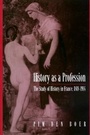
History as a Profession
The Study of History in France, 1818-1914
1st Edition
Published on 14. July 2014
488 pages
978-1-4008-6484-3 (ISBN)
Description

This is a vivid portrait of the French historical profession in the nineteenth and early twentieth centuries, concluding just before the emergence of the famous Annales school of historians. It places the profession in its social, academic, and political context and shows that historians of the period have been unfairly maligned as amateurish and primitive in comparison to their more celebrated successors.
Pim den Boer begins by sketching the contours of French historiography in the nineteenth century, examining the quantity of historical writing, its subject matter, and who wrote it. He traces the growing influence of professional historians. He shows the increasing involvement of the national government in historical studies, paying special attention to the impact of political factions, ranging from ultraroyalists to radical republicans. He explores how historical research and teaching changed at schools and universities. And he shows how nineteenth-century historians' keen understanding of the past and of historical methodology laid the foundations for historiography in the twentieth century. archives, including official documents, confidential reports, and personal letters. Den Boer makes use of statistical, biographical, and methodological analysis and demonstrates comprehensive knowledge of both minor historians and leading scholars, including Charles Seignobos and Charles-Victor Langlois.
Originally published in 1998.
The Princeton Legacy Library uses the latest print-on-demand technology to again make available previously out-of-print books from the distinguished backlist of Princeton University Press. These editions preserve the original texts of these important books while presenting them in durable paperback and hardcover editions. The goal of the Princeton Legacy Library is to vastly increase access to the rich scholarly heritage found in the thousands of books published by Princeton University Press since its founding in 1905.
Pim den Boer begins by sketching the contours of French historiography in the nineteenth century, examining the quantity of historical writing, its subject matter, and who wrote it. He traces the growing influence of professional historians. He shows the increasing involvement of the national government in historical studies, paying special attention to the impact of political factions, ranging from ultraroyalists to radical republicans. He explores how historical research and teaching changed at schools and universities. And he shows how nineteenth-century historians' keen understanding of the past and of historical methodology laid the foundations for historiography in the twentieth century. archives, including official documents, confidential reports, and personal letters. Den Boer makes use of statistical, biographical, and methodological analysis and demonstrates comprehensive knowledge of both minor historians and leading scholars, including Charles Seignobos and Charles-Victor Langlois.
Originally published in 1998.
The Princeton Legacy Library uses the latest print-on-demand technology to again make available previously out-of-print books from the distinguished backlist of Princeton University Press. These editions preserve the original texts of these important books while presenting them in durable paperback and hardcover editions. The goal of the Princeton Legacy Library is to vastly increase access to the rich scholarly heritage found in the thousands of books published by Princeton University Press since its founding in 1905.
More details
Series
Edition
Course Book
Language
English
Place of publication
Princeton, NJ
United States
Publishing group
De Gruyter
Target group
Professional and scholarly
Edition type
Digital original
Illustrations
11 halftones 1 map 24 tables
ISBN-13
978-1-4008-6484-3 (9781400864843)
Schweitzer Classification
Other editions
Additional editions

Book
04/2016
Princeton University Press
€153.90
Article not available at the moment

Book
07/2014
Princeton University Press
€58.70
Article not available at the moment
Book
07/1998
Princeton University Press
€142.60
Article exhausted; check different version
Persons
Content
List of Illustrations
List of Tables
Preface
Ch. 1 The Contours of French Historiography, 1820-1914 3
Ch. 2 Paying for History 50
Ch. 3 History at School 118
Ch. 4 History and Higher Education 175
Ch. 5 The Old Professors and the New 224
Ch. 6 Changes in Professional Writing 309
Conclusion 358
Appendixes 367
Notes 387
Sources and Bibliography 437
Name Index 463
List of Tables
Preface
Ch. 1 The Contours of French Historiography, 1820-1914 3
Ch. 2 Paying for History 50
Ch. 3 History at School 118
Ch. 4 History and Higher Education 175
Ch. 5 The Old Professors and the New 224
Ch. 6 Changes in Professional Writing 309
Conclusion 358
Appendixes 367
Notes 387
Sources and Bibliography 437
Name Index 463
