

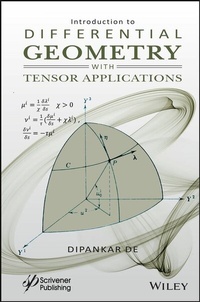
Introduction to Differential Geometry with Tensor Applications
Description

This is the only volume of its kind to explain, in precise and easy-to-understand language, the fundamentals of tensors and their applications in differential geometry and analytical mechanics with examples for practical applications and questions for use in a course setting.
Introduction to Differential Geometry with Tensor Applications discusses the theory of tensors, curves and surfaces and their applications in Newtonian mechanics. Since tensor analysis deals with entities and properties that are independent of the choice of reference frames, it forms an ideal tool for the study of differential geometry and also of classical and celestial mechanics. This book provides a profound introduction to the basic theory of differential geometry: curves and surfaces and analytical mechanics with tensor applications. The author has tried to keep the treatment of the advanced material as lucid and comprehensive as possible, mainly by including utmost detailed calculations, numerous illustrative examples, and a wealth of complementing exercises with complete solutions making the book easily accessible even to beginners in the field.
Groundbreaking and thought-provoking, this volume is an outstanding primer for modern differential geometry and is a basic source for a profound introductory course or as a valuable reference. It can even be used for self-study, by students or by practicing engineers interested in the subject.
Whether for the student or the veteran engineer or scientist, Introduction to Differential Geometry with Tensor Applications is a must-have for any library.
This outstanding new volume:
* Presents a unique perspective on the theories in the field not available anywhere else
* Explains the basic concepts of tensors and matrices and their applications in differential geometry and analytical mechanics
* Is filled with hundreds of examples and unworked problems, useful not just for the student, but also for the engineer in the field
* Is a valuable reference for the professional engineer or a textbook for the engineering student
More details
Other editions
Additional editions
Person
Content
- Cover
- Half-Title Page
- Series Page
- Title Page
- Copyright Page
- Dedication
- Contents
- Preface
- About the Book
- Introduction
- Part I: TENSOR THEORY
- 1 Preliminaries
- 1.1 Introduction
- 1.2 Systems of Different Orders
- 1.3 Summation Convention Certain Index
- 1.3.1 Dummy Index
- 1.3.2 Free Index
- 1.4 Kronecker Symbols
- 1.5 Linear Equations
- 1.6 Results on Matrices and Determinants of Systems
- 1.7 Differentiation of a Determinant
- 1.8 Examples
- 1.9 Exercises
- 2 Tensor Algebra
- 2.1 Introduction
- 2.2 Scope of Tensor Analysis
- 2.2.1 n-Dimensional Space
- 2.3 Transformation of Coordinates in Sn
- 2.3.1 Properties of Admissible Transformation of Coordinates
- 2.4 Transformation by Invariance
- 2.5 Transformation by Covariant Tensor and Contravariant Tensor
- 2.6 The Tensor Concept: Contravariant and Covariant Tensors
- 2.6.1 Covariant Tensors
- 2.6.2 Contravariant Vectors
- 2.6.3 Tensor of Higher Order
- 2.6.3.1 Contravariant Tensors of Order Two
- 2.6.3.2 Covariant Tensor of Order Two
- 2.6.3.3 Mixed Tensors of Order Two
- 2.7 Algebra of Tensors
- 2.7.1 Equality of Two Tensors of Same Type
- 2.8 Symmetric and Skew-Symmetric Tensors
- 2.8.1 Symmetric Tensors
- 2.8.2 Skew-Symmetric Tensors
- 2.9 Outer Multiplication and Contraction
- 2.9.1 Outer Multiplication
- 2.9.2 Contraction of a Tensor
- 2.9.3 Inner Product of Two Tensors
- 2.10 Quotient Law of Tensors
- 2.11 Reciprocal Tensor of a Tensor
- 2.12 Relative Tensor, Cartesian Tensor, Affine Tensor, and Isotropic Tensors
- 2.12.1 Relative Tensors
- 2.12.2 Cartesian Tensors
- 2.12.3 Affine Tensor
- 2.12.4 Isotropic Tensor
- 2.12.5 Pseudo-Tensor
- 2.13 Examples
- 2.14 Exercises
- 3 Riemannian Metric
- 3.1 Introduction
- 3.2 The Metric Tensor
- 3.3 Conjugate Tensor
- 3.4 Associated Tensors
- 3.5 Length of a Vector
- 3.5.1 Length of Vector
- 3.5.2 Unit Vector
- 3.5.3 Null Vector
- 3.6 Angle Between Two Vectors
- 3.6.1 Orthogonality of Two Vectors
- 3.7 Hypersurface
- 3.8 Angle Between Two Coordinate Hypersurfaces
- 3.9 Exercises
- 4 Tensor Calculus
- 4.1 Introduction
- 4.2 Christoffel Symbols
- 4.2.1 Properties of Christoffel Symbols
- 4.3 Transformation of Christoffel Symbols
- 4.3.1 Law of Transformation of Christoffel Symbols of 1st Kind
- 4.3.2 Law of Transformation of Christoffel Symbols of 2nd Kind
- 4.4 Covariant Differentiation of Tensor
- 4.4.1 Covariant Derivative of Covariant Tensor
- 4.4.2 Covariant Derivative of Contravariant Tensor
- 4.4.3 Covariant Derivative of Tensors of Type (0,2)
- 4.4.4 Covariant Derivative of Tensors of Type (2,0)
- 4.4.5 Covariant Derivative of Mixed Tensor of Type (s, r)
- 4.4.6 Covariant Derivatives of Fundamental Tensors and the Kronecker Delta
- 4.4.7 Formulas for Covariant Differentiation
- 4.4.8 Covariant Differentiation of Relative Tensors
- 4.5 Gradient, Divergence, and Curl
- 4.5.1 Gradient
- 4.5.2 Divergence
- 4.5.2.1 Divergence of a Mixed Tensor (1,1)
- 4.5.3 Laplacian of an Invariant
- 4.5.4 Curl of a Covariant Vector
- 4.6 Exercises
- 5 Riemannian Geometry
- 5.1 Introduction
- 5.2 Riemannian-Christoffel Tensor
- 5.3 Properties of Riemann-Christoffel Tensors
- 5.3.1 Space of Constant Curvature
- 5.4 Ricci Tensor, Bianchi Identities, Einstein Tensors
- 5.4.1 Ricci Tensor
- 5.4.2 Bianchi Identity
- 5.4.3 Einstein Tensor
- 5.5 Einstein Space
- 5.6 Riemannian and Euclidean Spaces
- 5.6.1 Riemannian Spaces
- 5.6.2 Euclidean Spaces
- 5.7 Exercises
- 6 The e-Systems and the Generalized Kronecker Deltas
- 6.1 Introduction
- 6.2 e-Systems
- 6.3 Generalized Kronecker Delta
- 6.4 Contraction of dijkaß?
- 6.5 Application of e-Systems to Determinants and Tensor Characters of Generalized Kronecker Deltas
- 6.5.1 Curl of Covariant Vector
- 6.5.2 Vector Product of Two Covariant Vectors
- 6.6 Exercises
- Part II: DIFFERENTIAL GEOMETRY
- 7 Curvilinear Coordinates in Space
- 7.1 Introduction
- 7.2 Length of Arc
- 7.3 Curvilinear Coordinates in E³
- 7.3.1 Coordinate Surfaces
- 7.3.2 Coordinate Curves
- 7.3.3 Line Element
- 7.3.4 Length of a Vector
- 7.3.5 Angle Between Two Vectors
- 7.4 Reciprocal Base Systems
- 7.5 Partial Derivative
- 7.6 Exercises
- 8 Curves in Space
- 8.1 Introduction
- 8.2 Intrinsic Differentiation
- 8.3 Parallel Vector Fields
- 8.4 Geometry of Space Curves
- 8.4.1 Plane
- 8.5 Serret-Frenet Formula
- 8.5.1 Bertrand Curves
- 8.6 Equations of a Straight Line
- 8.7 Helix
- 8.7.1 Cylindrical Helix
- 8.7.2 Circular Helix
- 8.8 Exercises
- 9 Intrinsic Geometry of Surfaces
- 9.1 Introduction
- 9.2 Curvilinear Coordinates on a Surface
- 9.3 Intrinsic Geometry: First Fundamental Quadratic Form
- 9.3.1 Contravariant Metric Tensor
- 9.4 Angle Between Two Intersecting Curves on a Surface
- 9.4.1 Pictorial Interpretation
- 9.5 Geodesic in Rn
- 9.6 Geodesic Coordinates
- 9.7 Parallel Vectors on a Surface
- 9.8 Isometric Surface
- 9.8.1 Developable
- 9.9 The Riemannian-Christoffel Tensor and Gaussian Curvature
- 9.9.1 Einstein Curvature
- 9.10 The Geodesic Curvature
- 9.11 Exercises
- 10 Surfaces in Space
- 10.1 Introduction
- 10.2 The Tangent Vector
- 10.3 The Normal Line to the Surface
- 10.4 Tensor Derivatives
- 10.5 Second Fundamental Form of a Surface
- 10.5.1 Equivalence of Definition of Tensor baß
- 10.6 The Integrability Condition
- 10.7 Formulas of Weingarten
- 10.7.1 Third Fundamental Form
- 10.8 Equations of Gauss and Codazzi
- 10.9 Mean and Total Curvatures of a Surface
- 10.10 Exercises
- 11 Curves on a Surface
- 11.1 Introduction
- 11.2 Curve on a Surface: Theorem of Meusnier
- 11.2.1 Theorem of Meusnier
- 11.3 The Principal Curvatures of a Surface
- 11.3.1 Umbillic Point
- 11.3.2 Lines of Curvature
- 11.3.3 Asymptotic Lines
- 11.4 Rodrigue's Formula
- 11.5 Exercises
- 12 Curvature of Surface
- 12.1 Introduction
- 12.2 Surface of Positive and Negative Curvature
- 12.3 Parallel Surfaces
- 12.3.1 Computation of aaß and baß
- 12.4 The Gauss-Bonnet Theorem
- 12.5 The n-Dimensional Manifolds
- 12.6 Hypersurfaces
- 12.7 Exercises
- Part III: ANALYTICAL MECHANICS
- 13 Classical Mechanics
- 13.1 Introduction
- 13.2 Newtonian Laws of Motion
- 13.3 Equations of Motion of Particles
- 13.4 Conservative Force Field
- 13.5 Lagrangean Equations of Motion
- 13.6 Applications of Lagrangean Equations
- 13.7 Himilton's Principle
- 13.8 Principle of Least Action
- 13.9 Generalized Coordinates
- 13.10 Lagrangean Equations in Generalized Coordinates
- 13.11 Divergence Theorem, Green's Theorem, Laplacian Operator, and Stoke's Theorem in Tensor Notation
- 13.12 Hamilton's Canonical Equations
- 13.12.1 Generalized Momenta
- 13.13 Exercises
- 14 Newtonian Law of Gravitations
- 14.1 Introduction
- 14.2 Newtonian Laws of Gravitation
- 14.3 Theorem of Gauss
- 14.4 Poisson's Equation
- 14.5 Solution of Poisson's Equation
- 14.6 The Problem of Two Bodies
- 14.7 The Problem of Three Bodies
- 14.8 Exercises
- Appendix A: Answers to Even-Numbered Exercises
- References
- Index
- Also of Interest
- EULA
1
Preliminaries
1.1 Introduction
Some quantities are associated with their magnitude and direction, but certain quantities are associated with two or more directions. Such a quantity is called a tensor, e.g., the stress at a point of an elastic solid is an example of a tensor which depends on two directions: one is normal and the other is that of force on the area. Tensor comes from the word tension.
In this chapter, we discuss the notation of systems of different orders, which are applied in the theory of determinants, symbols, and summation conventions. Also, results on some matrices and determinants are discussed because they will be used frequently later on.
1.2 Systems of Different Orders
Let us consider the two quantities, a1, a1 or a1, a2, which are represented by ai or ai, respectively, for i = 1, 2. In such cases, the expressions ai, ai, ai j, ai j, and are called systems. In each value of ai and ai are called systems of first order and each value of ai j, ai j, and is called a double system or system of second order, of which a12, a22a23, a13, and are called their respective components. Similarly, we have systems of the third order that depend on three indices shown as ai jk, aikl, ai jm, ai jn, and and each number of their respective components are 8.
In a system of order zero, it is shown that the quantity has no index, such as a. The upper and lower indices of a system are called its indices of contravariance and covariance, respectively. For a system of , i and j are indices of a contravariant and k is of covariance. Accordingly, the system Aij is called a contravariant system, Aklm is called a covariant system, and is called a mixed system.
1.3 Summation Convention Certain Index
If in some expressions a certain index occurs twice, this means that this expression is summed with respect to that index for all admissible values of the index.
Thus, the linear form has an index, i, occurring in it twice. We will omit the summation symbol S and write aixi to mean a1x1 + a2x2 + a3x3 + a4x4. In order to avoid S, we shall make use of a convention used by A. Einstein which is accordingly called the Einstein Summation Convention or Summation Convention.
Of course, the range of admissible values of the index, 1 to 4 in this case, must be specified. If the symbol i has a range of values from 1 to 3 and j ranges from 1 to 4, the expression
(1.1)represents three linear forms:
(1.2)Here, index i is the identifying (free) index and since index j, occurs twice, it is the summation index.
We shall adopt this convention throughout the chapters and take the sum whenever a letter appears in a term once in a subscript and once in superscript or if the same two indices are in subscript or are in superscript.
Example 1.3.1. Express the sum .
Solution:
1.3.1 Dummy Index
The summation (or dummy) index can be changed at will. Thus, Equation (1.1) can be written in the form aikxk if k has the same range of values as j.
We will assume that the summation and identifying indices have ranges of value from 1 to n.
Thus, aixi will represent a linear form
For example, can be written as aikxixk and here, i and k both are dummy indexes.
So, any dummy index can be replaced by any other index with a range of the same numbers.
1.3.2 Free Index
If in an expression an index is not a dummy, i.e., it is not repeated twice, then it is called a free index. For example, for ai jxj, the index j is dummy, but index i is free.
1.4 Kronecker Symbols
A particular system of second order denoted by , is defined as
(1.3)Such a system is called a Kronecker symbol or Kronecker delta.
For example, , by summation convention is expressed as
We shall now consider some properties of this system.
Property 1.4.1. If x1, x2, . xn are independent variables, then
(1.4)Property 1.4.2. From the summation convention, we get
Similarly, dii = dii = n
Property 1.4.3. From the definition of di j, taken as an element of unit matrix I, we have
Property 1.4.4.
(1.5) (1.6) (1.7)Property 1.4.5.
Also, by definition,
In particular, when i = k, we get
Remark 1.4.1. If we multiply xk by , we simply replace index k of xk with index i and for this reason, is called a substitution factor.
Example 1.4.1. Evaluate (a) and (b) where the indices take all values from 1 to n.
(1.8a) (1.8b)(b) by 1.8b
Example 1.4.2. If xi and yi are independent coordinates of a point, it is shown that
Solution: The partial derivative of ? in two coordinate systems are different and are connected by the following formula of Differential Calculus:
(1.9a)Since xj is independent of, when j ? i
(1.9b)Hence, the result follows from (1.9a) and (1.9b).
1.5 Linear Equations
Let us consider n linear equations such that
(1.10a)where x1, x2, .. xn are n unknown variables.
Let us consider:
For the expansion of det |ai j| in terms of cofactors we have
(1.10b)where a = |ai j| and the cofactor of ai j is Ai j.
We can derive Cramer's Rule for the solution of the system of n linear equations:
Now, multiplying both sides of (1.10a) by Ai j, we get
by (1.10b), we get, axj = biAi j.
From here, we can easily get
Example 1.5.1. Show that , where a is a determinant ai jie a = |ai j| of order 3 and Ai j are cofactors of ai j.
Solution: By expansion of determinants, we have:
Which can be written as a1jA1j = a a1jA2j = 0 and a1jA3j = 0 [we know aijAij = a].
Similarly, we have
Using Kronecker Delta Notation, these can be combined into a single equation:
All nine of these equations can be combined into .
1.6 Results on Matrices and Determinants of Systems
It is known that if the range of the indices of a system of second order are from 1 to n, the number of components is n2. Systems of second order are organized into three types: ai j, ai j, and their matrices,
each of which is an n × n matrix.
We shall now establish the following results:
Property 1.6.1. If , then and .
Proof: We shall prove this result by taking the range of the indices from 1 to 2, but the results hold, in general, when they range from 1 to n.
We get . Hence, .
Taking the determinant of both sides, we get , as we know |AB| = |A||B|.
Property 1.6.2. If , then, and , where (bik)T is the transpose of
Proof: We have , hence, .
Therefore,
Taking determinants of both sides, we get (since │AT│ = │A│).
Property 1.6.3. Let the cofactor of the element in the determinant be denoted by . Then, by summation convention we have
If the cofactor of aij is represented by Akj, it is expressed by the equation:
If we divide the cofactor Akj of the element of akj by the value a of the determinant, we form the normalized cofactor, represented by:
The above equation becomes
Property 1.6.4. Let us consider a system of n linear equations:
for n unknown xi, where
, where is cofactor of .
, which is called Cramer's Rule, for the solution of n linear equations.
Property 1.6.5. Considering the transformation zi = zi(yk) and yi = yi(xk), let N function zi(yk) be of independent N variables of yk so that .
Here, N equation zi = zi(yk) is solvable for the z's in terms terms of yi's.
Similarly, yi = yi(xk) is a solution of yi in terms of xi's so that .
Now, we have by the chain rule of differentiation that
Taking the determinant, we get
(1.11)Considering a particular case in which zi = xi, Equation (1.5) becomes
Or
This implies that the Jacobian of Direct...
