

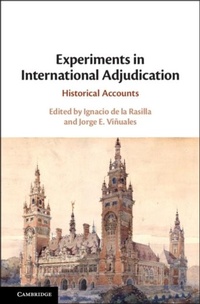
Experiments in International Adjudication
Historical Accounts
Published on 20. March 2019
342 pages
978-1-108-63877-7 (ISBN)
Description

The history of international adjudication is all too often presented as a triumphalist narrative of normative and institutional progress that casts aside its uncomfortable memories, its darker legacies and its historical failures. In this narrative, the bulk of 'trials' and 'errors' is left in the dark, confined to oblivion or left for erudition to recall as a curiosity. Written by an interdisciplinary group of lawyers, historians and social scientists, this volume relies on the rich and largely unexplored archive of institutional and legal experimentation since the late nineteenth century to shed new light on the history of international adjudication. It combines contextual accounts of failed, or aborted, as well as of 'successful' experiments to clarify our understanding of the past and present of international adjudication.
Reviews / Votes
'Experiments in International Adjudication is a treasure. Recovering successful and failed efforts at international adjudication in the nineteenth and twentieth century, spanning Africa, Europe, Latin America, and the Middle East, a stellar group of scholars considers why history does and does not remember or build on early efforts at international adjudication. Beyond explicating little known international adjudication experiments, we learn of the forces working for and against generalizing these experiments so as to lay the groundwork for constructing an international judiciary capable of resolving trans-border disputes and generating state responsibility and accountability to international law.' Karen J. Alter, Northwestern University and iCourts 'Experiments in International Adjudication is an overdue and necessary complement to the burgeoning research on international courts and tribunals. The authors, outstanding experts, have shed light on so far unknown institutions, facets of seemingly familiar ones, and show how many of the 'experiments' failed, while others led to unforeseen results. This book fills a gap and will stimulate further investigations on the histories and functions, problems and potentials of eminently important institutions in international law and relations.' Anne Peters, Director of the Max Planck Institute for Comparative Public Law and Public International Law and Ruprecht-Karls-Universitaet Heidelberg, Freie Universitaet Berlin and William C. Cook Global Law Professor at the University of Michigan 'This collection of fascinating essays on instances and experiments in international adjudication from the last two centuries significantly thickens the narrative of the historical emergence of present-day international courts and tribunals. By delving into the rich histories of failed or unfinished experiments with arbitral and judicial dispute settlement between states, the book shows that the recent proliferation and diversification of international adjudication has deep historical roots and that the disruptive effects these variations are often perceived to have on international law as a system, may actually be crucial to its endurance.' Randall Lesaffer, Tilburg University and Katholieke Universiteit Leuven 'Experiments in International Adjudication is a very welcome addition to the already large literature on international courts and tribunals. But different from most other books, this volume reveals the story of little-known experiments of international adjudication. Thereby, it enriches our understanding in a multitude of ways and makes us rethink what really works in terms of international adjudication. Written by a set of understanding scholars, this book is a little treasure trove that should be read by anyone with an interest in the history of international law.' Mikael Rask Madsen, Director of iCourts, Centre of Excellence for International Courts, University of Copenhagen 'This comprehensive volume follows a chronological approach and reveals the well-co-ordinated research carried out by this interdisciplinary group of eminent scholars. It critically recalls some underresearched 'strands of the historical record that can be seen as genuine 'trials' and 'errors' in the long process of experimentation relating to international adjudication', considering their intellectual, socio-political, and international legal context, connecting past and present experiments, and offering 'fresh perspectives on this usually 'neglected', but significant discipline' ... This book makes a decisive contribution to the research and understanding of the history of international adjudication.' Eduardo Jimenez Pineda, The British Yearbook of International Law 'Most readers will be enriched ... will have learned about a new institution, an unknown conflict or case, or about missed opportunities in dispute settlement. ... they taught me a lot (e.g. about Commonwealth and Maghreb tribunals) and often made me think.' Christian J. Tams, Journal of the History of International LawMore details
Language
English
Place of publication
Cambridge
United Kingdom
Target group
Professional and scholarly
Illustrations
Worked examples or Exercises
File size
3,60 MB
ISBN-13
978-1-108-63877-7 (9781108638777)
Copyright in bibliographic data and cover images is held by Nielsen Book Services Limited or by the publishers or by their respective licensors: all rights reserved.
Schweitzer Classification
Other editions
Additional editions
Ignacio de la Rasilla | Jorge E. Vinuales
Experiments in International Adjudication
Historical Accounts
Book
07/2021
Cambridge University Press
€49.50
Shipment within 15-20 days
Ignacio de la Rasilla | Jorge E. Vinuales
Experiments in International Adjudication
Historical Accounts
Book
03/2019
Cambridge University Press
€147.50
No shipping information available
Persons
Content
Part I. International Adjudication - An Ever-Present History: 1. Experiments in international adjudication - past and present Jorge E. Vinuales; 2. The turn to the history of international adjudication Ignacio de la Rasilla; Part II. Experiments in Dispute-Specific Adjudication: 3. Imperial consolidation through arbitration: territorial and boundary disputes In Africa (1870-1914) Inge Van Hulle; 4. How to prevent a war and alienate lawyers - the peculiar case of the 1905 North Sea Incident Commission Jan Lemnitzer; 5. The Arbitral tribunal for Upper Silesia: an early success in international adjudication Gerard Conway; Part III. Context-Specific Redress Mechanisms: 6. Mixed claim commissions and the once centrality of the protection of aliens Frederic Megret; 7. The general claims commission (Mexico and the United States) and the invention of international responsibility Jean d'Aspremont; 8. Mirage in the desert: regional judicialization in the Arab world Cesare P. R. Romano; Part IV. The Quest for a Permanent Court: 9. Saving face: the political work of the permanent court of arbitration (1902-1914) Andrei Mamolea; 10. First to rise and first to fall: the Court of Cartago (1907-1918) Freya Baetens; 11. The failure of the 1930 tribunal of the British Commonwealth of Nations: a conflict between international and constitutional law Donal Coffey; Part V. Experiments in specialised courts: 12. The intellectual foundations of the European Court of Human Rights Angelo Junior Golia and Ludovic Hennebel; 13. From international law to a constitutionalist dream? The history of European law and the European Court of Justice, 1950-1993 Morten Rasmussen.
