

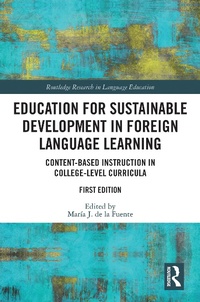
Education for Sustainable Development in Foreign Language Learning
Content-Based Instruction in College-Level Curricula
1st Edition
Published on 29. November 2021
264 pages
978-1-000-48017-7 (ISBN)
Description

This unique volume utilizes the UNESCO Education for Sustainable Development (ESD) framework to illustrate successful integration of sustainability education in post-secondary foreign language (FL) learning.
Showcasing a variety of approaches to using content-based instruction (CBI) in college-level courses, this text valuably demonstrates how topics relating to environmental, social, and cultural dimensions of sustainability can be integrated in FL curricula. Chapters draw on case studies from colleges throughout the US and consider theoretical and practical concerns relating to models of sustainability-based teaching and learning. Chapters present examples of project-, problem-, and task-based approaches, as well as field work, debate, and reflective pedagogies to enhance students' awareness and engagement with sustainable development issues as they acquire a foreign language. Insights and recommendations apply across languages and highlight the potential contribution of FL learning to promote sustainability literacy amongst learners.
This text will benefit researchers, academics, and educators in higher education with an interest in Modern Foreign Languages, sustainability education, training, and leadership more broadly.
Showcasing a variety of approaches to using content-based instruction (CBI) in college-level courses, this text valuably demonstrates how topics relating to environmental, social, and cultural dimensions of sustainability can be integrated in FL curricula. Chapters draw on case studies from colleges throughout the US and consider theoretical and practical concerns relating to models of sustainability-based teaching and learning. Chapters present examples of project-, problem-, and task-based approaches, as well as field work, debate, and reflective pedagogies to enhance students' awareness and engagement with sustainable development issues as they acquire a foreign language. Insights and recommendations apply across languages and highlight the potential contribution of FL learning to promote sustainability literacy amongst learners.
This text will benefit researchers, academics, and educators in higher education with an interest in Modern Foreign Languages, sustainability education, training, and leadership more broadly.
More details
Series
Edition
1. Auflage
Language
English
Place of publication
London
United Kingdom
Publishing group
Taylor & Francis Ltd
Target group
College/higher education
Illustrations
27 Tables, black and white; 9 Line drawings, black and white; 4 Halftones, black and white; 13 Illustrations, black and white
File size
7,28 MB
ISBN-13
978-1-000-48017-7 (9781000480177)
Copyright in bibliographic data and cover images is held by Nielsen Book Services Limited or by the publishers or by their respective licensors: all rights reserved.
Schweitzer Classification
Other editions
Additional editions
Maria de la Fuente
Education for Sustainable Development in Foreign Language Learning
Content-Based Instruction in College-Level Curricula
Book
05/2023
1st Edition
Routledge
€63.40
Shipment within 10-20 days
Maria de la Fuente
Education for Sustainable Development in Foreign Language Learning
Content-Based Instruction in College-Level Curricula
Book
11/2021
1st Edition
Routledge
€205.80
Shipment within 15-20 days
Person
Maria J. de la Fuente is Professor of Spanish in the Department of Romance, German, and Slavic Languages and Literatures at The George Washington University, USA.
Content
Introduction: What is Education for Sustainable Development (EDS) and Why Should it be Integrated in College Foreign Language Curricula? Part 1: Approaches to Integrating Education for Sustainable Development into Foreign Language Curricula 1. Sustainability and the Pluriverse: from Environmental Humanities Theory to Content-Based Instruction in Spanish Curricula 2. Multiliteracies Pedagogy: Theory to Practice for Scaffolding Sustainability Literacies 3. Project-Based Language Learning: Addressing Cultural and Linguistic Diversity Issues in Climate Action 4. Problem-Based Pedagogy for the Advanced College Language Curriculum: Becoming a Multicompetent Language User through Sustainability Education Part 2: Implementing Sustainability-Based Curricular Initiatives in Foreign Language Education 5. Engaging Students with Social, Cultural, and Environmental Sustainability Topics in the Spanish-Speaking World: A Reimagined Beginning Spanish Curriculum 6. Beyond the Language Requirement: Implementing Sustainability-Based Fl Education in the Spanish Foundations Program 7. Toward the Greening of the Intermediate French Language Curriculum 8. Toward Sustainability in German Curricula Part 3: Exploring Interdisciplinary Collaborations toward Sustainability Education in FL Programs 9. Cross-Disciplinarity at the Core: Teaching Sustainability in a Business German Course 10. Content-Based Instruction in a Spanish Language Classroom: Climate, Identity, and Historical Patterns of Latin American Migration to the United States 11. Sustainability across the Curriculum: A Multilingual and Intercultural Approach 12. Translanguaging in Language and Area-Studies Curriculum: A Japanese FLAC Course of Minamata and Fukushima in Environmental Humanities Conclusion
